May 4th

On April 30, 1970, President Richard Nixon announced to a national television audience that he was ordering troops into Cambodia. Although the stated purpose of this so-called “incursion” was to hasten an end to the ongoing slaughter in Vietnam, many Americans, myself included, thought this a wholly-unwarranted expansion of the war effort.

I was in the last semester of my undergraduate college days at this time: politically-active and fervently anti-war. I had received a draft notice in June of 1969 and spent 22 days in the Air Force until a chronic knee condition led to a medical discharge. Although I was (because of my discharge) no longer at risk of losing my life to this insane activity, I had spent four long college years with the specter of the military draft – and the prospect of a gruesome, lonely death in a jungle a million miles away from home. For me, the war was personal.

Richard Nixon had been elected, at least in part, on the basis of his “secret plan” to end the war. Yet, here he was, less than two years later, ordering an obvious escalation.

I was pissed. I remember spending the remainder of the evening after Nixon’s speech composing a letter to the editor of my local newspaper. My writing skills were not too finely developed then and my letter was not the most eloquent piece of prose. But what I lacked in style, I hope I made up for in passion: Nixon was wrong. He was a madman. He had to go. The war must end.

Many, many people agreed with me. Unrest on the nation’s campuses, especially, took a dramatic turn. On May 4, 1970, my letter was published in the Eau Claire (WI) Leader-Telegram, the same day that four full-time college students (Allison Krause, Jeffrey Miller, Sandra Scheuer and William Schroeder) at Kent State University were gunned down by Ohio National Guard troops on their own campus. Another nine students (Joseph Lewis, John Cleary, Thomas Grace, Robbie Stamps, Donald Scott MacKenzie, Alan Canfora, Douglas Wrentmore, James Russell and Dean Kahler) were wounded; one was paralyzed for life, the others seriously maimed.

The students of the University of Wisconsin - Eau Claire, in the days immediately following the Kent State massacre, rallied. I, for one, picketed the Science building where I had spent the majority of my time as a chemistry student. On May 6th we held a campus-wide protest, gathering on the lawn right outside the student union building. And we planted four trees in memory of the dead in Ohio. The plaque from that memorial service is still there today, as are three of the four original trees.

May 4, 1970, was thirty-six years ago. On this day, today, let us not forget the madness that can afflict us as a nation.

Let us also not forget that we always have a voice. Let’s remember that protest can lead to change. We must know that when we perceive injustice in the world, we can stand, march, shout and be heard. We can make a difference.

Thought for the day: We have the ability to put an end to the killing. All it takes is the will.

Soundtrack Suggestion

Tin soldiers and Nixon coming,
We’re finally on our own.

This summer I hear the drumming,
Four dead in Ohio.

Gotta get down to it
Soldiers are gunning us down
Should have been done long ago.

What if you knew her
And found her dead on the ground
How can you run when you know?

Gotta get down to it
Soldiers are gunning us down
Should have been done long ago.

What if you knew her
And found her dead on the ground
How can you run when you know?

Tin soldiers and Nixon coming,
We’re finally on our own.

This summer I hear the drumming,
Four dead in Ohio.

(“Ohio” – Neil Young)

Read More
Blogger Post, Culture, Politics TechnoMonk Blogger Post, Culture, Politics TechnoMonk

Peace Now

To mark the occasion of the third anniversary of the U.S. invasion of Iraq, two days ago I was part of a contingent of approximately ten thousand who gathered in downtown Portland on a bright, sunny, spring-like Sunday afternoon to rally for peace. It was the largest demonstration I had ever been part of.

I admit that I use the term “rally for peace” quite purposefully. To label this a “war protest” would be a mischaracterization, I believe.

Let me elaborate...

I lived through the Sixties. (And, yes, I actually remember them.) As a young man who turned the draft-eligible age of 18 in 1965, I knew that, quite literally, my life was on the line with practically every personal decision. After high school, I made the choice to go to college – admittedly as much to earn a student deferment as an education.

College campuses then were much different than they are today, and often known for their level of anti-war activity. Students – we – knew what war was, were able to view its horrors on television every evening, and (the males at least) were acutely aware of the fate that awaited us should we cease to be students. Campuses were home for “the movement.”

And, by the time this massive social movement generated most of its heat, in the late Sixties and early Seventies, organized protests were serious, intensely-emotional experiences. Thousands and thousands of young American men had lost their lives, and there seemed to be no end to the slaughter. We, the country, increasingly (yes, I know, it took several years, and it was never a consensus view) deemed Vietnam an unjust war, entered in to illegally, and perpetuated by leaders who lied to the country about its origin and purpose. And, no exit strategy was in sight.

(My, how times have changed, eh?)

Candidate Richard Nixon’s “secret plan to end the war” was seductive, and served to dupe the electorate enough to get him elected President in 1968. But, of course, there was no such plan, and by November 1969, protests reached massive proportions; a march on Washington, D.C., (the largest ever, I believe) that month attracted over 250,000 emotional, highly-motivated participants. Then, on May 4, 1970, four students were killed at Kent State University as they raised their voices in opposition to Nixon’s decision to invade Vietnam’s neighbor, Cambodia.

The demonstrations I participated in, in Eau Claire, Wisconsin, and Corvallis, Oregon, were less dramatic than those, but still, certainly, intense. For example, I remember standing, for the most of one entire night, outside the county courthouse in Eau Claire listening to the reading of the names of war dead. And, even in sleepy, conservative Corvallis, I witnessed acts of civil disobedience during this period.

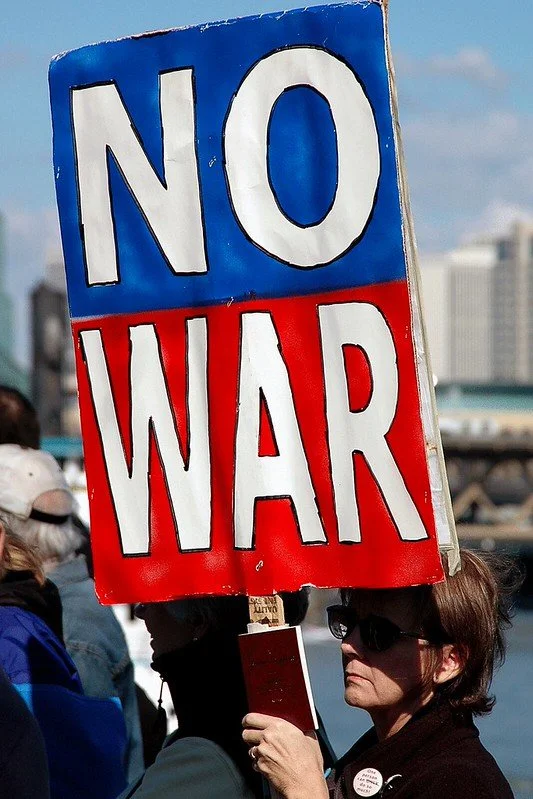
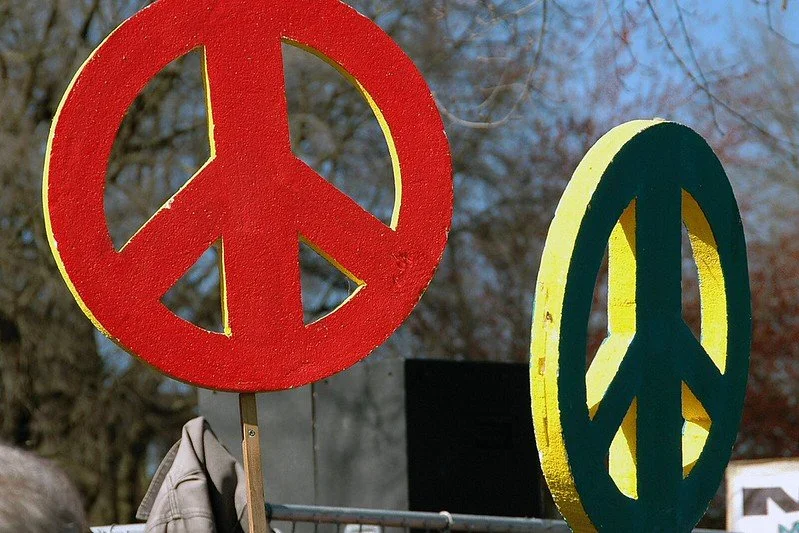
My point is: the anti-war movement, back then, involved actual protest. My sense of what goes on now, and, regrettably how I experienced the event on Sunday, was that we (and I’ll include myself) engaged in a social gathering as much as a “protest.” Yes, it was a rally. Yes, there were speeches and inflammatory rhetoric. Yes, there were placards with serious messages, some of them quite outrageous and irreverent. Yes, there were marching and chanting. (“What do we want? PEACE! When do we want it? NOW!”) Yes, there was plenty of that typical protest-like activity.

But, did the event seem oriented toward effecting change? To me: no. It simply didn’t have that feel. Rather, it reminded me of a retro theme party. There were many, many of us (yes, again, I’m guilty) with still- and video-cameras, engaged in a party-picture kind of enterprise, posing for photos, while with friends and/or holding signs. There were families and others congregated into small groups. There were dogs and Frisbees. There were information tables and pamphlets. There were commercially-made flags and other artifacts, likely ordered from internet sources. And everyone had a cell phone. Geeesssh.

OK: bottom line, here’s what I miss. The outrage. I want us, the American people, collectively, to be incredibly angry about the meaningless large-scale loss of life in a part of the world where we really have no legitimate business. I want us to be incensed about the erosion of our civil liberties. I want to hear of our insistence on being told the truth. I want a gathering of this magnitude to mean something: to be acknowledged as part of a nationwide effort to change the direction of the morally-bankrupt regime in, and agenda that we now have coming from, Washington, D. C.

I want peace. And, I want it now.

Read More
Blogger Post, Education, Oregon, Politics TechnoMonk Blogger Post, Education, Oregon, Politics TechnoMonk

Oregon’s Schools

An editorial in The Oregonian today discussed the recent death of the “CIM” (Certificate of Initial Mastery) for public K-12 schools in Oregon. The “CAM” (Certificate of Advanced Mastery), of course, never, really, had a life. Both of these initiatives were products of school-reform legislation passed by the Oregon Legislative Assembly in 1991 (as the “Oregon Educational Act for the 21st Century”) but, from the beginning, faced impressive amounts of resistance from a number of constituencies: politicians, educators, parents, and students alike.

So, here we are, fourteen years later, admitting the failure of these proficiency-based approaches to student learning…at least as they have been implemented here in Oregon. Susan Castillo, our current State Superintendent of Public Instruction, indicated yesterday that the CIM and CAM embraced “...high standards, strong accountability for student performance and creat[ed] a relevant learning experience…” (The Oregonian, December 10, 2005, p. B4), and vowed not to abandon those goals. What she plans to propose to the Oregon State Board of Education and to the legislature, in the place of CIM and CAM (if anything), remains a mystery.

Really, folks, even after years and years of effort, the CIM and CAM never had a chance in this state, despite the superhuman efforts of so many who wanted to see them succeed. The Proficiency-based Admissions Standards System (PASS) of the Oregon University System (public higher-education’s response to lower-ed’s reforms) was, in my opinion, always similarly doomed. Why? Well, timing might be one response, but lack of leadership, funding, and commitment are really the answers.

In 1991, when the initial school reform legislation was enacted (it has been amended in every legislative session since then), Oregon voters had just passed Measure 5, the property-tax limitation initiative, in the 1990 election. When I moved away from Oregon in the summer of 1990, I knew of no one who gave Measure 5 a chance of passing. But, come that November, it did. And, in terms of the political and economic landscapes of the state, Oregon has never really been the same. Certainly Oregon education, at all levels, has quite dramatically changed since then.

We are idea rich and dollar poor. Well, truthfully, we're probably idea poor as well. The “no new taxes” mantra of the first G. Bush, has been translated, by Oregon voters, into “no taxes.” Period. It seems the citizens of this state expect government, and the education systems it supports (K-12, community colleges, public universities), to do their jobs with less and less. But, to the point here, Oregon passed school-reform legislation at the very time that we were beginning to seek ways to implement Measure 5, and there just has never been enough money to do the job. School reform really wasn’t (and isn’t) that bad of an idea. It’s just that it takes resources, and, of course, leadership. The likes of Norma Paulus, Stan Bunn, and Susan Castillo, our elected State Superintendents since 1991, simply put, have been prime examples of poor educational leadership.

Oregon: we deserve better. We need resources. We need leadership. We need an enlightened public.

Read More