

The Campaign to Make America Hate Again
We have serious problems to solve, and we need serious people to solve them. And whatever your particular problem is, I promise you [Donald Trump] is not the least bit interested in solving it. He is interested in two things, and two things only: making you afraid of it, and telling you who's to blame for it. That, ladies and gentlemen, is how you win elections. You gather a group of middle-age, middle-class, middle-income voters who remember with longing an easier time, and you talk to them about family, and American values and character, and … you scream about patriotism. (“The American President” – 1995)

As the sage, cultural observer John Oliver recently noted, the person we have just elected as president is a “Klan-backed, misogynistic, internet troll.”
It would seem, fellow citizens, that we “have a lot of ’splainin to do.”
Alas, I am one of those highly-educated, elitist, left-coast, blue-state, living-in-a-bubble progressives, who thought it totally impossible the country could elect such a toxic and unqualified candidate. Plus, this is true: I did buy into the polls that predicted a substantial win for HRC.
However, by donning my value-laden blinders this way, I was ignoring what I knew, deep down, about human nature. And, especially, what I believed about the male of the species in this country.
It now seems evident that Donald Trump’s racist, female-objectifying, gutter talk spoke to millions. In fact, I believe all those “disqualifying” verbal moments by the candidate, the ones we progressives expressed such utter disdain for, were actually the very essence of The Donald’s broad appeal.

And, oh, there were so many examples of his outrageous behavior: the labeling of Mexicans as rapists; implying that all Muslims are terrorists; referring to African Americans as “The Blacks.” He dismissed John McCain’s war heroism and went to absurd lengths to attack Khizr and Ghazala Khan, parents of a Muslim-American soldier who died heroically in Iraq. During the first Republican debate, he joked about his derogatory comments made toward Rosie O’Donnell, including calling her a “pig.” Further, during a Clinton-Trump debate, we learned of his sexist behavior and remarks toward Alicia Machado (“Miss Piggy,” “Miss Housekeeping”), a former Miss Universe. And then, the most explicit, demeaning and aggressive sexual language of all (“grab them by the pussy”), was revealed with the release of that “Access Hollywood” encounter with Billy Bush.
There was one outrageous episode after another, for well over a year, and still, Donald Trump was alive and well as a candidate. How could this possibly be?, we all asked.
Well, I’m here to suggest that the American public just couldn’t get enough of this in-your-face, potty-mouth, fuck-you-all attitude. In fact, (a huge portion of) the country fell totally in love with his message. There is a lot of racial rage, and anger with the system, out there, as well as a tenacious attachment to “traditional” male/female roles (that look and feel much like the 1950s). Unfortunately, such beliefs, attitudes, language and behavior haven’t changed much over time, no matter what we progressives would like to believe about the current level of American cultural enlightenment.
I say all this speaking from personal experience as a white American male who has been alive during the last half of the 20th century – and so far into the 21st. (I am basically Donald Trump’s age.) Although I have spent most of my life in the relatively safe arena of academia, I do have first-hand knowledge of the pervasive racism and sexism out there in the “real world.” For example, when I was in college, during two summers I worked “on the line” at two different factory jobs in the upper Midwest. Virtually all my co-workers were middle-aged white males. During these months, I witnessed, every day, the manner in which “the other” was viewed. I heard the “N” word – and learned about how “the woman’s place is in the home” viewpoint prevailed. Many years have passed since my time on an assembly line, but I can assure you these attitudes and behaviors are all very pervasive, contemporary and real.

Then, in addition, I have years’ worth of other experience witnessing the lives and values of more privileged white males. For five years, I was a professional event photographer, during which time I went to fraternity and sorority parties for a living. I worked very closely with these types of campus social groups and became intimately involved with members and their out-of-classroom activities. The whole scene fascinated me so much that, years later, as a Ph.D. candidate in Higher Education Administration, I wrote a doctoral dissertation describing the socialization process of a college fraternity. I spent three years doing fieldwork and, in my report, explicitly described the recruitment and indoctrination of new members. During this time, for example, I attended social events held for high-school seniors where fraternity members presented a number of skits, meant to both entertain and inform newcomers about fraternity life.
Here is how I described one of those occasions, lifted directly from my dissertation (Indiana University, 1995, pp. 58-59).
The skits were apparently a takeoff on “Saturday Night Live,” and initially reminded me of the kinds of things we used to do at Boy Scout camp on occasion: just good-clean-all-male fun. That first impression did not persist for very long, however.
On this particular night, there were about eight or ten skits altogether. During one of them, two members, portraying “cool” fraternity guys, talked between themselves about what being in a fraternity is like. For example, one asked the other what happened after the party the other night, with the reply, “Hey, I got laid, sucked and fucked. It’s a given!”
During the skit, women were consistently referred to as “bitches,” and were usually yelled at with an order to do something – to perform some act. It was explained that “two vocabulary words fraternity men must know the meaning of” are “leave” and “cram” – and each was explained and used in an appropriate context. “Leave” was illustrated in a number of shouted sentences such as “BITCH, LEAVE YOUR CLOTHES OVER THERE!” and “BITCH, YOU BETTER LEAVE, I CAN HEAR YOUR BOYFRIEND HONKING OUTSIDE.” “Cram” was used in the context of “CRAM MY DICK INTO HER PUSSY.” Much laughter accompanied almost every line of the skit. It appeared that everyone in the room thought all of this to be quite funny. I tried to pay particular attention to the few women in the room, since the material seemed to be so patently offensive. They, however, were laughing along with all the guys as best as I could tell. (Note: a few sorority women had been invited and were present to serve food and to do some cleaning up.)

During the time of the 2016 campaign when people around the world were reacting to Trump’s use of the word “pussy,” the claim was that “no one talks like this.” We heard from many, “I don’t talk like this, and I don’t know anyone who does. This doesn’t happen in my locker room.” And the women said, indignantly, “I can assure you that my husband (brother, son, boyfriend) doesn’t use language like this.”
I am here to confidently contradict such claims. I’m sorry to report: yes, men do talk like this. If others, like me, have long outgrown it, then they certainly have heard other males use this language and likely have, at one time or another in their life, engaged in similar behavior themselves. Of course, this is largely behind-closed-doors talk in today’s world. But, on the other hand, listen to any woman who has walked by a big-city construction site, and ask her about the male language and behavior she’s encountered. Not so enlightened after all, are we?
Donald Trump, wearing his red baseball cap with the silly slogan, and his man-of-the-people language, was saying to many American men and women out there, “I am one of you. I know who you are.” And, by example, “It’s OK to hate. It’s OK to disparage women. It’s OK to be racist. It’s OK to beat up people.” And, finally, “There are no rules of decorum any more. Political correctness is dead.”
“Vote for me,” he pleaded.
And vote we did; enough of us in the right states to give him the win.
So here’s where I end up: “Oh, shit. What the fuck do we do now?”
Soundtrack Suggestion
Yeah, my blood’s so mad, feels like coagulatin’
I’m sittin’ here, just contemplatin’
I can’t twist the truth, it knows no regulation
Handful of Senators don’t pass legislation
And marches alone can’t bring integration
When human respect is disintegratin’
This whole crazy world is just too frustratin’
And you tell me over and over and over again my friend
Ah, you don’t believe we’re on the eve of destruction.
(“Eve of Destruction” – Barry McGuire)
WTF, America
I had been having a pretty good day yesterday. I was happy the electioneering was over and feeling confident that HRC was in the bullpen, ready to come into the game as POTUS 45.
I went for a long walk in the morning, then meditated later. And when I took my blood pressure, I got a healthy result.
I bought a Papa Murphy’s pizza late in the afternoon and brought it home to settle in for some time with the folks on MSNBC. The hosts of the NPR Politics podcast, which I had listened to on my walk, thought the race could be called as early as 11:30 (Eastern), which is 8:30 here in the West.
All seemed right with the world.

And then. Of course. The universe shifted.
Y’all know what happened. The polls were wrong. Many of you likely watched the drama play out on your favorite network or cable channel.
It seems that our misguided electorate thought that handing the reigns of our democracy over to a misogynistic, racist, xenophobic, sexually-predatory, narcissistic, anti-intellectual sociopath was the way to go.
What the fuck, America.
Kent State Plus 45
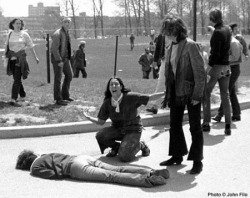
One of the Kent State casualties. Mary Ann Vecchio kneels by the body of Jeffrey Miller in this iconic, Pulitzer-Prize winning photograph by John Filo.
Tomorrow is Monday, May 4th, the 45th anniversary of the massacre at Kent State University. The tragedy was a seminal event in American history - a stunning blow to the American psyche as well as to the anti-war movement. Whatever side you were on regarding the question of the Vietnam War (and most people were aligned with one side or the other), if you were alive on Monday, May 4, 1970, you were aware of the events on the Kent State campus that day.
Here is my version of that time and why I write about it now.
On April 30, 1970, President Richard Nixon announced to a national television audience that he was ordering American troops into Cambodia. Although the stated purpose of this so-called “incursion” was to hasten an end to the ongoing slaughter in Vietnam, many Americans, myself included, were thoroughly appalled and believed the act to be an insane expansion of the war effort. Just ten days earlier, in another television address, Nixon had led us all to believe that our involvement in Southeast Asia was winding down in a meaningful way.
May 1970 was the last month of my final semester as an undergraduate student. I was a chemisty major, but I was socially-aware, politically-active and fervently anti-war. My college career had been interrupted when I received a draft notice on June 18,1969. I subsequently spent 22 days in the Air Force during late September and early October of that year – until a chronic knee condition quickly led to a medical discharge. Although by May of 1970 I was no longer at risk of losing my life in this war, I had spent four long years under the specter of the military draft – and the prospect of a gruesome, lonely death in a jungle a million miles away. For myself, and every American male my age, the war was personal. And, like many of my peers, I believed the U.S. intervention in Vietnam to be both illegal and immoral.
President “Tricky Dick” Nixon had been elected, at least in part, on the basis of his “secret plan” to endthe war. Yet, here he was, a little over a year into his presidency, ordering an escalation.

The original Kent State Memorial at UW-EC, dedicated on May 8, 1970. This plaque was removed from its original location in 2010 and presumably now resides in the campus archives. (Photo taken in July 2005. Click for enlarged version.)

From my personal file cabinet. Front page of UW-EC student newspaper “The Spectator” - published May 7, 1970. University President Leonard Haas addresses the Kent State demonstration in the middle of campus. The little red arrow on the left-hand side of the page points to me in the crowd. (Click for enlarged version.)
I was pissed. I remember spending the rest of the evening, after watching Nixon’s speech, composing a letter to the editor of my local newspaper. My misssive was not the most eloquent piece of prose ever written, but what I lacked in style, I hope I made up for in passion. This is the last straw. Nixon is wrong. He has to go. The war must end.
Many Americans agreed with me. Unrest on the nation’s campuses, especially, took a dramatic turn. On May 4, 1970, my letter was published in the Eau Claire (WI) Leader-Telegram, the same day that four full-time college students (Allison Krause, Jeffrey Miller, Sandra Scheuer and William Schroeder) at Kent State University were gunned down by Ohio National Guard troops. Another nine students (Joseph Lewis, John Cleary, Thomas Grace, Robbie Stamps, Donald Scott MacKenzie, Alan Canfora, Douglas Wrentmore, James Russell and Dean Kahler) were wounded; one was paralyzed for life, the others seriously maimed.
In the days immediately following Kent State, students at the normally-placid University of Wisconsin - Eau Claire (UW-EC) rallied. This was my campus. I, for one, picketed the Science building and boycotted classes where I had spent the majority of my time studying chemistry and math. On May 6th, a campus-wide demonstration was held, with a group of over 3,000 gathering on the lawn right outside the student union building. (See the accompanying photo, to the left, as published in the student newspaper the next day.) Two days later, four crab-apple trees were planted, along with a commemorative plaque (see photo above), in memory of the dead in Ohio. (See also accompanying photo, below, of article published in the May 14th edition of the student paper.)
In 2010, the Kent State Memorial was removed from the UW-EC campus as part of modernization efforts and the construction of a new student center building. Upon learning of the disappearance of this memorial, I was distressed. For four decades, I had rarely made a visit to the state of Wisconsin that didn’t include some time in meditation sitting among the trees and plaque belonging to the Kent State Four. The institution, without this particular artifact belonging to those turbulent times, somehow seemed incomplete.
TODAY, happily, after enduring five years of uncertainty about the status of the Kent State Memorial, I am here to report a significant new development. I recently received notice (see below) from UW-EC that on May 4th, tomorrow, a new memorial will be dedicated. The old memorial consisted of four crab-apple trees and a plaque. The word is that tomorrow’s event will unveil a memorial also consisting of four crab-apple trees and a plaque (though not the original one pictured above). I am sad that I cannot be there to participate in the event, but very pleased that there will be a new Kent State Memorial to get acquainted with during my next trip to campus.

From my personal file cabinet. UW-EC student newspaper “The Spectator” - published May 14, 1970. Continuing coverage of the Kent State demonstrations and the days that followed, including the dedication of a memorial: four crab-apple trees and a plaque planted in the ground by the student center building to forever remember the slain students. That’s me, at age 22, in the top left-center of the photo - taken during the May 6th demonstration. (Click for enlarged version.)
A few closing thoughts. The marches, demonstrations and class boycotts in the aftermath of Kent State added up to the most unrest the UW-EC campus had ever seen (or has seen since). And, in sum, when viewed in their historical context, the invasion of Cambodia, the ensuing protests, the massacre at Kent State, and the National Student Strike, were a turning point for the Nixon presidency. To recognize the significance of these events 45 years later, PBS recently (April 28, 2015) debuted a one-hour documentary entitled “The Day the ‘60s Died.” In this film about May 1970, the claim is made that the Kent State killings had a chilling effect on the nation’s anti-war activity. Indeed, it is diffcult to dispute the fact that The Movement was never quite the same. The National Guard was never held accountable. Demonstrations in support of the war became more frequent. The country was more polarized than ever, essentially divided into warring tribes. And it wasn’t until January 27, 1973, that the Paris Peace Accords ending the conflict were finally signed.
Soundtrack Suggestion
Tin soldiers and Nixon coming,
We’re finally on our own.
This summer I hear the drumming,
Four dead in Ohio.
(“Ohio” – Neil Young)

Batshit Crazy
Before being nudged, not-so-gently, into retirement, Dr. Teller had spent the last ten years of his academic career as a community-college dean. The final position lasted for seven, interminably-long and difficult years at a junior college in California’s Bay Area.
Teller had come to believe that the life of an academic dean was: Just. Plain. Fucking. Nuts. The most frequent question that coursed through his brain was “why am I here?” Surely this wasn’t an existence that any truly healthy person would take on – other than from a sense of desperation.
The fact was, though: Teller had been desperate. The offer that ultimately came his way emerged after three-plus years of interim positions and a lifestyle of never-ending job-search. When he lost his state-level higher-education post in Oregon, he had been forced to seek out something else to do with his life. When the opportunity arose to be a college dean, he thought, “why not?” And after two temporary gigs in his home state, the California job seemed to provide him some sense of direction, resolution and permanency.

But while he was quite experienced with, and even amazingly skillful at, managing the highly-political nature of academia, the navigation of community-college campus-level politics turned out to be somewhat akin to living in the “Twilight Zone.” It was as if Rod Serling had come back to provide the script and narration for Teller’s time on this planet.
Of the 112 community colleges in the California community-college system, Teller ended up working at one of the smaller ones. And as it turned out, it had a quite-specific statewide reputation. Not that he knew anything about that when he moved there, of course.
But the reputation was discoverable and, in the end, indisputable: the place was batshit crazy.
To wit:
The collective-bargaining agreement between the faculty and the institution was an absurdly-long and complicated document. It was poorly-written, internally-contradictory, maddeningly-prescriptive, and reflected decades worth of administrative concessions. It served as the college’s Bible. It was, indisputably, batshit crazy.
The Board of Trustees was a self-absorbed, totally-dysfunctional body, prone to micromanagement, lack of boundaries, role confusion, internal strife, senseless speech-making, and meetings that lasted until midnight. Individually, and collectively, they were the very essence of batshit crazy.
The collection of department chairs, a gang that convened monthly, consistently and vigorously attacked anyone unlucky enough to have the title of vice president. They truly believed that the world revolved around them. The group was distinguished by its inability to move any agenda along and famous for its failure to acknowledge (what the rest of the world might call) “reality.” Individually, and collectively, an easy call: batshit crazy.
Overt and covert conflicts between faculty members and administrators were frequent, mean-spirited, and embarrassing for any innocent bystander to witness. The dynamic was full-on batshit crazy.
The door to the vice president’s office was a revolving one, hosting seven different occupants during Teller’s time there. Some were laughably inept. At least two were verbally and/or emotionally abusive. One was middle-twentieth-century sexist. One was certifiably batshit crazy.
Stories of bad behavior by faculty members were legendary, provided a mystical aura to the institution, and wove the fabric of the college’s culture. The campus employed several who had been there for decades and had long ago given up pretending to care about students. Teller believed that a certain percentage of them had substance-abuse or mental-health issues, and assessed this faction to be, unquestionably, batshit crazy.
Still, despite all the evidence in support of its reputation, Teller had not planned on leaving the college when he did. His departure, ultimately, came as a big surprise to him. The interim vice president, who had once been among Teller’s most-trusted allies on campus, had apparently drunk the Kool-Aid too many times. Acting as an agent of the president, she was the one who informed Teller that his time on campus was over.
He was devastated by the betrayal.
When all was said and done, Teller probably should have seen it coming. But he didn’t.
The evidence is there to support the notion that Dr. Teller, himself, had gone native.
In other words: batshit crazy.
Soundtrack Suggestion
Now and then I think of all the times you screwed me over
But had me believing it was always something that I’d done
And I don’t wanna live that way
Reading into every word you say
You said that you could let it go
And I wouldn’t catch you hung up on somebody that you used to know…
[“Somebody That I Used To Know” – Gotye]
Occupy Wall Street West
The Occupy Movement emerged from its state of winter hibernation in San Francisco yesterday on the second anniversary of the U.S. Supreme Court’s decision in Citizens United v. Federal Elections Commission.

(As I’m sure you know, Citizens United is the landmark case that removed limits on how much money corporations and labor unions could donate to political causes. As a result of this lunatic 5-4 decision by our high court, a new type of political action committee, the so-called “Super PAC,” is now legal. Taken together, these unregulated, large-money organizations have, so far this year, dominated the political landscapes of Iowa, New Hampshire, and South Carolina during the Republican caucuses and primaries.)
The protests here in San Fran were part of day-long, Occupy Wall Street-related demonstrations all over the country demanding that banks put an end to evictions and foreclosures.
I very much wanted to take part in this Occupy protest and to be there to document it photographically. However, I wasn’t able to get downtown as it was a busy workday for me. Of course, fair-weather protester that I am, I’m not sure I would have shown up anyway; it was a very blustery winter day here in the Bay Area.
The event was mostly a success for Occupy: the San Francisco Chronicle reported that there were several hundred demonstrators in the Financial District who took to the streets, made a lot of noise, and shut down the headquarters of Wells Fargo Bank. The thousands of protesters that had been anticipated did not materialize, though.
I will have to get downtown soon for an Occupy-related event. I want to see how it’s evolved since I began my hiatus from protesting (because of my surgery and subsequent recovery). I ferried into the city nine straight weekends during the fall (from October 7 to December 3, 2011) to photograph the people, signs, structures, marches and other happenings of #OccupySF.
(I see the Huffington Post reports that the former (former?) Occupy San Francisco (#OccupySF) movement has reorganized and now calls itself Occupy Wall Street West. I didn’t know that until today.)
