I think you’ll agree that Boomers’ bodies are showing definite signs of wear and tear … and that these fragile shells of ours need more and more attention as time marches on. Of course, those of us attending to such maintenance chores are the fortunate ones: we’re still here.
To help monitor and support my body, I see a primary-care physician; a urologist; a neurologist; a rheumatologist; an opthamologist; a physical therapist; a massage therapist; a bodywork therapist; a naturopath; and a practitioner of Traditional Chinese Medicine (TCM). I’ve moved three times in the last four years, and every time I’ve done so, I’ve needed to make it a first order of business to assemble a new team.
I am watchful of my cholesterol and blood pressure, and obsess about my PSA. I dread the twice-yearly DRE. I’ve had a colonoscopy and a cystoscopy. At one point, I needed to wait, for eight long days, on the results of a prostate biopsy. During one long emergency-room visit some time ago, I was (mis-) diagnosed with bladder cancer.
But, knock on wood: I have never needed the services of an oncologist. Or a surgeon. And my new physical therapist recently observed that I am “basically healthy.”
Still, when you get to be a sexagenarian, the probability of needing a highly-skilled medical specialist increases virtually every minute. And all of us have family, friends and loved ones who have been very ill or are no longer with us.
To help ensure that I delay the need for extreme intervention as long as possible, I spend (what I believe to be) inordinate amounts of time and energy every day focusing on this old bod. I walk, I stretch, I ice my back and shoulders. I soak in hot Epsom-salt baths. I engage in a rigorous regimen of vitamins, minerals, supplements and TCM herbs. I drink green tea and lots of water. I eat small portions of mostly-healthy foods. I don’t drink or smoke. I avoid sugar, preservatives, red meat and caffeine. I have regular bodywork and physical-therapy appointments. I read, and collect, books on a variety of health issues. I subscribe to an internet newsletter that provides me with regular updates on natural health and healing. And I check in with an online fibromyalgia support group on occasion.
I’ve been thinking that, pretty much, getting old is a full-time job. No wonder there’s such a thing as retirement! Who has time to work when there’s so much other stuff in life to pay attention to?
As I enjoy a leisurely holiday weekend away from my current place of employment, I’m thankful for my basic good health. And that I’m a Boomer. For if there’s anything good about being a member of this generation, it’s that you’re never, really, alone.
The last entry was about my rather ambitious level of physical activity during the weekend. Activity that came with a price. Silly me! As it turns out, there can be too much of a good thing. Since then, I’ve been dealing with the fallout from those outings. Oh, woe is me; my aches and pains have flared up.
Which has me asking, as always: what’s the deal with my body?
The medical establishment clearly does not have it together when it comes to understanding, diagnosing and treating this mysterious affliction called fibromyalgia. Theories about this disease (or is it a syndrome — who knows?) abound.
Right after the first medical opinion came in suggesting that fibromyalgia was the label for my condition, one of the first reference works I found was Fibromyalgia and Chronic Myofascial Pain (Starylanyl & Copeland, 2001). This book became the starting point in my search for answers to what ails this aging shell. The authors state that they “believe that there is often an initiating event that activates biochemical changes, causing a cascade of symptoms” (p. 11). There are many statements throughout the text that fibromyalgia “may be due to this” or “may be due to that.” And there is an incomprehensible preoccupation with the distinction between tender points and trigger points and their role in fibromyalgia and myofascial pain. The book is subtitled “A Survival Manual,” and that’s exactly what it is: a blueprint for living with chronic pain.
In an ambitious 2006 book (What Your Doctor May Not Tell You About Fibromyalgia), authors R. Paul St. Amand, M.D., and Claudia Craig Marek postulate their theory of “inadequate energy as the cause of fibromyalgia” (p. 32). They suggest that the bodies of sufferers do not produce enough ATP (adenosine triphosphate), which they label as the “currency of energy” (p. 31) in our cells. They claim to have “stumbled upon the treatment for fibromyalgia quite by accident” (p. 40). And that treatment, they say, is a substance called guaifenesin (an expectorant drug, often present in cough and cold remedies, and also available in pill form as a supplement).
In an equally-impressive analysis and argument, Dr. David Dryland (of Ashland, Oregon), just this year (2007), published The Fibromyalgia Solution. His hypothesis is that fibromyalgia victims suffer from fight-or-flight fatigue (an ubiquitous condition of modern living), which leads to sleep deprivation and a diminished supply of the neurotransmitter dopamine. In terms of possible treatment implications, Dryland suggests that two dopamine drugs (originally prescribed for Parkinson’s disease and/or restless-leg syndrome) are likely candidates to provide relief for many. These drugs go by the names of Mirapex and Requip.
What is going on here? Well, what I’ve just provided is a brief list of examples demonstrating that fibromyalgia remains a total mystery not only to me but to the entire medical world. And those of us who suffer with this illness, or think we do, are left to go from doctor to doctor, or one alternative practitioner to another, in order to find some relief from our ever-present pain.
This last week, in the space of three days, I revisited my Traditional Chinese Medicine practitioner and my body-work therapist. They are both very skillful and helpful in my quest for pain relief. I will keep seeking them out, especially when I’m in the kind of state I find myself in now. However, of all the approaches I’ve tried, in all the experiments I’ve performed on myself, the single most effective remedy I’ve found so far is the element magnesium (in the form of a supplement called Fibroplex.) I discovered this particular miracle because of an off-hand remark made last winter at a neurofeedback specialist’s office. He said, “Jim, you may want to try some of this” – as he went over to the shelf to pick up a bottle of the product. I purchased it, tried it, and I’ve felt much, much better ever since. Of course, it wasn’t thecure, it’s just the one thing that has made the most difference in my life in years. Since then, I’ve discovered much evidence to suggest that magnesium deficiency is commonly associated with a significant percentage of my current symptoms.
Now, another possibility has come along. A few days ago, good friend “V” in Oregon suggested that I take a look at the latest issue (November 2007) of Scientific American. In a persuasive article (pp. 62-72; the full article is not available online without a subscription) entitled “ Cell Defenses and the Sunshine Vitamin,” researchers Luz E. Tavera-Mendoza and John H. White outline the dangers to a human body without enough Vitamin D.
In short, the authors offer evidence to suggest the possibility of “widespread vitamin D deficiency contributing to a number of serious illnesses” (p. 64). And, as it turns out, fibromyalgia may be one of them. Yes, you guessed it: doing a Google search on the topic turned up several references, among them an article entitled “Vitamin Deficiency Causes Fibromyalgia!”
Who knows. Maybe this is the answer. At any rate, it seems easy enough to check out. I’ve now added 4,000 international units of D3 to my daily regimen of supplements.
For the time being, I’ve given up running and aerobics. Perhaps I am forever retired from the world of Jazzercise, who knows? Now I walk for my physical, mental, emotional and spiritual health.
Worms will not eat living wood where the vital sap is flowing; rust will not hinder the opening of a gate when the hinges are used each day. Movement gives health and life. Stagnation brings disease and death.
So far here in Marin, most of my daily walking-time has been spent on one particular bikepath near my apartment. It’s a good route and very accessible. It quickly became known to me after I moved here. And it quite rapidly evolved into my routine.
And, of course: now it has become boring as well. I have been caught in a rut with no new scenery, no variation from the norm.
So, this last weekend, I decided to change all that. You know, mix things up a little bit…and live on the wild side!
On Saturday I drove down the road a little ways to the Natalie Coffin Greene Park in the Town of Ross – and actually found a place to park this time. Spots are very limited there (24 spaces or so), so on my previous visits, I had always ended up turning around to find someplace else to park and hike (namely my old standby path).
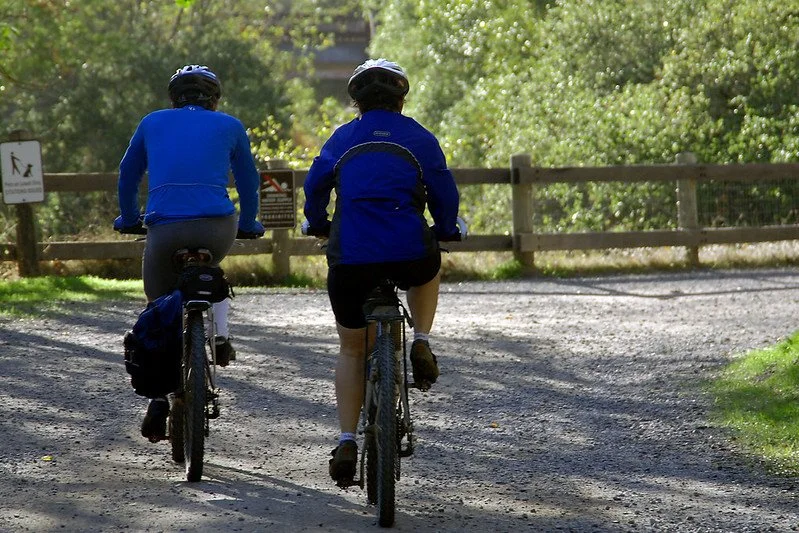
The trail leading from this park goes very quickly into the woods and splendid isolation along Phoenix Lake. It’s a beautiful place, rather hilly and secluded (except for other like-minded outdoor folk; see photo of bicyclists above), and I fell in love with the place immediately. I suspect that from now on I’ll wait my turn to park in the lot, just to be able to enjoy this amazing little getaway place so near home. (Perhaps it’ll be my new “Mt. Pisgah” – the favorite hiking spot of all time for me, right outside Eugene, OR.)
Then, on Sunday, I did something I had envisioned myself doing ever since I entertained the thought of moving to Marin: I walked the length of the Golden Gate Bridge. It was a cloudless and balmy afternoon, and I figured: it’s time! I discovered directions on the web about where to park, so I found my way to the Vista Point lot on the north side of the bridge. I walked the bridge from north to south, wandered around the visitor’s facilities at that end (i.e., the gift shop and café), then walked the span again back to my car.
What a totally perfect day to do this! I’ll have to go back again soon, though, when the photos will turn out with more “mood” associated with them.
Soundtrack Suggestion
I’m walkin’, yes indeed and I’m talkin’ ’bout you and me I’m hopin’ that you’ll come back to me, uh uh.
Recently, as I was explaining my medical history and ongoing issues with chronic pain to my new doc here in California, he seemed to actually do some listening. Although he didn’t quite buy into a diagnosis of fibromyalgia to explain my problems, he seemed to concede that my symptoms could be accounted for thusly. He suggested we rule out other explanations as well, though, so he ordered some tests.
One of which is a nuclear-med procedure called a whole-body bone scan. I went to the hospital yesterday to have it performed.
The process started with an injection (into a vein in my arm) of a gamma-radiation-emitting radioactive substance (technetium-99m , a metastable nuclear isomer of technetium-99) suspended in methylene-diphosphonate (MDP), a substance which can be preferentially taken up by bone.
I was told to drink lots of water, then come back for the actual imaging procedure three hours later. I went back to work and tried to keep my mind on some simple tasks for awhile. Upon my return to the hospital, and after making sure I went to the restroom, the technician escorted me back to the nuclear-med scanner.
I emptied my pockets and took off my belt, sort of like preparing for airport security, and was told to lie down (face up) on the massage-table-like part of the machine. Buttons were pressed, there was a whirring sound, and soon I found myself inside the device with a portion of the machine about four inches above my nose. I closed my eyes and reminded myself to keep breathing.
Soon she said, “we’re taking pictures,” and I realized that the table was slowly moving. It wasn’t long before I was brave enough to open my eyes and discovered that my head was outside the chamber.
I lost track of time, but the first part of the scanning procedure probably lasted about 20 or 25 minutes. After a short rest-room break (I had taken the water-drinking assignment seriously!), we did the second part, which the technician called “close-ups.” It was during this part of the procedure, when my head was turned for a time, that I was able to see an image of the bones of my head and upper body, from my cranium down to my ribs.
Weird!
Apparently the way this works, for diagnostic purposes, is that any increased physiological function, such as a fracture in the bone, will typically lead to an increased concentration of the technetium-99m. This can result in the appearance of a hot-spot on the image. Some disease processes result in the exclusion of a tracer, resulting in the appearance of a cold-spot.
It should be noted that nuclear medicine differs from most other imaging types in that the tests primarily show the physiological function of the system being investigated as opposed to the anatomical. Additionally, this differs from an x-ray procedure because instead of delivering the radiation source externally, this time it is internal.
I’m told this is a pretty expensive procedure. Luckily, it’s covered by my insurance. And I’m hoping for a totally-negative result, because for many of the kinds of things this test picks up, well, nobody really wants to hear that kind of news.
The Mayo Clinic website has an easy-to-understand discussion of the procedure, in case you’re interested.
Soundtrack Suggestion
Toe bone connected foot bone Foot bone connected leg bone Leg bone connected knee bone Don’t you hear the word of the Lord?
It was exactly two months ago today, July 2, that I arrived here in California to take possession of my apartment in Larkspur. I started packing up my boxes for this latest move the first week of June, and have been basically living from cardboard containers ever since…until last weekend, that is. I have finally unpacked the last of my things, put the artwork up on the walls, and reorganized my rented storage area. And I’ve had the apartment thoroughly cleaned by my new housekeeper for the first time. As of now, I’m officially “moved-in.”
I would like to say that I’m “settled” (as in: “Jim, are you all settled in yet?”), but that’s not really the case. There has been too much stress associated with moving to a different state and taking on a new, high-stress job to (in all honesty) say that I’m settled. But, being unpacked and moved in feels like good progress along that path, I must admit.
To be “settled,” I think I need a little more time to adjust culturally. The change I’m experiencing by moving from an ultra-conservative, economically-depressed community in southern Oregon to a liberal county with the highest per-capita income in the U.S. has been mind-blowing, to say the least.
And that’s not to say I’m not enjoying it here. Because I am. Believe me, living in a place that is on the liberal cutting-edge is quite refreshing. What an incredible relief that I’ve found my way here!
But I experience a good deal of preoccupation, and some degree of angst, about how different this place is, too. For one, I am continually reminded of the high cost of living: everything costs more here, and sometimes it’s way more expensive. Just this morning I went to the nearest car wash, for example, and paid $19.99 for the most basic service they offer. In Eugene, at what I think is the most pricey car wash in the city, the cost is less than half of what I just coughed up today.
And, of course, it’s the first of the month and I just wrote out another rent check. It’s a good thing I finally received a full-month’s pay: my rent is roughly two and a half times of what it was last year. Really, I can’t think of one thing that costs less here.
Additionally, one of the most interesting things that has been on my mind in the last few weeks, as I’ve been looking around trying to pay attention to my surroundings, is my perception that the residents of Marin County are a considerably better-looking lot than I’ve been around in recent times. I started out by noticing the much larger number of people sporting sun tans than are evident in rainy, cloudy, cooler Oregon. And then, as I kept reminding myself that “you can observe a lot just by watching,” I noticed that it wasn’t only the tans, it’s that people seem to look more attractive, more together, and just plain healthier here. For example, it’s my perception that there are significantly fewer obese folks around me now than there have been during the last few years.
So, it was with great interest that last Thursday I came across an MSNBC article that suggests ZIP codes are surprisingly accurate predictors of obesity. As I was able to learn, “in a study published in the September issue of the journal Social Science & Medicine, University of Washington researchers found that adults living in ZIP codes with the highest property values were the slimmest, and those living in ZIP codes with the lowest property values were the fattest.” The data presented in this study are entirely consistent with my informal, non-scientific observations of Marin County residents. With property values here that are literally off-the-charts, according to the UW research people here should be slim(mer). And they are.
My one last observation (for today, anyway) about the culture here is that the attitudes of Marin County residents tend toward elitism, entitlement & privilege. My opinion is that these Mariners know they live in an enchanted place among the rich and beautiful…and somehow these conditions give them a rather special place in society. It’s not really anything specific that anybody says…it’s just that the sense of entitlement here is palpable.
I imagine that once I’m more accepting (i.e., less judgmental) of the cultural values I’m discovering, then I’ll consider myself more “settled.”