Aging, Love, Life, Personal Growth Jim Arnold Aging, Love, Life, Personal Growth Jim Arnold

The Shape of What Didn’t Hold

Not long ago, I wrote about Lauren Kessler’s Everything Changes Everything, a memoir that revolves around love, loss, and what it means to keep on living. It is, in many ways, a simple proposition. We form attachments. We lose them. And then, ready or not, we find a way to move on.

My last significant relationship, with Gwen, comes to mind when I think about all that.

We met on her sixty-fifth birthday, in March 2019, when I was in my early seventies. I remember attaching a certain significance to that date, as if the timing itself carried meaning. At our age, it felt possible, even sensible, to imagine that what began then might be the last relationship for each of us. There was comfort in that idea. An appeal. A sense of arrival. Or at least of being done with new beginnings.

What followed, instead, was the start of a pattern that led to considerable pain for both of us.

We broke up and then reconciled many more times than I can count. Our endings never quite held. Sometimes they were quiet, other times louder and more-obviously decisive, but during the five years we tried, I became conditioned to believe that none of them were truly final.

She had many ways of reappearing in my life: a text; a voicemail; a call; more than once, a knock on my door. At one point, a sighting on the bike path resulted in a conversation that turned into something else. Then, despite whatever resolve I had constructed in her absence, I would find myself drawn back in.

In March 2020, I started back into therapy. It was there that I was introduced to Attachment Theory, which provided a framework for understanding what felt, at the time, both confusing and inevitable. In simple terms, some individuals move toward closeness when a bond feels uncertain, while others move away when the closeness feels threatening. The anxiously-attached partner leans in, trying to secure the connection. The avoidantly-attached one withdraws, trying to protect a sense of independence. Neither position feels optional from the inside; people are, in many ways, hard-wired from early in life.

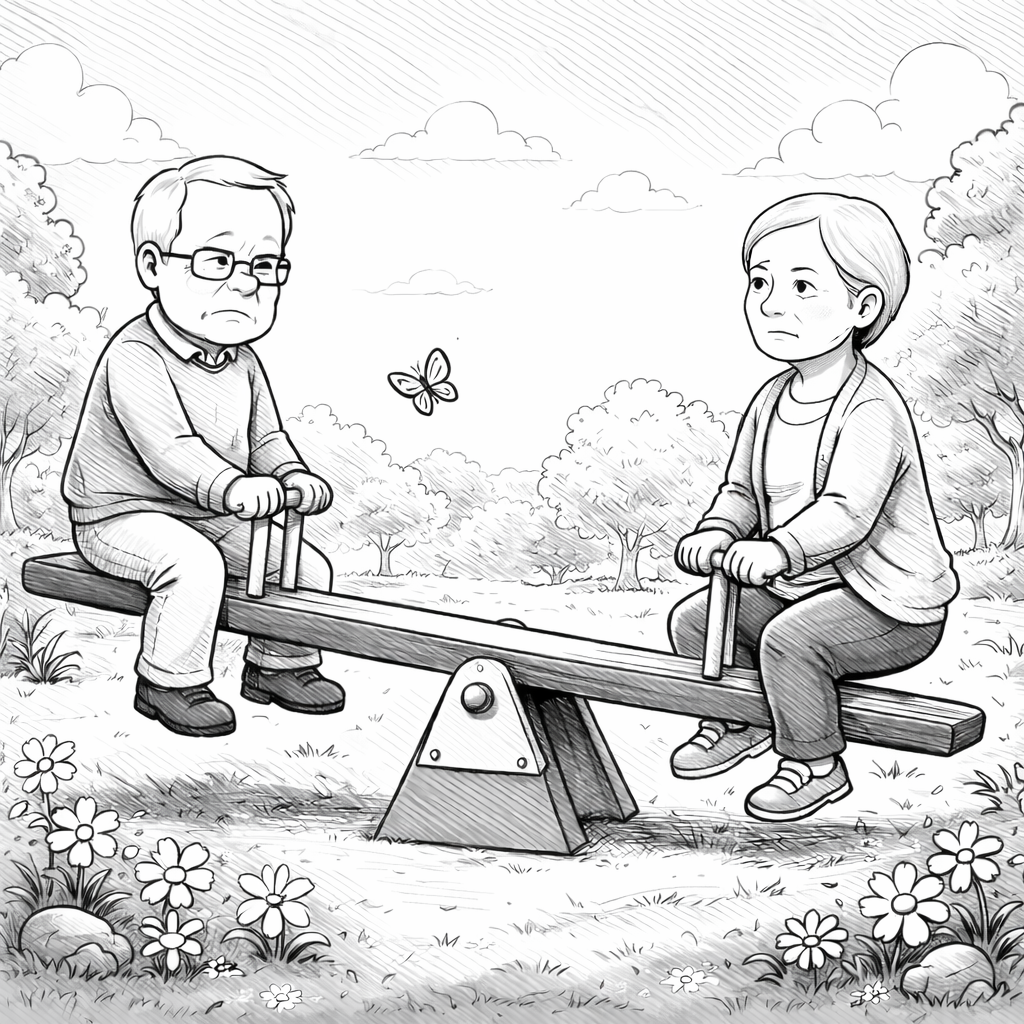
Gwen and I fit this pattern with an uneasy and predictable precision. The more distance I felt, the more I tried to close it. The more I tried to close it, the more she needed to back away. While there was an intensity to our reunions that suggested a renewed closeness, it rarely held for long.

Over time, I came to understand a bit more about her beginnings. As the oldest child, early in life she was left with her grandmother for a time while her mother went on to build a life that did not include her. I do not pretend to draw straight lines from that fact, but it is not difficult to imagine how early abandonment might echo later in life, shaping how closeness is approached and how distance is managed.

Of course, it is only fair to acknowledge that I brought my own baggage into this relationship. My mother was physically present throughout my childhood, but I rarely experienced her as emotionally available or supportive. Looking back, it is not hard to see how that absence, of a different kind, may have left its own imprint, shaping my need for reassurance and a hyper-sensitivity to distance.

We even tried, toward the end, to step out of our destructive pattern and call it “friendship.” That, too, proved to be fraught with difficulty. Too much had been said, and unsaid. Too many endings had left us wounded and scarred. Whatever ease friendship requires, we had long since worn it down.

In the end, the final separation came not with a shared understanding, but with a story that could hold. She came to see me as the one who had wronged her, and while I did not share that view, I came to understand how it made a clean ending possible where none had existed before. She stopped knocking on my door.

Now, as I approach my seventy-ninth birthday, I see quite clearly how much of this decade of life was spent inside a relationship that just did not have enough positive emotional adhesive to endure. We’re now over two years down the road from our last contact and I still think of all the painful times shaped by that push-and-pull dynamic. As Kessler reminds us, life continues, making its way around and through both the love and the loss.

Soundtrack Suggestion

I was on my way to you and I was worried
I was all torn up and nervous cause I knew that you’d be gone
I knocked and crossed my fingers while I waited
And I couldn’t hold the teardrops when I walked away alone

It’s all over, it’s all over, my heart echoed
Every minute that you cry for her is wasted don’t you know
It’s all over, it’s all over, so forget her
Stop your cryin’ turn around and let her go, let her go, boy
Let her go

(“It’s All Over” — Johnny Cash)


Read More