
Federal Court Corrects an Injustice
Since spring 2025, I have written five essays* about Lane Community College, examining its divided Board, troubled governance, strained labor relations, budget choices and loss of public trust. Unfortunately, evidence of institutional dysfunction continues to mount. The latest example concerns the College’s treatment of an outspoken student and a Federal judge’s response. It raises basic questions about free speech, administrative power and accountability.
Richard Riordan is an LCC student who challenged the administration and the Board of Education at public meetings and via email. He questioned program cuts, budget decisions and the data used to defend them. LCC responded by banning him from seven college properties and blocking him from registering for classes. On September 28, U.S. District Judge Michael McShane ordered LCC to remove the registration hold and let Riordan return to campus for academic purposes.
The College called these actions a trespass notice and an enrollment hold, bureaucratic labels that obscure their severity. Riordan risked arrest and prosecution if he entered LCC property. His enrollment hold was set to last until December 31, 2099. In practical terms, LCC had expelled him for life.
This ruling is not final. It is a preliminary injunction, an order that applies while the lawsuit continues. Even so, McShane found that Riordan is likely to succeed on his claim that LCC retaliated against him for speech protected by the First Amendment. That is a serious rebuke to President Stephanie Bulger, her administration and LCC’s elected Board.
I am a retired college administrator and former part-time LCC faculty member. Though not a lawyer, I read McShane’s opinion closely and attended every Board meeting where Riordan spoke during public comment. I found him outspoken, rambling, persistent and often sarcastic. McShane described him as “annoying, long-winded, aggressive, hyperbolic, and grandiose.”
But the judge also found “nothing in the record” showing that Riordan posed a threat. He said Riordan’s statements were hyperbole, jokes and political rhetoric, not real threats of violence.
The court’s account of LCC’s response is troubling. During a campus conversation about an upcoming Board meeting, Riordan told Vice President Shelley Tinkham he was “ready for the spin.” Public Safety Director Lisa Rupp then filed a report on Tinkham’s behalf claiming Riordan had “accosted” her. LCC’s Threat Assessment Team then began monitoring Riordan without his knowledge. Dean Carl Yeh and Rupp later told him to stop sending mass emails and to “be careful,” but did not identify any college rule he had broken.
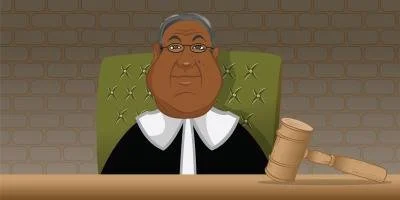
LCC also relied on an email meme and Riordan’s self-deprecating comparison of his writing to a “drive-by shooting.” McShane found that the College took those statements out of context and turned them into threats. He wrote that LCC’s misrepresentation “approaches dishonesty” and said the College appeared to be “covertly building a case” against Riordan.
The judge was just as direct about the harm LCC caused. He wrote that its actions effectively expelled Riordan and would discourage an ordinary person from speaking out. He called LCC’s safety argument “anemic and unconvincing” and its sanctions “unreasonable and legally unsupported.” He said the College’s conduct looked “much like blacklisting.”
McShane accepted that some officials may truly have been afraid. But feeling afraid is not proof that someone poses a threat. The judge allowed Riordan to return for classes but barred him from attending Board meetings in person or approaching the officials named in the suit. He said those limits were meant to calm the situation, not to suggest LCC’s fears had an objective basis.
That difference matters. LCC must act when a threat is credible. But fear alone cannot turn protected political speech into threatening conduct. Before punishing a student, the College must consider the student’s words in context and separate discomfort from a serious threat of violence. Officials may need to remove a student briefly when there is credible evidence of immediate danger. Any longer campus ban or registration block should require written notice, access to the evidence, a prompt hearing and a fair appeal.
Those safeguards are necessary, but they are not enough. President Bulger is responsible for the administration she leads. If she approved these actions, she must answer for a serious abuse of power. If she did not know senior officials were building a case against a student critic and pushing him out of college, then she failed to supervise them. Neither explanation is acceptable.
The Board should commission an independent review to determine who approved the sanctions, what evidence they relied on, why Riordan was not clearly told what rule he had broken and why he had no fair chance to respond. The findings should be made public, and Bulger should be required to answer them.
The Board must then act on those findings. LCC should correct any unsupported claims in Riordan’s records that could hurt his education or employment. The Board should also determine what consequences, if any, are warranted for the officials responsible.
But an independent review should not become an excuse to delay what is already due: a sincere public apology from Bulger and the Board to Riordan and the community. Accountability requires admitting what went wrong, repairing the harm and making sure it does not happen again. Until Bulger and the Board do that, LCC’s claims to value free speech and student rights will ring hollow.
*Here are links to those five publications.
“LCC Board Vote.” Eugene Weekly, April 17, 2025.
“Solving the LCC Board.” Eugene Weekly, October 10, 2025.
“No Confidence.” Eugene Weekly, November 25, 2025.
“Criticism of LCC Faculty Union Ignores the Deeper Issues.” Lookout Eugene-Springfield, November 2, 2025.
“Higher Education and the Long Shadow of Oregon Ballot Measure 5.” Lookout Eugene-Springfield, June 3, 2026.
Kent State Plus 45
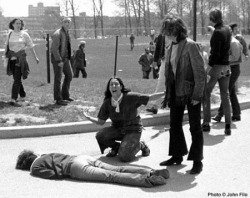
One of the Kent State casualties. Mary Ann Vecchio kneels by the body of Jeffrey Miller in this iconic, Pulitzer-Prize winning photograph by John Filo.
Tomorrow is Monday, May 4th, the 45th anniversary of the massacre at Kent State University. The tragedy was a seminal event in American history - a stunning blow to the American psyche as well as to the anti-war movement. Whatever side you were on regarding the question of the Vietnam War (and most people were aligned with one side or the other), if you were alive on Monday, May 4, 1970, you were aware of the events on the Kent State campus that day.
Here is my version of that time and why I write about it now.
On April 30, 1970, President Richard Nixon announced to a national television audience that he was ordering American troops into Cambodia. Although the stated purpose of this so-called “incursion” was to hasten an end to the ongoing slaughter in Vietnam, many Americans, myself included, were thoroughly appalled and believed the act to be an insane expansion of the war effort. Just ten days earlier, in another television address, Nixon had led us all to believe that our involvement in Southeast Asia was winding down in a meaningful way.
May 1970 was the last month of my final semester as an undergraduate student. I was a chemisty major, but I was socially-aware, politically-active and fervently anti-war. My college career had been interrupted when I received a draft notice on June 18,1969. I subsequently spent 22 days in the Air Force during late September and early October of that year – until a chronic knee condition quickly led to a medical discharge. Although by May of 1970 I was no longer at risk of losing my life in this war, I had spent four long years under the specter of the military draft – and the prospect of a gruesome, lonely death in a jungle a million miles away. For myself, and every American male my age, the war was personal. And, like many of my peers, I believed the U.S. intervention in Vietnam to be both illegal and immoral.
President “Tricky Dick” Nixon had been elected, at least in part, on the basis of his “secret plan” to endthe war. Yet, here he was, a little over a year into his presidency, ordering an escalation.

The original Kent State Memorial at UW-EC, dedicated on May 8, 1970. This plaque was removed from its original location in 2010 and presumably now resides in the campus archives. (Photo taken in July 2005. Click for enlarged version.)

From my personal file cabinet. Front page of UW-EC student newspaper “The Spectator” - published May 7, 1970. University President Leonard Haas addresses the Kent State demonstration in the middle of campus. The little red arrow on the left-hand side of the page points to me in the crowd. (Click for enlarged version.)
I was pissed. I remember spending the rest of the evening, after watching Nixon’s speech, composing a letter to the editor of my local newspaper. My misssive was not the most eloquent piece of prose ever written, but what I lacked in style, I hope I made up for in passion. This is the last straw. Nixon is wrong. He has to go. The war must end.
Many Americans agreed with me. Unrest on the nation’s campuses, especially, took a dramatic turn. On May 4, 1970, my letter was published in the Eau Claire (WI) Leader-Telegram, the same day that four full-time college students (Allison Krause, Jeffrey Miller, Sandra Scheuer and William Schroeder) at Kent State University were gunned down by Ohio National Guard troops. Another nine students (Joseph Lewis, John Cleary, Thomas Grace, Robbie Stamps, Donald Scott MacKenzie, Alan Canfora, Douglas Wrentmore, James Russell and Dean Kahler) were wounded; one was paralyzed for life, the others seriously maimed.
In the days immediately following Kent State, students at the normally-placid University of Wisconsin - Eau Claire (UW-EC) rallied. This was my campus. I, for one, picketed the Science building and boycotted classes where I had spent the majority of my time studying chemistry and math. On May 6th, a campus-wide demonstration was held, with a group of over 3,000 gathering on the lawn right outside the student union building. (See the accompanying photo, to the left, as published in the student newspaper the next day.) Two days later, four crab-apple trees were planted, along with a commemorative plaque (see photo above), in memory of the dead in Ohio. (See also accompanying photo, below, of article published in the May 14th edition of the student paper.)
In 2010, the Kent State Memorial was removed from the UW-EC campus as part of modernization efforts and the construction of a new student center building. Upon learning of the disappearance of this memorial, I was distressed. For four decades, I had rarely made a visit to the state of Wisconsin that didn’t include some time in meditation sitting among the trees and plaque belonging to the Kent State Four. The institution, without this particular artifact belonging to those turbulent times, somehow seemed incomplete.
TODAY, happily, after enduring five years of uncertainty about the status of the Kent State Memorial, I am here to report a significant new development. I recently received notice (see below) from UW-EC that on May 4th, tomorrow, a new memorial will be dedicated. The old memorial consisted of four crab-apple trees and a plaque. The word is that tomorrow’s event will unveil a memorial also consisting of four crab-apple trees and a plaque (though not the original one pictured above). I am sad that I cannot be there to participate in the event, but very pleased that there will be a new Kent State Memorial to get acquainted with during my next trip to campus.

From my personal file cabinet. UW-EC student newspaper “The Spectator” - published May 14, 1970. Continuing coverage of the Kent State demonstrations and the days that followed, including the dedication of a memorial: four crab-apple trees and a plaque planted in the ground by the student center building to forever remember the slain students. That’s me, at age 22, in the top left-center of the photo - taken during the May 6th demonstration. (Click for enlarged version.)
A few closing thoughts. The marches, demonstrations and class boycotts in the aftermath of Kent State added up to the most unrest the UW-EC campus had ever seen (or has seen since). And, in sum, when viewed in their historical context, the invasion of Cambodia, the ensuing protests, the massacre at Kent State, and the National Student Strike, were a turning point for the Nixon presidency. To recognize the significance of these events 45 years later, PBS recently (April 28, 2015) debuted a one-hour documentary entitled “The Day the ‘60s Died.” In this film about May 1970, the claim is made that the Kent State killings had a chilling effect on the nation’s anti-war activity. Indeed, it is diffcult to dispute the fact that The Movement was never quite the same. The National Guard was never held accountable. Demonstrations in support of the war became more frequent. The country was more polarized than ever, essentially divided into warring tribes. And it wasn’t until January 27, 1973, that the Paris Peace Accords ending the conflict were finally signed.
Soundtrack Suggestion
Tin soldiers and Nixon coming,
We’re finally on our own.
This summer I hear the drumming,
Four dead in Ohio.
(“Ohio” – Neil Young)
