Nuclear Medicine
I had my first experience with nuclear medicine this week.
Recently, as I was explaining my medical history and ongoing issues with chronic pain to my new doc here in California, he seemed to actually do some listening. Although he didn’t quite buy into a diagnosis of fibromyalgia to explain my problems, he seemed to concede that my symptoms could be accounted for thusly. He suggested we rule out other explanations as well, though, so he ordered some tests.
One of which is a nuclear-med procedure called a whole-body bone scan. I went to the hospital yesterday to have it performed.
The process started with an injection (into a vein in my arm) of a gamma-radiation-emitting radioactive substance (technetium-99m , a metastable nuclear isomer of technetium-99) suspended in methylene-diphosphonate (MDP), a substance which can be preferentially taken up by bone.
I was told to drink lots of water, then come back for the actual imaging procedure three hours later. I went back to work and tried to keep my mind on some simple tasks for awhile. Upon my return to the hospital, and after making sure I went to the restroom, the technician escorted me back to the nuclear-med scanner.
I emptied my pockets and took off my belt, sort of like preparing for airport security, and was told to lie down (face up) on the massage-table-like part of the machine. Buttons were pressed, there was a whirring sound, and soon I found myself inside the device with a portion of the machine about four inches above my nose. I closed my eyes and reminded myself to keep breathing.
Soon she said, “we’re taking pictures,” and I realized that the table was slowly moving. It wasn’t long before I was brave enough to open my eyes and discovered that my head was outside the chamber.
I lost track of time, but the first part of the scanning procedure probably lasted about 20 or 25 minutes. After a short rest-room break (I had taken the water-drinking assignment seriously!), we did the second part, which the technician called “close-ups.” It was during this part of the procedure, when my head was turned for a time, that I was able to see an image of the bones of my head and upper body, from my cranium down to my ribs.
Weird!
Apparently the way this works, for diagnostic purposes, is that any increased physiological function, such as a fracture in the bone, will typically lead to an increased concentration of the technetium-99m. This can result in the appearance of a hot-spot on the image. Some disease processes result in the exclusion of a tracer, resulting in the appearance of a cold-spot.
It should be noted that nuclear medicine differs from most other imaging types in that the tests primarily show the physiological function of the system being investigated as opposed to the anatomical. Additionally, this differs from an x-ray procedure because instead of delivering the radiation source externally, this time it is internal.
I’m told this is a pretty expensive procedure. Luckily, it’s covered by my insurance. And I’m hoping for a totally-negative result, because for many of the kinds of things this test picks up, well, nobody really wants to hear that kind of news.
The Mayo Clinic website has an easy-to-understand discussion of the procedure, in case you’re interested.
Soundtrack Suggestion
Toe bone connected foot bone
Foot bone connected leg bone
Leg bone connected knee bone
Don’t you hear the word of the Lord?
(“Dry Bones” – Negro Spiritual)
You Can Observe A Lot Just By Watching
It was exactly two months ago today, July 2, that I arrived here in California to take possession of my apartment in Larkspur. I started packing up my boxes for this latest move the first week of June, and have been basically living from cardboard containers ever since…until last weekend, that is. I have finally unpacked the last of my things, put the artwork up on the walls, and reorganized my rented storage area. And I’ve had the apartment thoroughly cleaned by my new housekeeper for the first time. As of now, I’m officially “moved-in.”
I would like to say that I’m “settled” (as in: “Jim, are you all settled in yet?”), but that’s not really the case. There has been too much stress associated with moving to a different state and taking on a new, high-stress job to (in all honesty) say that I’m settled. But, being unpacked and moved in feels like good progress along that path, I must admit.
To be “settled,” I think I need a little more time to adjust culturally. The change I’m experiencing by moving from an ultra-conservative, economically-depressed community in southern Oregon to a liberal county with the highest per-capita income in the U.S. has been mind-blowing, to say the least.
And that’s not to say I’m not enjoying it here. Because I am. Believe me, living in a place that is on the liberal cutting-edge is quite refreshing. What an incredible relief that I’ve found my way here!
But I experience a good deal of preoccupation, and some degree of angst, about how different this place is, too. For one, I am continually reminded of the high cost of living: everything costs more here, and sometimes it’s way more expensive. Just this morning I went to the nearest car wash, for example, and paid $19.99 for the most basic service they offer. In Eugene, at what I think is the most pricey car wash in the city, the cost is less than half of what I just coughed up today.
And, of course, it’s the first of the month and I just wrote out another rent check. It’s a good thing I finally received a full-month’s pay: my rent is roughly two and a half times of what it was last year. Really, I can’t think of one thing that costs less here.
Additionally, one of the most interesting things that has been on my mind in the last few weeks, as I’ve been looking around trying to pay attention to my surroundings, is my perception that the residents of Marin County are a considerably better-looking lot than I’ve been around in recent times. I started out by noticing the much larger number of people sporting sun tans than are evident in rainy, cloudy, cooler Oregon. And then, as I kept reminding myself that “you can observe a lot just by watching,” I noticed that it wasn’t only the tans, it’s that people seem to look more attractive, more together, and just plain healthier here. For example, it’s my perception that there are significantly fewer obese folks around me now than there have been during the last few years.
So, it was with great interest that last Thursday I came across an MSNBC article that suggests ZIP codes are surprisingly accurate predictors of obesity. As I was able to learn, “in a study published in the September issue of the journal Social Science & Medicine, University of Washington researchers found that adults living in ZIP codes with the highest property values were the slimmest, and those living in ZIP codes with the lowest property values were the fattest.” The data presented in this study are entirely consistent with my informal, non-scientific observations of Marin County residents. With property values here that are literally off-the-charts, according to the UW research people here should be slim(mer). And they are.
My one last observation (for today, anyway) about the culture here is that the attitudes of Marin County residents tend toward elitism, entitlement & privilege. My opinion is that these Mariners know they live in an enchanted place among the rich and beautiful…and somehow these conditions give them a rather special place in society. It’s not really anything specific that anybody says…it’s just that the sense of entitlement here is palpable.
I imagine that once I’m more accepting (i.e., less judgmental) of the cultural values I’m discovering, then I’ll consider myself more “settled.”
“Chee” Whiz
chi
Variant: or ch’i also qi \'chē\
Function: noun
Usage: often capitalized
Etymology: Chinese (Beijing) qì, literally, air, breath
: vital energy that is held to animate the body internally and is of central importance in some Eastern systems of medical treatment (as acupuncture) and of exercise or self-defense (as tai chi)
A year and a half ago (February 2006), I wrote an entry entitled, simply, “Qi” (pronounced “chee”). At that time I speculated my “life force,” “vital energy,” or “spiritual energy” [rough English-language equivalents of the Traditional Chinese Medicine (TCM) term “qi”], was in decline – and I was just beginning to see an acupuncturist in Portland to determine whether or not I could address some of my body issues via the TCM route. I saw a practitioner there for about four months, right up until the time I had to move away. One of the things that always concerned me about her, though, was that she did not seem to subscribe to the philosophy upon which the practice was based: while she was a seemingly adequate technician of the craft, I don’t believe she believed. Ultimately, I didn’t really experience much benefit from those treatments.
At the current time, of course, I have improved my health situation a lot. The TCM practitioner I found in Roseburg earlier this year was instrumental in helping me dramatically turn my life around. She was an all-around Medicine Woman: a true healer. I was fortunate to have found her when I did. Western Medicine was not helping, and in fact may have been hurting, me. This “alternative” approach very likely saved my life.
Alas, I had to leave my Oregon Medicine Woman behind and move yet again. (Don’t get me wrong: it was a good, good thing to leave Roseburg.) So, ever since I’ve been here in Marin County, almost two whole months now, my quest has been to find other healers who can keep me on my recovery path.
As of last week, I have found two individuals who fit this description, both as a result of referrals from my Roseburg miracle-worker. As it turns out, two of her primary instructors are from the Bay Area. The Lauren Berry Method (of bodywork) teacher she studied with lives in Berkeley; when I contacted that person she referred me to a colleague in Marin County who works a few miles north of here in Novato. The TCM guru she studied with lives in San Francisco; and he subsequently referred me to a practitioner even closer, just over in San Rafael.
My new bodywork person seems to be incredibly gifted in her craft. She is very intuitive and gentle, and after just three treatments seems to be making a positive difference with regard to my pain and energy levels. I can’t believe my luck that I’ve found someone with these talents so swiftly.
The TCM story is a bit different, however. Before calling the San Rafael practitioner, I first tried one in San Anselmo. This person had Saturday office hours, which I found desirable, and I had heard good things about him in terms of making a difference in people’s lives. Alas, after just two sessions I determined that he was not the one for me. When I reported to him little results from the first session, the second time he proceeded to get much more aggressive with his acupuncture needles…resulting in unwanted (and I believe unwarranted) pain. (“Holy shit!,” I shouted out, at least a couple of times.) I decided I needed to try something (someone) different, so I called the San Rafael practitioner I had been led to from my Roseburg contact.
I saw him for the first time last Thursday. When I told him, at the intake conversation, that I was turning 60 the next day, he reported that he had turned 60 the previous Saturday. He was very patient, listened attentively to all my concerns, carefully examined the Chinese herbs I have been taking for a few months, and very thoroughly explained his way of working. Fortunately, he was also quite skilled in terms of the actual decorating of my body with his needlework.
His assessment of me rang true…that I was “deficient in qi.” Of course, this is no surprise. This is a long-standing life issue and, as much progress I have made in recent months, I know I still have quite a long way to go.
In case you’re interested, I found a website that explains the five functions of qi (and what happens when one is qi deficient). These are direct quotes from that discussion…
1. Promoting function
Qi provides the active, vital energy necessary for the growth and development of the human body and to perform the physiological functions of the organs, meridians and tissues. If there is a deficiency of qi, its promoting functions are weakened…and growth and development can be affected or delayed, the organs and meridians cannot function properly and blood formation is hampered…2. Warming function
Being a heat source, qi warms the body and keeps it at a constant temperature so normal physiological functions can take place. Deficiency of qi can lead to a lowered body temperature, intolerance of cold and cold hands and feet.3. Defending function
In TCM, one of the main causes of disease is the invasion of “Evils”. By resisting the entry of “illness evils” into the body, qi defends against their attack and maintains healthy physiological functions. In western terms, this qi defending function acts like the immune system.4. Consolidation and retention function
Qi consolidates and retains the body’s substances and organs by holding everything in its proper place…if qi is deficient, the consolidating function is weakened, leading to various kinds of health problems such as hemorrhage; frequent urination, premature ejaculation and stomach or kidney prolapses…The promoting and consolidating functions work in a complementary manner. For example, qi promotes blood circulation and the distribution of body fluids, but it also controls and adjusts the secretion of fluid substances. The balance between these two functions is essential for maintaining a healthy blood circulation and water metabolism.
5. Transforming functions
Qi also possesses “vaporization” or “transformation” functions, which are important for the metabolism of fundamental substances. As suggested by these words, qi may “vaporize” substances in the body and transform them into essence or vital energy. For example, certain actions of qi allow food to be changed into food essence, which is in turn transformed into different types of qi and blood. Indigestible food and waste are also transformed by qi into urine and stools for excretion.
A lot of the description above is, really, the “story of my life.” Consider, especially, the “warming function.” As a chronically cold human being, nothing could be more profound evidence that I am qi deficient.
Through the use of acupuncture and herbs (as well as the aforementioned bodywork techniques), I am hoping to turn this qi deficiency around and be whole again…transforming myself into a physically-healthy person with a correspondingly healthy spirit.
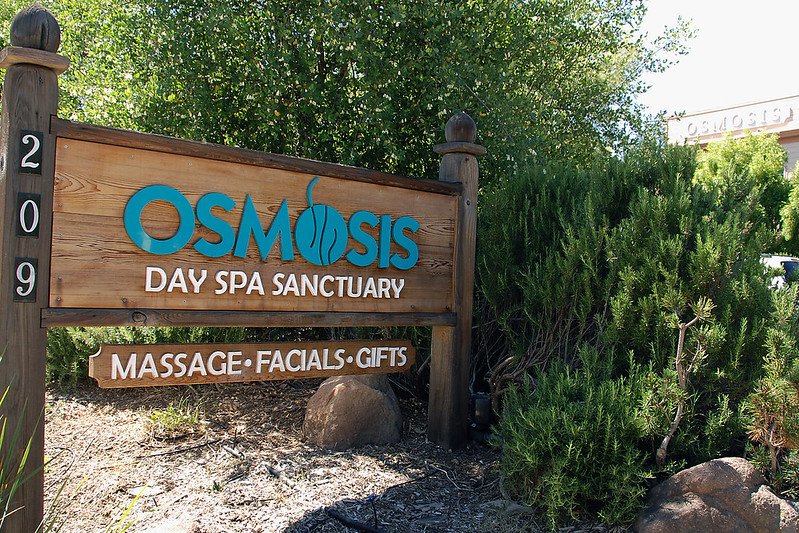
Osmosis
Osmosis ( äz-mō'-sĕs ).
Function: noun.
Etymology: New Latin, short for endosmosis.
1: movement of a solvent (as water) through a semipermeable membrane (as of a living cell) into a solution of higher solute concentration that tends to equalize the concentrations of solute on the two sides of the membrane.
2: a process of absorption or diffusion suggestive of the flow of osmotic action; especially : a usually effortless often unconscious assimilation <learned a number of languages by osmosis — Roger Kimball>.