
Is This How I Die?
I have walked almost every day for over forty years, including the past twelve on Eugene’s Ruth Bascom Riverbank Path System. I’m now retired and these walks remain essential to both my physical and emotional health, but the path no longer feels as safe as it once did. Several years ago, I began hugging the right side out of fear that a speeding cyclist might run me over. With e-bikes now racing along the same shared space, my concern has become even more urgent and I ask: Is this how I die?
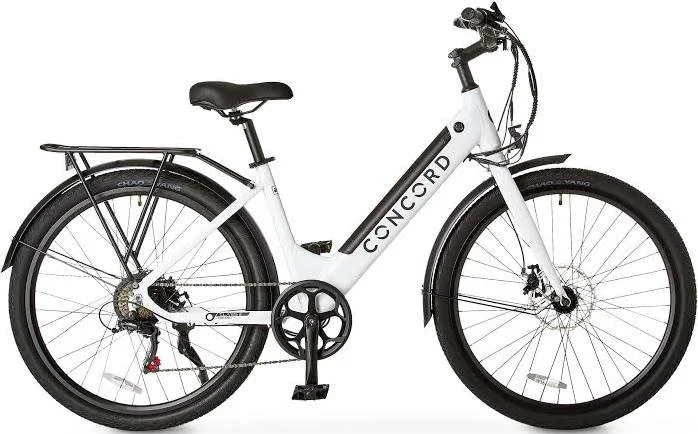
That scenario seems even more plausible after the September 8 report in Lookout Eugene-Springfield about the planned overhaul of PeaceHealth Rides, our local bike-share program. Its operator hopes to replace the current fleet with 400 to 500 new bicycles by spring 2028, likely divided evenly between conventional bicycles and e-bikes. The e-bikes would have maximum speeds between 15 and 20 miles per hour. This could put 200 to 250 city-sanctioned e-bikes into circulation, including in the hands of first-time and inexperienced riders.
But let’s take a step back. Before Eugene embraces any such expansion, we should be clear about what an e-bike is. Oregon recognizes three classes, two of which stop providing electric assistance at 20 miles per hour. Class 3 provides pedal assistance up to 28. Then there are e-motos, powerful electric motorcycles often mistaken for e-bikes. Eugene says a throttle-powered vehicle without usable pedals is not legally an e-bike, even if its maximum speed is 28 miles per hour or less. E-motos are prohibited on Eugene paths, sidewalks, bike lanes and park trails.
On a shared path, Eugene says e-bike riders should travel no faster than 12 miles per hour when other people are present. Twenty miles per hour is allowed only when the rider is alone on the path. Cyclists must yield to walkers, pass on the left and give an audible warning. E-bikes are prohibited on sidewalks, and riders must be at least sixteen years old.
Despite the prevailing rules and laws regarding e-bikes, however, I don’t think concerns about my personal well-being are unreasonable. There are increasing numbers of reports surfacing that e-bikes are responsible for serious injuries to pedestrians. For example, earlier this year an 81-year-old Vietnam vet in Orange County, California, was killed by a 14-year-old driving recklessly on an electric motorcycle.
And then there is well-documented evidence about the negative consequences to e-bike riders themselves. An August 2026 NBC News report found that emergency-room visits involving e-bike and e-scooter injuries among children and teenagers had increased by more than 600 percent in three years. Head and neck injuries were among the most common. A Wisconsin pediatric emergency physician said accidents he once saw only occasionally had become a daily occurrence.
The local figures are equally sobering. As the Register-Guard reported in August, PeaceHealth Sacred Heart Medical Center treated 13 people for e-bike injuries in 2023 and 48 in 2025, an increase of roughly 250 percent. More than half of the injured riders in both years reportedly were not wearing helmets. Doctors are treating broken ribs, fractures, severe head injuries and facial trauma once associated mainly with motorcycles.
I recognize that many riders use e-bikes responsibly and that the technology can replace car trips or make cycling possible for older adults and people who are unable to ride conventional bicycles. A properly managed bike-share program might offer some advantages over privately-owned machines. But before adding hundreds of e-bikes, PeaceHealth Rides and its public partners should explain how they will verify riders’ ages, teach path rules, enforce the 12-mile-per-hour limit and respond when rented machines are used recklessly.
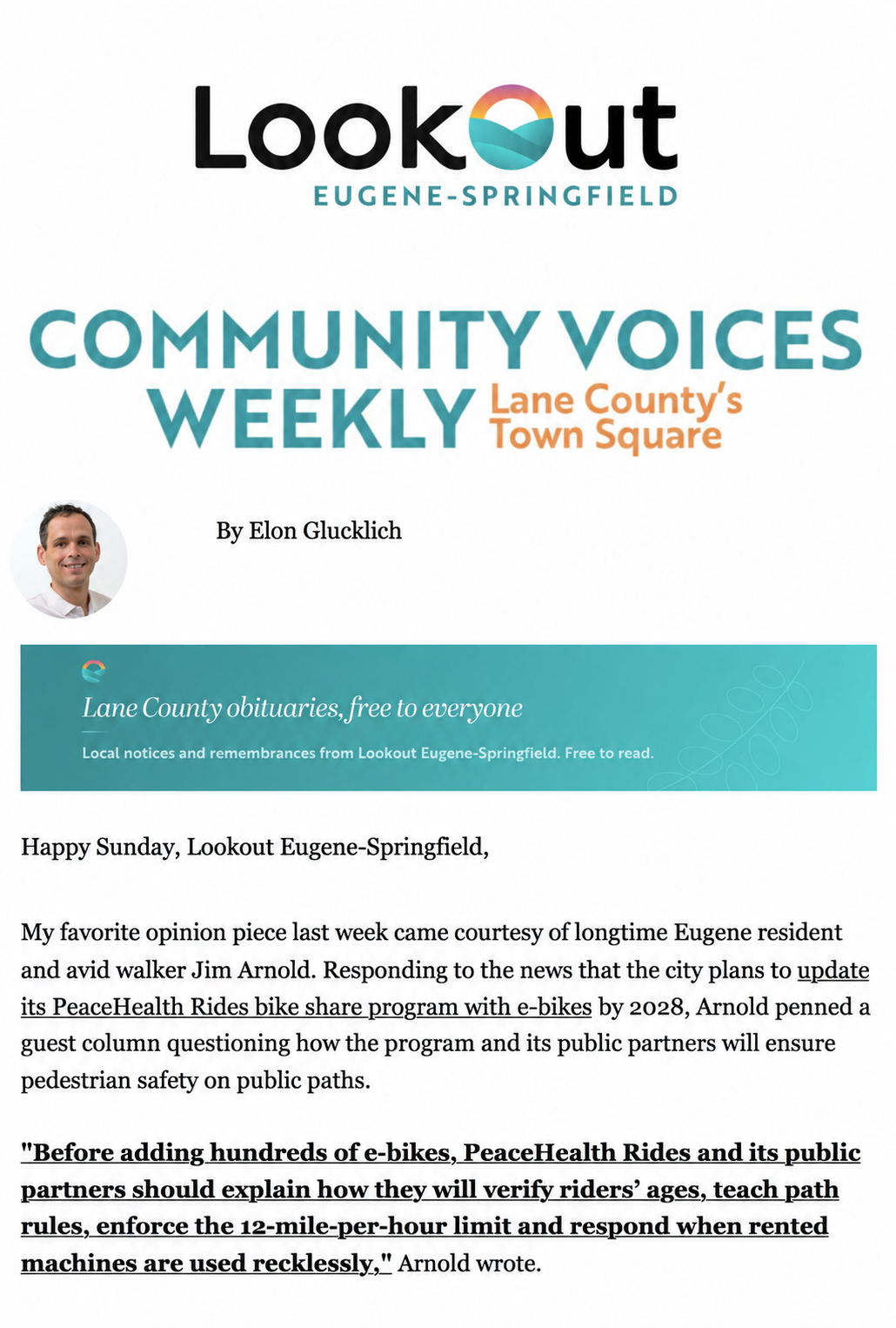
That Lookout report raises an even more alarming red flag. Brodie Hylton, executive director of Cascadia Mobility, said future options might include e-scooters or what he called a “pedalless e-bike.” Under Eugene’s own published definition, however, a throttle-only vehicle without usable pedals is not an e-bike. If officials are considering such vehicles, they must say precisely what they are proposing, where the vehicles could legally be ridden and how they would be kept off prohibited paths. A catchy new label cannot turn an electric motorcycle into a bicycle.
To keep both riders and pedestrians safe, Eugene needs more than a website, signs, educational campaigns and polite reminders. The city needs visible enforcement, including speed monitoring, citations for reckless riding and meaningful consequences for illegal e-moto use. Any PeaceHealth Rides expansion should include enforceable speed controls, clear identification of each vehicle and a system for suspending users who endanger others.
Rules that are not enforced are merely suggestions, and these suggestions offer little real protection to me as I walk beside the river. Eugene should address these issues before spending millions of dollars and placing hundreds of additional electric vehicles on our bike paths. It should not wait for me (or any other innocent bystander) to be killed before deciding that enforcement matters.
Editing Note: After posting a version of this essay on September 7, 2026, the very next day
Lookout Eugene-Springfield reported out on the developments with PeaceHealth Rides.
I subsequently revised the piece, and the final version is what you find above.
Update on September 15, 2026:
This essay, in a slightly-edited form, was published as a Guest Column in the Lookout Eugene-Springfield today.
Soundtrack Suggestion
How could I forget to mention
The bicycle is a good invention
Sitting there in a silent movie
Beside the only girl who really ever knew me
Happy days, but sad I’m facin’
Heaven knows I’m on the case, oh
How could I forget to mention the bicycle?
(“Bicycle Song” — Red Hot Chili Peppers)
Shrinking
“Shrinking.” noun: a popular series on Apple TV.
“Shrinking.” adjective: becoming smaller in size or amount.
Lately, the word brings the TV show to mind first. Harrison Ford, Jason Segel, and Jessica Williams play therapists sharing a small private practice. I’m quite fond of it. It manages to be funny while taking on friendship, parenting, grief, and the frequent ethical angle. I really look forward to each episode.
But there is also a more personal meaning these days: becoming smaller in size. It turns out that is not just a definition; it is my life.
The older I get, the smaller my world becomes.
Last fall I traveled to my high school reunion, only the second trip I’ve taken since the pandemic. Both trips have been to small-town northern Wisconsin. Travel has become such a physical ordeal that I now approach it with the strategic planning of a minor military operation. Fortunately, I had enough frequent flier miles to upgrade to first class each time. I am not sure I would have survived the cattle-car-in-the-back alternative. Or at least with not much dignity; my claustrophobic tendencies would likely have taken up too much attention.
Closer to home, my world has settled into a familiar circuit. The UPS store for my Amazon packages. Three grocery stores in regular rotation. And then the medical offices. So many medical offices! I seem to have assembled quite an impressive team of specialists, each responsible for a different body part that is no longer performing as originally advertised. Most of these businesses and offices are in North Eugene where I live. My ophthalmologist, pain doc, and therapist are in South Eugene.
Yes, I have a therapist. At this age. I still have issues.
There is also my daily walk, which remains essential for body, mind and spirit. Not that long ago I was walking three miles a day, more than a thousand miles a year. These days I manage about one mile, often pausing halfway to stretch and negotiate with my back. Spinal stenosis and its accompanying nerve pain have reset expectations. They have also reduced how often I attend protests or head out with a camera, both once reliable parts of my routine.
And then there is my height. I used to measure 5 foot 7 at my annual physical. Last month, even standing as tall as I could, I came in just under 5 foot 5. Apparently, I am not only aging, I am compressing. Yes, I have osteoporosis. I do not like this. In high school I was among the shortest in my class, often the last chosen for teams. I remember the feelings of inadequacy that resulted. While I am no longer being chosen for teams, the world is still a different place for a short man. It always has been.
What I am left with, it seems, is a smaller map. Fewer miles traveled, fewer places to go, fewer things I can easily do. Even a shorter reach upward.
Despite everything, though, I seem to be getting a better look at what’s right in front of me.
And if necessary, I suppose, I can always stand on tiptoe.
Soundtrack Suggestion
Well, I don’t want no short people
Don’t want no short people
Don’t want no short people
‘Round here
Short people got nobody
Short people got nobody
Short people got nobody
To love
(“Short People” — Randy Newman)
The Executor Dilemma
A Boy Scout’s Guide to Late-life Logistics
In my previous essay, I found myself reflecting on the subject of time. Writing it left me thinking much more seriously about how much of it I may have left. At my age — I’m now in my 79th year — existential angst is to be expected. Many friends and colleagues are now gone, while those of us still here seem increasingly occupied with managing one physical malady or another.
Ah yes, the maladies. They arrive in clusters at this stage of life, don’t they? For example, my walking regimen, once integral to both my physical and mental health, has become disturbingly limited. Chronic nerve pain from spinal stenosis now restricts my mobility, and more recently I have added compression stockings to my wardrobe to deal with peripheral edema. It really is no secret that a senior-citizen’s body is a full-time maintenance project.
Now, as it happens, I was a Boy Scout in my youth, and the motto drilled into every Scout was simple: Be Prepared.
Robert Baden-Powell, the founder of Scouting, did not mean that only in the sense of carrying the right gear on a camping trip. He meant it as a way of approaching life itself. Think ahead. Get things in order before the moment arrives.
So. Let’s get real. It definitely is time for me to get serious about preparing for my Final Exit.
The pandemic, of course, had previously served to sharpen this realization. In 2020 I was well into the category of people considered highly vulnerable to COVID. Although we did not know the precise statistics at the time, we now know that people over 65 accounted for the vast majority of deaths from the disease. I behaved cautiously and, for whatever reason, never contracted the virus.
However, during that unsettling time, I did make a few modest strides toward “getting my affairs in order.” Ever since then, a white 9×12 envelope labeled “Important Stuff” has been attached to my refrigerator door, quietly waiting to be needed. Inside it are my Advance Directive, which I prepared back in 2014 (upon retirement), along with some basic information about my finances and where funds should be directed upon my death.
Of course, one rather obvious detail remained unresolved. Who exactly would carry out these wishes? I never actually completed a Will.
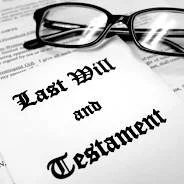
Not that I didn’t try. I went to the FreeWill website and started working through the prompts. Everything went smoothly until I reached the section asking me to name an Executor. Who would that be? I do not have a spouse or significant other, and most of my relatives live far away. Asking friends to take on the administrative burden of settling someone’s affairs felt like a rather large favor to request.
So the process stalled.
But I have just recently discovered that there are professionals who can perform this role. Licensed Professional Fiduciaries can serve as a Personal Representative, handling the various financial, legal, and logistical details that follow a person’s death. In cases like mine, where the estate is modest, the process may even be handled through a Simple Estate Affidavit rather than a lengthy probate proceeding.
I am still learning about how all of this works, of course, but I have already contacted a local firm that provides fiduciary services and requested an initial consultation.
None of this is especially dramatic; it is simply the quiet work of tidying up important details. It’s the kind of effort that is easy to postpone because the moment requiring it always seems far away. Yet eventually the time arrives. Deep down, we all know that.
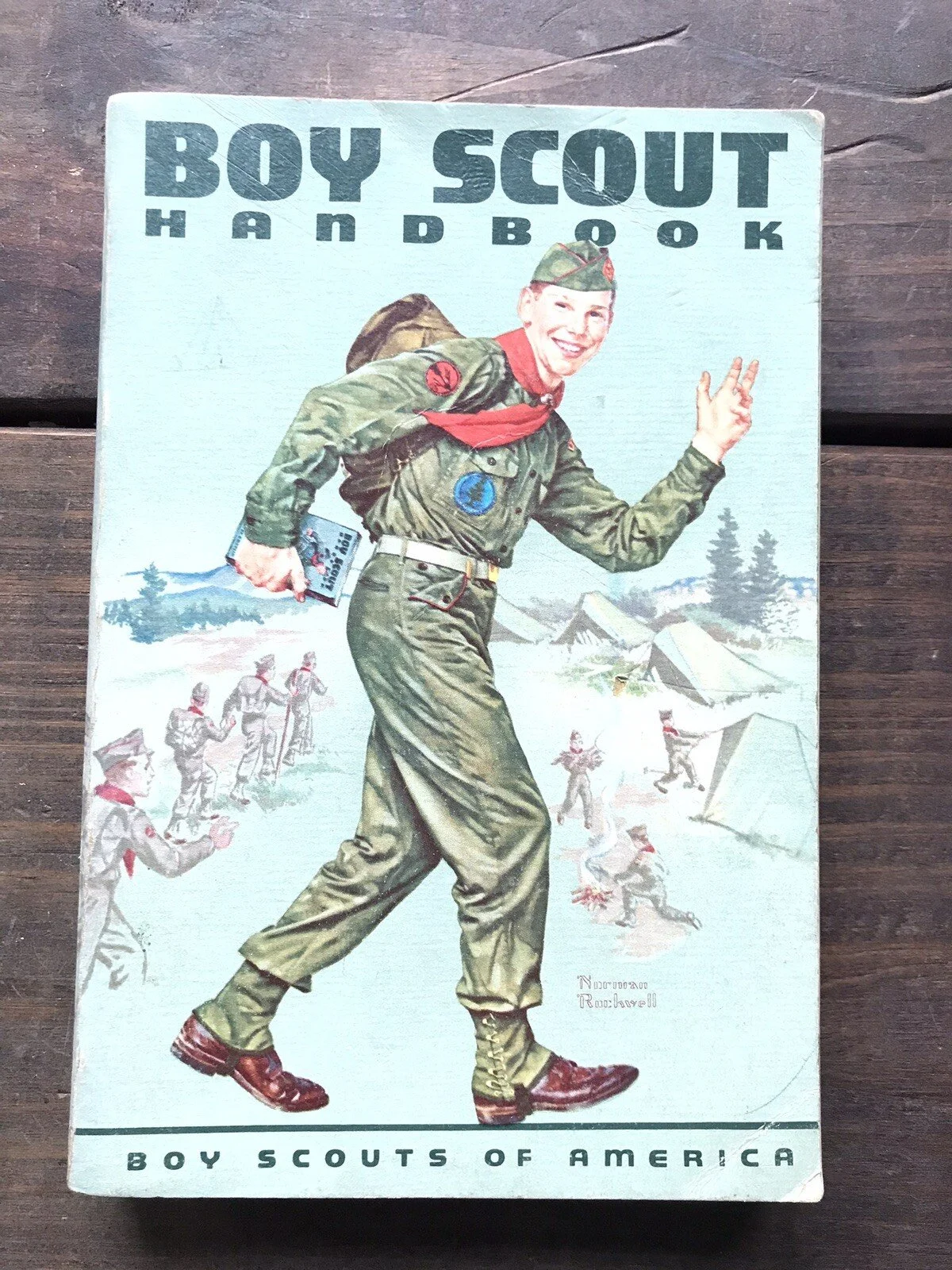
And so I find myself returning to bits of advice first learned long ago in the Boy Scout Handbook. The lessons were about life. And now death.
Be prepared.
Soundtrack Suggestion
I’m not scared of dying
And I don't really care
If it’s peace you find in dying
Well, then let the time be near
If it’s peace you find in dying
And if dying time is near
Just bundle up my coffin cause
It’s cold way down there
I hear that's it’s cold way down there
Yeah, crazy cold way down there
(“And When I Die” — Laura Nyro; Blood, Sweat & Tears)
Generosity and Free Will
“I was trying to figure out what I should have already told you, but I never have. Something important, something every father should impart to his daughter. I finally got it: generosity. Be generous, with your time, with your love, with your life.” [From a terminally-ill, near death, Dr. Mark Greene, to daughter Rachel, during “On the Beach,” an episode of “ER,” May 9, 2002; emphasis mine.]

I wrote last time about my fall on the ice during the recent storm. As reported, I did not break any bones; however, the residual effects of the mishap continue to linger on. The trauma of the tumble seems to have taken up residence in my lower and upper back – as well as in my psyche. My spirits are quite low.
In the first two weeks after the storm, I had massage, physical-therapy, and Zero-balancing sessions – in addition to my regularly-scheduled therapy appointment. At this point, though, my recovery still has a way to go. I need significantly more time – andhelp- to facilitate my healing.
In questioning my life’s choices during this period of blueness, I reviewed an essay from February 2006 here on Musings entitled “Generosity.” I have had reason to reflect again on the meaning of this term and specifically its place in the context of friendship.
What am I talking about? Well, I now have reason to believe that what I had experienced as acts of generosity from a friend were, perhaps, deeds that had been misinterpreted by me. I now suspect that perhaps some kind of relational score-keeping had been in play. This has sent me even more into an emotional tailspin, leading me into a deeper examination of my own behavior; to wit: Who am I as a friend? Am I in search of some kind of reciprocity rather than act from a generous spirit? Am I generous enough with my love? My time? My energy? My life? Who am I, really? And, in this context, how am I perceived by others?

I have always believed that each of our lives are comprised of our own individual choices – a sum of the good and/or bad. This long-held belief has, recently, however, come to be challenged. During the last few weeks I have been trying to make my way through Determined by Robert Sapolsky, a dense academic treatise on the topic of free will. Sapolsky makes the compelling argument that, essentially, free will is a myth -- that our livesare really the sum of our biology, our environment, our experiences, of human evolution. The theory is that whatever we choose to do in any moment is dictated by the sum of our life up until the previous moment, that that moment is the result of the previous moment, on and on and on. From Sapolsky’s viewpoint “…all we are is the history of our biology, over which we have no control, and of its interaction with environments, over which we also have no control, creating who we are in the moment” (Sapolsky, 2023, p. 85).
So, in this particular paradigm of human existence, none of us can really be held accountable for our actions – they have all been pre-determined. In fact, every act of mine (ours), lets say in the matters of charity or generosity, are built into us and that we don’t really choose to behave in one way or the other.
I admit that I find myself being quite depressed at the concept that my (and your) existence has already been determined in advance, that my (our) choices are not really choices. Thinking about this interpretation of being human has not done anything positive for my spirits.
So, in sum, right now my body and my soul are in pain. I am seeking help from various sources to manage life right now. But I am in a state of confusion about the meaning of the human experience and what actions I (we) may (or may not) have control over. I am wondering what “choice” is --and whether or not I have the ability to actually choose the right way to work my way out of this painful period.
Reference
Sapolsky, R. (2023). Determined. New York: Penguin Press.
Surviving Winter
As I sit here in my neighborhood Starbucks, sipping a hot chocolate on this late-January Sunday afternoon, I am thinking about how I have (mostly) successfully made it through another horrible winter-weather event. No, here in the Willamette Valley we really don’t have the blizzards and sub-zero temperatures that regularly incapacitate other parts of the country; that’s not our thing. The experience that we have all collectively lived through here, recently, is yet another Oregon ice storm.

Starting nine days ago, on the evening of Friday, January 12, freezing rain began to coat the landscape from Eugene, here the southern valley, up to Portland in the north. When it started we didn’t really know how bad it was going to get, of course. But the forecast was not encouraging. And when I awoke last Saturday morning, it brought back unpleasant memories of a previous ice-storm disaster we had here. It was in December of 2016, when I was living in another neighborhood of north Eugene, that freezing rain left a good portion of the city immobilized. I had electricity for the first day of the storm, but when I awoke during the middle of that night, I had the realization the power was out. For the first full day of darkness, and then the second, I wore multiple layers of clothing (including a down jacket and ear muffs), huddled on my couch, for hours and hours at a time, under a big pile of blankets. I kept my phone powered on with an external battery pack and listened to the news.
The temperature outside remained in the teens and twenties. More trees fell under the weight of the ice, more power lines went down. I learned that it could be several days before power was restored. The temperature in my apartment continued to fall. It was about the time that I began to see my breath that my mood began to significantly decline. Oh, I thought, this is the very scenario that plays out when it is ultimately learned that the storm has led to various fatalities: people freezing to death, alone in their own dwellings.
It was after two full nights alone in the cold when I decided, on the third day, that I needed to take some kind of action. Given that the power was not out all over the area, there were pockets where life was, unbelievably, going on as usual. I called a hotel a few miles away, learned that they had power, and that they were offering discounts to folks who were seeking a safe place in the storm. I made a reservation, hastily packed a suitcase with my frozen fingers, and very carefully drove over there. I settled in, took a long hot bath, and started to feel safe. But this whole experience had been traumatizing and had left me with a sense of dread, unease, and extreme vulnerability.
Now, fast forward to 2024 and this storm. The weather this time turned out to last days longer and be more severe than originally anticipated; in fact, this storm was even worse than last time, according to the experts. Reports kept coming in with more and more power outages, even as my lights remained on. I became increasingly anxious. I rather expected to have to relive the trauma of 2016 all over again. And this time, any kind of escape seemed even more problematic; I didn’t believe my car would make it out of my parking lot, much less get me to a hotel that had power. What was going to be my survival maneuver this time?
