
My Nikon School Experience

I attended Nikon School again this year. This is an all-weekend, two-day photography seminar sponsored by the makers of Nikon cameras; it is available in several cities around the country over the course of any given year. No other camera manufacturer has a program that’s even remotely similar, if my information is correct. The first day, Saturday, is a beginner’s session entitled “Introduction to Digital SLR Photography.” It starts with the basics of ISO, shutter speed and aperture and goes from there, including exposure modes; white balance; lens choice; composition; and framing. The second day is called “Next Steps: Color, Light & Technology.” This day is much more technical, and includes such topics as understanding the qualities of light; how to make the most of RAW format images and maximize a workflow built around them; color management from camera to print; and a demo of Capture NX2 (Nikon’s own photo-editing software). Both days are incredibly packed with information: so much so that the first time I attended the “Next Steps” day, I thought my head was going to explode. Luckily, I keep up with most parts of all topics now, so I don’t walk away so overloaded and exhausted. At the end of the weekend, I’m more energized than anything, so I guess that’s why I keep going back year after year.
Last weekend marked my fifth year in a row attending Nikon School in Berkeley, and perhaps my tenth time overall (honestly, I've lost track). I’ve also attended Nikon Schools offered in Portland and Seattle (two or three times in each of those locations, when I lived in Oregon). Back in the early 2000s when I first started attending, I was still shooting film, as was one of the two instructors (Sam Garica; Bill Durrence was shooting digital.)

Autofocus Speedlight SB-700
An additional topic (not listed above) for the “Next Steps” day is flash photography, with a discussion of fill- and bounce-flash. The presentation includes a live demonstration using multiple Speedlights (the name for Nikon’s line of flashes) in a simulated portrait session. For this part of the seminar, one audience participant is asked to volunteer to sit on stage as their subject.
When it came time for this demo, I thoroughly expected the instructors to choose a female (and certainly someone who doesn’t wear glasses, as that adds an unneeded complication to their work) for this very interesting, but rather-intense part of the show. However, this year, they didn’t ask for volunteers! With no advance warning of what was to come, I was, more-or-less, simply selected to be the subject.
How did this happen? Well, Nick Didlick, along with Reed Hoffmann, were the two instructors this time around and I’ve been Facebook friends with Nick for a couple years now. He knew I was in the audience … right there in the front row, as usual. The flash demo was his topic, and when he started it out, he simply pointed to me and indicated that he’d like me to come up and help. I don’t exactly remember how he asked: I was too stunned. However, I was flattered to be chosen, and, of course, got up on stage. I remember saying, jokingly, something like, “you’ll be sorry.”

© 2012 Nick Didlick
Despite my embarrassment at having every single frame immediately visible on the big screen, I pretty much enjoyed myself. Nick really worked hard, and eventually produced some good shots. (There were lots of bad ones, too, as he quite ably demonstrated what didn’t work so well.)
Amazingly, I had packed my MacBook Air along with me to the seminar. This was the first time I had ever carried a computer in. It certainly came in handy as, during the break, Nick allowed me to download the entire photo shoot onto my machine. I’ve included one of my favorite shots here.
You may want to check out the websites of the five Nikon School instructors: Nick Didlick, Bill Durrence, Reed Hoffmann, Bob Pearson, and Michael Schwartz.
Bottom line: I heartily recommend attending Nikon School if it ever comes to your neighborhood.
[See also: Nikon Acquisition Syndrome.]
Social Media & Whatever Happened to the Class of '65
It was a little over two years ago when I first signed up for Facebook and then wrote about my initial experiences and impressions here. At that time, I admitted I had little idea what was I was doing or what it meant to be so affiliated. However, I also reported that, quite rapidly, as a result of Facebook and Twitter, I felt “less alone” in the world.
Time has marched on, and I believe I have a much better handle on the whole social-media scene now than I did then. Over the last couple years, I’ve tweeted and Facebooked (yes, I used that as a verb) much more than anything else I’ve done online, including posting essays here. My level of online activity really hasn’t diminished at all … it just changed direction. The biggest reason, I suppose, is that Facebook and Twitter are much more interactive: there is simply more two-way communication with other people than there ever was with this blog. A lot of the time, this site has been like a very long (and sometimes boring) lecture; Twitter and Facebook have the capacity to be more conversation-like.
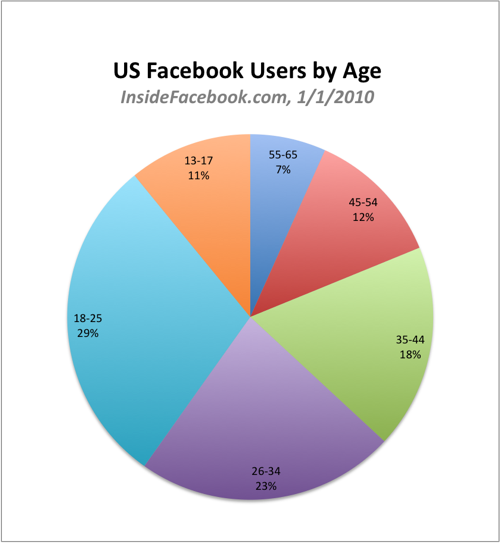
Not everyone is with me here, though … as I am repeatedly reminded. There are tons of people my age who remain as uninterested in online social networking as I once was, and totally stay away from such activity. In fact, I may be the oldest person among my (as of today) 657 followers on Twitter and my 107 friends on Facebook. Earlier this year, I learned that just 7% of all Facebook users are in the 55-65 age bracket (see graph).
So, it would appear that my level of online activity just might put me in the top few percent, or even fraction of one percent, of my contemporaries in terms of social-media savvy.
Apparently, I’m not alone in recognizing my relative uniqueness.
Last weekend was the 45-year reunion of my high school class (in Rice Lake, Wisconsin). I did not attend the gathering because of its rather inconvenient timing (this was the first time we’ve ever held a reunion other than in the summer months). However, I still happened to play a part in the events of last Saturday evening. During the MC’d program after dinner, it was proposed that a class website be set up as we all do the five-year countdown toward our 50th (gasp!) reunion in 2015. One former classmate suggested that the best person for the job would be ME, and, by acclamation, I was elected to make such magic happen.
Hence, being so honored (?), I wrote a few emails, tried to figure out what the heck the expectations were, and just generally spent some time figuring out what we (that is, I) might do.
My decision, supported by those I’ve consulted with, was to construct a group for us all on Facebook, using their just-released (four days ago) “new groups” feature. It is now up and running. (I don’t waste time: give me an assignment, and I do it!) Two days ago I sent out an email to everyone (who submitted an email address to our reunion organizers) announcing the availability of the new group (with some simple instructions about joining Facebook). Right now, we have thirteen members. (I think we have about 200 surviving classmates at this time.)
So, now there’s a small core of us waiting to see how many former classmates will join us in this social network. (I think it would be nice, perhaps amazing, if this experiment actually works!)
Soundtrack Suggestion
When I think back on all the crap I’ve learned in high school
It’s a wonder I can think at all…
(“Kodachrome” – Simon & Garfunkel)
Update on October 11, 2010:
I should acknowledge…
Of course, the title of this entry is somewhat a rip-off of the title of the 1976 book What Really Happened to the Class of ’65? by Michael Medved and David Wallechinsky.
My Online Life
