Maximum Multiplicity
On an episode of the TV program Curb Your Enthusiasm (HBO) I watched recently, Larry David took off on one of his famous stream-of-consciousness digressions – this time about his preference and tendency to use stalls, rather than urinals, when visiting public restrooms.
Interestingly enough (or maybe not), his admission stimulated some electrical impulses and activity in my warped brain that led me to think of Hund’s Rule of Maximum Multiplicity – a topic you must remember from general chemistry class. Of course, this postulate is often referred to as “the bus-seat rule.”
Hund’s Rule describes the process of populating atomic orbitals with electrons – specifically the way those electrons are arranged – as atomic number increases. Quite simply, the rule stipulates that if two electrons have two spaces (i.e., orbitals) to occupy, then they would rather occupy one orbital each rather than “pair up” and occupy just one orbital.
So, for example, take the case of the element Boron which has three “p” orbitals but just one electron in that particular energy level. For argument’s sake, let’s say that that lone electron occupies the p(x) orbital. The next element on the periodic table, Carbon, has the same number of p orbitals (but one more electron than Boron) with one electron in each of the p(x) and p(y) orbitals. And Nitrogen, the next element in line, has three electrons in this energy level, one in each of the p(x), p(y), and p(z) orbitals. Can you visualize this at all? Electrons are distributing themselves among the p orbitals much as passengers on a bus: nobody sits next to someone else unless and until they really have to. So, in the case of Oxygen, yet the next element under consideration, the configuration would have two electrons in p(x) and one each in the other two orbitals. (The two electrons in p(x) are said to be a “lone pair.”)
So, you’re probably wondering where I’m going with this? (If you’re still reading, that is). What does Larry David’s use of stalls have to do with Hund’s Rule and electrons?
Well, actually, hardly anything. It’s just that I’ve been thinking about bathroom behavior myself (remember I’m talkin’ Larry David not Larry Craig kinda stuff here!)…given that last summer, in some of the buildings on campus, new urinals were installed. Our urinals are supposedly the latest in “green” technology – as they are waterless devices that don’t use H2O to flush with. They actually don’t flush: all in all, not a bad idea to conserve water, and the campus is making points in the community for its conservation efforts.
The thing is, the urinals have been installed with no privacy dividers between them. When you’re standing there doing your business, it’s sort of like lining up at a public trough. And, for me, that’s not the most comfortable situation in the world. What’s the deal here, anyway? We’re already conserving 2.5 million gallons of water per year (!) …do we really have to give up our privacy rights too?
So: this is where the bus-seat rule comes into play. With no dividers between the urinals (hence no privacy) and, I think, many of us modern men having similar reservations about the public-trough concept, what we do is situate ourselves as far apart as possible when we’re in the restroom doing our thing. For example, I’ll walk in and I’m the only one in there. I’ll take the urinal that’s next to the partition separating the sink and the urinal sections. The next guy comes in and will take the urinal that’s tenth (out of ten) in line…around the corner a little bit. If a third person comes in, he’ll take one of the urinals approximately midway between us. And so on.
Given this, doesn’t it seem that our bathroom behavior is a little like seating on a bus or electrons in orbitals? Or, I guess, even other types of human behavior. For example, a blogger named Vishy, in a post from early 2005, observed that Hund’s Rule can also apply to seating ourselves in a cafeteria or taking the elevator.
Not that keeping your distance from others is such a bad thing. Sometimes there are certain activities that are just plain better when performed alone. Hund tells us that the pairing of electrons is an unfavorable process where energy must be expended in order to make it occur. I suggest that the closeness of humans, in some situations, is not the greatest of things either… with there being energetic, emotional and social barriers to making it (i.e., the closeness) happen.
Me? I support the practice of privacy dividers in our public restrooms or, in their absence, maximum multiplicity.
The Liddypudlians

A couple of months ago I wrote about the one “day off” I had during the whole change-your-life kinda summer that 2007 provided me. On that day (June 30), in Eugene, I wandered about Saturday Market and ended up at the stage area listening to a local musician sing the entire Beatles Abbey Road album from start to finish…while accompanying himself on the ukulele!
What a tremendous treat that was!
And, what a totally Eugene, at-home-like experience that turned out to be.
Given my subsequent move to a new and totally unfamiliar part of the world, I have been asking myself: when am I ever going to be able to replicate that kind of feeling again? Will I ever be “at home” again? And also: when will I ever hear live Beatles music again?!
Well, as it turns out, I didn’t have that long to wait. (At least for the answer to that last question…)

Last Sunday, the little hippie-dippie Marin County town of Fairfax held its second annual Town-Wide Picnic at the local ball field. Now, I didn’t really plan to attend. In fact, I was absolutely oblivious to the fact that this thing was happening at all until, on a whim, I decided to visit Fairfax that afternoon simply to check out a nearby place with a Eugene-like (read: “liberal” or “tie-dye”) kind of reputation.
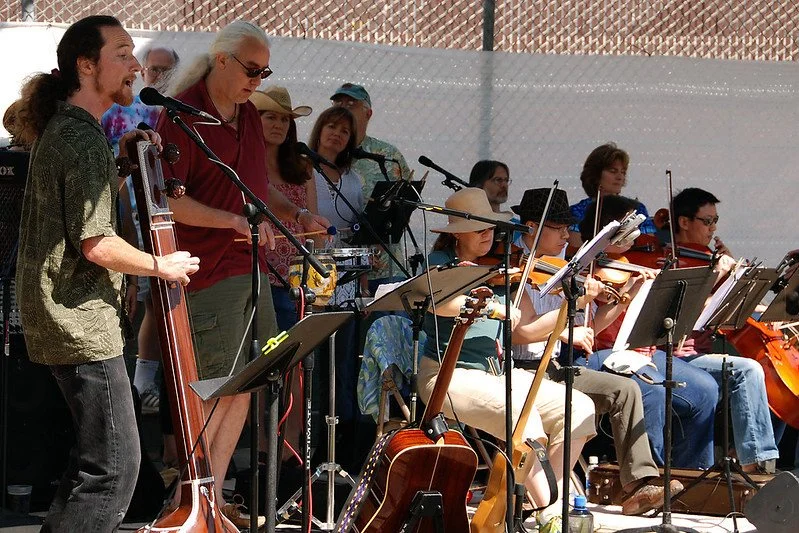
As I was walking around, I noticed posters in a couple of windows advertising the event (that was supposed to be happening at that very moment) and, at first, all I could think of was “where’s the ball field?” Well, given that this is an extremely tiny place, it didn’t take long to find out. (I simply followed the foot traffic!) Of course, I was initially a little reluctant to join in the festivities, given that it’s a very small town and I’d be gate-crashing their party. But the thing that helped me overcome my hesitancy was the Beatles music coming from the stage. A group called “The Liddypudlians” was up there churning out some great stuff!
The band was 26 members strong…yes, I needed to count them! There were several (rotating) lead vocalists, lead and rhythm guitars, drums, a chorus -- as well as horn, string, and woodwind sections. This was an orchestra that reproduced Beatles songs quite faithfully -- meticulously consistent with any studio-produced Beatles-album track.
I sat on the lawn, soaked up the sun, and enjoyed three sets of live Beatles tunes for just over three hours. I loved this group!
For a little while there, I almost felt like I was home.
You Can Observe A Lot Just By Watching
It was exactly two months ago today, July 2, that I arrived here in California to take possession of my apartment in Larkspur. I started packing up my boxes for this latest move the first week of June, and have been basically living from cardboard containers ever since…until last weekend, that is. I have finally unpacked the last of my things, put the artwork up on the walls, and reorganized my rented storage area. And I’ve had the apartment thoroughly cleaned by my new housekeeper for the first time. As of now, I’m officially “moved-in.”
I would like to say that I’m “settled” (as in: “Jim, are you all settled in yet?”), but that’s not really the case. There has been too much stress associated with moving to a different state and taking on a new, high-stress job to (in all honesty) say that I’m settled. But, being unpacked and moved in feels like good progress along that path, I must admit.
To be “settled,” I think I need a little more time to adjust culturally. The change I’m experiencing by moving from an ultra-conservative, economically-depressed community in southern Oregon to a liberal county with the highest per-capita income in the U.S. has been mind-blowing, to say the least.
And that’s not to say I’m not enjoying it here. Because I am. Believe me, living in a place that is on the liberal cutting-edge is quite refreshing. What an incredible relief that I’ve found my way here!
But I experience a good deal of preoccupation, and some degree of angst, about how different this place is, too. For one, I am continually reminded of the high cost of living: everything costs more here, and sometimes it’s way more expensive. Just this morning I went to the nearest car wash, for example, and paid $19.99 for the most basic service they offer. In Eugene, at what I think is the most pricey car wash in the city, the cost is less than half of what I just coughed up today.
And, of course, it’s the first of the month and I just wrote out another rent check. It’s a good thing I finally received a full-month’s pay: my rent is roughly two and a half times of what it was last year. Really, I can’t think of one thing that costs less here.
Additionally, one of the most interesting things that has been on my mind in the last few weeks, as I’ve been looking around trying to pay attention to my surroundings, is my perception that the residents of Marin County are a considerably better-looking lot than I’ve been around in recent times. I started out by noticing the much larger number of people sporting sun tans than are evident in rainy, cloudy, cooler Oregon. And then, as I kept reminding myself that “you can observe a lot just by watching,” I noticed that it wasn’t only the tans, it’s that people seem to look more attractive, more together, and just plain healthier here. For example, it’s my perception that there are significantly fewer obese folks around me now than there have been during the last few years.
So, it was with great interest that last Thursday I came across an MSNBC article that suggests ZIP codes are surprisingly accurate predictors of obesity. As I was able to learn, “in a study published in the September issue of the journal Social Science & Medicine, University of Washington researchers found that adults living in ZIP codes with the highest property values were the slimmest, and those living in ZIP codes with the lowest property values were the fattest.” The data presented in this study are entirely consistent with my informal, non-scientific observations of Marin County residents. With property values here that are literally off-the-charts, according to the UW research people here should be slim(mer). And they are.
My one last observation (for today, anyway) about the culture here is that the attitudes of Marin County residents tend toward elitism, entitlement & privilege. My opinion is that these Mariners know they live in an enchanted place among the rich and beautiful…and somehow these conditions give them a rather special place in society. It’s not really anything specific that anybody says…it’s just that the sense of entitlement here is palpable.
I imagine that once I’m more accepting (i.e., less judgmental) of the cultural values I’m discovering, then I’ll consider myself more “settled.”
May 4th