

Meditations on Time
Here I am, at age 78, seemingly surrounded by stories about time. These stories naturally have a way of turning my thoughts toward how short my own time may be.
I just reread a novel in which every adult on the planet receives a box containing a string that reveals exactly how long they will live. And I’m recalling the television comedy about a moral accounting system that tracks a person’s life here on Earth. Finally, there’s the recent film that imagines we get to choose the precise form our eternity will take.
I did not set out to braid these snippets of our popular culture together. They braided themselves. At this age, time insists on being the subject.
The reminders are constant. Obituary columns, for one. My personal calendar, for another, which now includes far more medical appointments than it once did. Routine blood work. MRI, CT and DEXA scans. Follow-ups, with each visit carrying the distinct possibility that this will be the one where the doctor pauses too long before speaking. Most of the time the news is ordinary. “See you in six months.” But the suspense never quite disappears.
In Nikki Erlick’s 2022 novel The Measure, a mid-life character suggests that a string long enough to reach age eighty would count as good news. When I read that passage, I felt a small jolt. Eighty no longer feels like a distant horizon. It is a number that is uncomfortably close.
If I opened my box today, I would automatically have a long string. The real question would be: how much longer? A year? Five years? Ten? More? Though If I died today, surely no one would lament that I was gone before my time.
All of which leads to other concerns. How many more years would I want if they are shadowed by increasing pain — or other physical or mental decline? Longevity, at this stage, is not automatically the goal. There are conditions.
The Good Place, the four-season television series originally airing on NBC (and now available on Peacock), begins with a moral scoring system; every human action or interaction earns positive or negative points. An endless array of cosmic accountants supposedly keeps track of these tallies someplace up there in the sky, and when you die your final count decides your destiny. It is morality, and judgment day, rendered as a dispassionate spreadsheet.
At 78, that premise feels less like satire and more like a quiet audit. I find myself reviewing my own ledger. Have I been good? Not necessarily accomplished. Nor productive. But good?

My entries must be mixed. I have lived and loved imperfectly. I have hurt people I did not intend to hurt. There are relationships that did not endure. Some ended gently. Others did not. Even now there is sadness attached to those chapters, a sense that certain conversations might have gone differently if I had been wiser, braver or simply more skilled.
I sometimes wonder whether those endings count against me, or whether they merely show that I kept trying to connect and sometimes failed.
The show ultimately dismantles its point system, though. Life, it suggests, is far too entangled for simple math. Growth matters more than totals; it matters more than being flawless.
What lingers for me now is the series’ ending. Even paradise becomes hollow if it stretches on forever. In the final season, the characters are offered an exit. They step through one last door when they feel complete. Eternity with no ending, the show suggests, flattens meaning.
So, I wonder: How, ultimately, will I measure my existence? Will there ever be a time when will I feel complete?
Those questions followed me into the 2025 film Eternity, now on Apple TV, where humanity is invited to choose the form one’s forever will take. The idea sounds appealing at first. Pick your paradise. A tropical beach, for example. Perfect weather. Endless calm.
But what would that mean after a thousand years? Ten thousand? How could any single scene, no matter how beautiful, sustain significance without limit? Without scarcity?
Part of what makes a late-life conversation more vivid is precisely that it may not be repeated endlessly. Scarcity is what gives weight to life’s ordinary moments.
If I knew the precise length of my string, maybe I would live differently. I might rush to repair what remains frayed. Or I might grow cautious, conserving energy. Uncertainty leaves me in between. Aware of the limit, but not of its measure. Isn’t it that uncertainty that keeps life from becoming either frantic or complacent?
If there is a ledger somewhere, I hope it records effort. That it shows I kept revising myself. That I tried to mend what I could. That I did not stop growing simply because the horizon drew closer.
I am not eager to open the box. And I am not certain I want a tropical eternity with no horizon. I only know that the ticking is audible now. Doctor visits. Quiet evenings. Old relationships to ponder. Meditations on time.
Age 78. Still adding to the ledger.
Poetry Selection: The Summer Day
Who made the world?
Who made the swan, and the black bear?
Who made the grasshopper?
This grasshopper, I mean —
the one who has flung herself out of the grass,
the one who is eating sugar out of my hand,
who is moving her jaws back and forth instead of up and down —
who is gazing around with her enormous and complicated eyes.
Now she lifts her pale forearms and thoroughly washes her face.
Now she snaps her wings open, and floats away.
I don't know exactly what a prayer is.
I do know how to pay attention, how to fall down
into the grass, how to kneel down in the grass,
how to be idle and blessed, how to stroll through the fields,
which is what I have been doing all day.
Tell me, what else should I have done?
Doesn't everything die at last, and too soon?
Tell me, what is it you plan to do
with your one wild and precious life?
-Mary Oliver
A Big Bold Beautiful Journey

I went into A Big Bold Beautiful Journey (2025), recently made available on Netflix, with absolutely no sense of the storyline. Sometimes that’s the best way to encounter a film. With no expectations to manage and no trailer logic to undo, you’re free to simply watch and see what happens. What I found was a fantasy-based romantic comedy that takes itself rather seriously at times, moves at its own pace, and ends up having more to say than I expected. I recommend it.
The film opens at a generically named “Car Rental Agency,” where David (Colin Farrell) encounters two unusually quirky employees, Kevin Kline as the Mechanic and Phoebe Waller-Bridge as the Cashier. David is on his way to a friend’s wedding. The car he rents, a 1994 Saturn SL, comes equipped with a GPS unit that quickly establishes itself as a character in the story.
At the wedding, David locks eyes with Sarah (Margot Robbie), and the two engage in flirtatious, slightly offbeat banter at the reception. At one point, Sarah semi-seriously asks David to marry her, a moment that clearly unsettles him. What is he to make of this unconventional woman? When Sarah then asks him to dance, he declines. Later, she leaves with another man.
Driving home, the GPS asks David if he’d like to go on a big, bold, beautiful journey. He agrees, and with that, the film’s fantasy premise is underway. David is soon instructed to take the next exit and order a fast-food cheeseburger. Inside the restaurant, he discovers Sarah, also eating a cheeseburger. When they leave, Sarah’s car, another Saturn from the same rental company, refuses to start, and David’s GPS instructs him to offer her a ride. She accepts, and the two begin sharing the rest of the drive home.
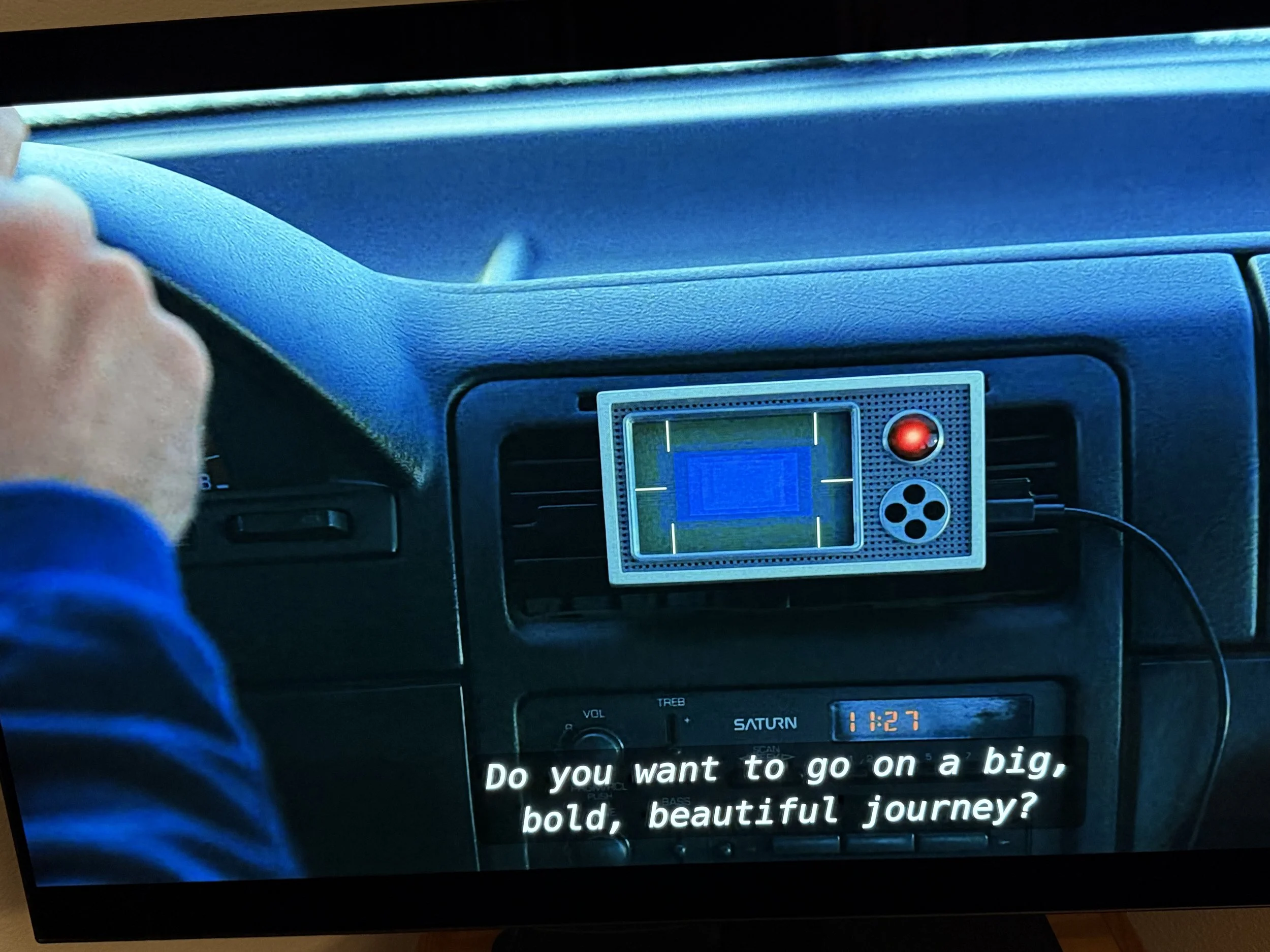
From there, the film settles into its central rhythm. The GPS directs David and Sarah to a series of roadside stops that turn out to be doors, both literal and metaphorical. Behind each door lies not so much a place as a moment in time. These episodes are drawn from the characters’ pasts, and what’s striking is how matter-of-factly they accept what’s happening. There is only a modicum of astonishment. David and Sarah step into these moments as if the past were still physically present, waiting to be revisited.
One door, for example, takes them to David’s high school on the night he is starring in the class musical, How to Succeed in Business Without Really Trying. He plays the lead role of J. Pierrepont Finch, with Sarah and his parents watching from the audience. During the show, David relives a painful romantic rejection, confessing his feelings to a costar offstage and then, in an impulsive moment, temporarily derailing the production by confronting her onstage with blunt observations about the life she will go on to lead.
In a later scene, they stop at a decaying roadside billboard with an opening that leads into a café. Inside, two conversations unfold at once. David’s former fiancée presses him for an explanation about the end of their engagement, while Sarah revisits the collapse of a relationship with a former boyfriend. Eventually, the two conversations merge, with all four characters seated at the same table. David and Sarah are given an unusually revealing view of how each has behaved in earlier relationships, and both are forced to acknowledge their own intimacy issues.
By this point, it’s very clear that this big, bold, beautiful journey is less about time travel than about self-examination. As David and Sarah move through these episodes together, the focus remains on how they respond to what they learn about one another. They watch. They ask important questions. They engage in remarkable amounts of self-disclosure. The film allows these moments to unfold slowly. The pace worked for me, though I can see why others might find it trying. This is not a movie in a hurry.
What the film seems most interested in is not whether David and Sarah will end up together, but what it means for two people to really see one another. By the time you’ve lived a while, introductions are never clean. Everyone arrives with baggage, earlier versions of themselves still visible around the edges. A Big Bold Beautiful Journey makes that idea concrete, and in doing so, captures something emotionally recognizable.
I was willing to go along with the unlikely premise and the deliberate pacing largely because the performances are so grounded. The connection between Farrell and Robbie builds through pauses, glances, shared silences and, often, moments of unusually deep honesty. That connection feels earned, not manufactured.

What stayed with me afterward was not a particular scene or line of dialogue, but the film’s underlying suggestion that not every meaningful encounter has to resolve into something permanent. Some meetings matter because they clarify where you are, or because they briefly align two lives that have been moving along separate tracks. That idea resonated with me more than any conventional romantic payoff might have.
Not everyone will be taken with this film. It asks for patience and a tolerance for ambiguity. It treats human connection as something provisional and fragile, shaped by timing and circumstance, and often understood only in retrospect.
By the end, A Big Bold Beautiful Journey felt less like a romance than a meditation on how lives intersect, diverge, and occasionally overlap just long enough to matter. For me, that made the journey worth taking.
Soundtrack Suggestion
When people keep repeating
That you’ll never fall in love
When everybody keeps retreating
But you can’t seem to get enough
When tragedy befalls you
Don’t let it drag you down
Love can cure your problems
You’re so lucky I’m around
Let my love open the door
Let my love open the door
Let my love open the door
To your heart
(“Let My Love Open the Door” — Pete Townshend)
Dear Peter
Peter Yarrow, of Peter, Paul & Mary fame, is currently battling cancer and nearing the end of his days. His daughter, Bethany, has put together a “Peter Yarrow Living Tribute” page online at https://www.peteryarrow.net. (Contributions to this page can be submitted at https://tinyurl.com/y26rfxv2.)
Here is the message I sent to Peter yesterday.
- - - - -
Dear Peter –
We have met on two occasions, but you have meant so much more to me than a couple of brief encounters. Here are just a few thoughts before you go…

In the early morning hours of December 18, 1969, as I was experiencing a relationship trauma, I needed an escape from my current situation, and as I got into my car, the radio came on to the gentle, unmistakable opening chords of “Leaving on a Jet Plane” – “All my bags are packed…” In the ten thousand times I’ve heard that song since, I’ve always been reminded of the strains of Peter, Paul & Mary during that cold winter morning in northern Wisconsin. And how meaningful those John Denver lyrics were for me at that point.
In November of 1988, when I was on a business trip, I went into an art shop in Lexington, Kentucky, and found a poster with a black & white 1964 photo, by John C Desaint, of John, Paul, George & Ringo; Peter, Paul & Mary; and Ed Sullivan (see below). I just had to have it. I gently carried this incredible find back home to Oregon, had the print framed, and it’s been on display in every place I’ve call home since. You were my favorite artists – the Beatles providing the pop, and PP&M the folk - for the soundtrack to my high school and college years.
On February 9, 1991, I attended a Peter, Paul & Mary concert (the only time I saw you together) at the Indiana University Auditorium in Bloomington. This was at the beginning of the first Gulf War. You, personally, invited any of us in attendance to get together with you after the concert to talk about current events, and I was in that very small group who was there. (Of the 3,200 at the concert, only about 20 of us hung around to talk with you.) I’m sure you don’t remember me from this event, but I remember that evening very clearly. Among the topics were the morality of that specific conflict. And all war. You were so very gentle, kind, informed and articulate. Just as I had imagined you.
On May 21, 2019, I was the event photographer at Linda Carroll’s house when you performed as a benefit for your new non-profit. Before dinner, you graciously posed with each of the attendees so that they could have a remembrance of that night. You worked with me via mail and email to personally sign all the prints so that I could then distribute them. You were really great to work with, and even signed multiple prints for me and my date, Gwendolyn. A signed 8x10 hangs in my living room right now; and it always will. I have since been able to brag that Peter Yarrow’s contact info is in my phone.
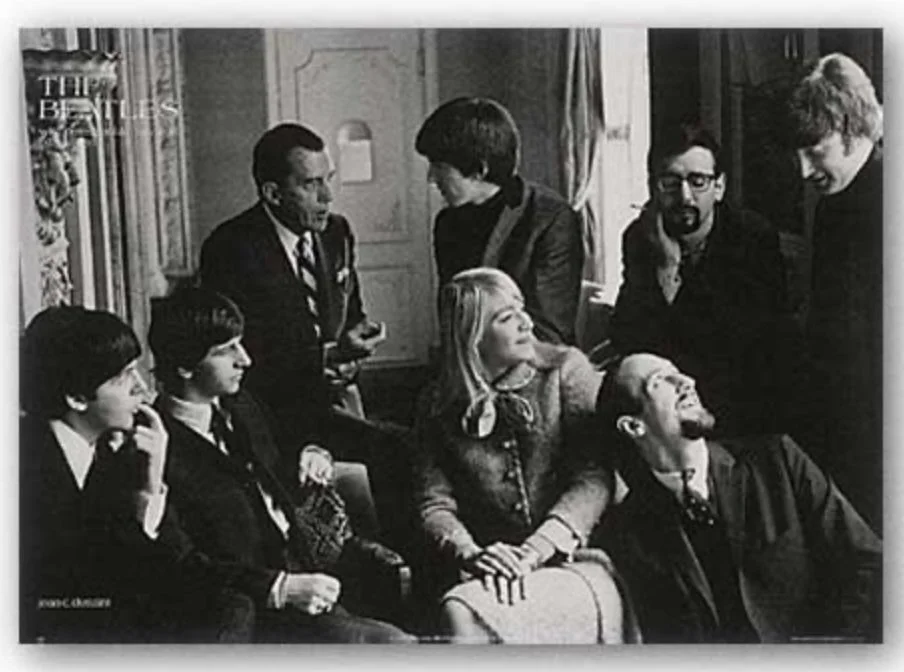
The Beatles; Peter, Paul & Mary; Ed Sullivan - by John C Desaint (1964)
Gwen and I sat in the front row of the folks gathered in Linda and Tim’s living room that night. A special and enduring memory of the occasion happened when you approached Gwen, sitting at the end of the row, and sang most of one verse of “Puff, the Magic Dragon” directly to her.
Peter, you have meant so much to so many. From the bottom of my heart, thank you for living the life you have. I’m glad our paths crossed.
Blessings…
- - - - -
Soundtrack Suggestion
Where have all the flowers gone?
Long time passing
Where have all the flowers gone?
Long time ago
Where have all the flowers gone?
Young girls have picked them, every one
Oh, when will they ever learn?
Oh, when will they ever learn?
(“Where Have All the Flowers Gone” – Pete Seeger)
Update on January 7, 2025:
Sadly, Peter died today. Here is the New York Times obituary.
A Swift Conversion
It would seem I’m in love again. Well, sorta, anyway. No, I don’t have another significant-other in my life. I don’t know if that will ever happen again. As it turns out, I have recently become rather taken with a young female pop star.
Nope, it’s not Billie Eilish. And I said pop star, so no, it’s not Caitlin Clark either. But both of those would be rather good guesses, as I have, of late, become fans of both.
Perhaps you’ve heard of my new interest: Taylor Swift. Ring a bell? Anybody? Well, I suspect you have, so here’s a little bit of the story.

It wasn’t more that maybe four or five months ago that I mentioned to a friend that this Taylor Swift person sure is in the news a lot these days. I had become more and more aware of her with the furor over The Eras Tour. And of course, this was during the NFL season, so Ms. Swift’s involvement with Kansas City Chiefs’ Travis Kelce was generating quite the buzz. Still, I confessed, despite the apparent fame and fortune of this very popular musician, I could not name even one song of hers. Well, my friend is a grandmother of two pre-adolescent girls so is slightly more contemporary-pop-culture aware than I am in this regard; she indicated that she knew one song: “Shake it Off.” So, for the first time, I watched the music video of that song, and said, “yeah, I guess that’s rather cute.” (It was very well produced, I do admit.)
And then, I went on about my life.
Subsequently, of course, there was all the news about Kansas City getting into the Super Bowl and would Taylor Swift be able to make it to the game, given that she was performing a concert in Japan the night before? Such controversy: holy crap! Well, of course, you probably know that not only did she make it to the game (the perks of having a private jet!), but the Chiefs beat the 49ers in overtime – and the game was watched by an increasingly large female TV audience hoping to catch a glimpse of Taylor in her private stadium suite.
Still, I was amused, but rather unmoved.

But then, things took a turn. At some point a few days ago, someone (sorry, I don’t recall who) on Facebook posted a link to a NPR Tiny Desk Concert. And I watched. This session was recorded over four years ago, in October 2019: showcasing a slightly-younger Taylor (can I now call you by your first name?), without the frills of a music video or the glitter while playing to an arena of tens-of-thousands. She played four tunes as, she said, “how the songs sounded when I first wrote them” (i.e, acoustic versions, two on guitar, two on piano). I had never heard these tunes before, of course, though it now seems obvious, given some further research, that most of the rest of the civilized world has. In the comments section, a 70-year-old guy from Oregon (not me) wrote, “I now see the appeal, the truly evident talent and most of all… the genuineness of her personality, and the deservedness of the accolades she has garnered.”
What especially caught my attention was the final song she performed, entitled, “All Too Well.” Right away, it became obvious that this was what could be definitively called a “breakup song.” Arggghhhhh! It totally socked me in the gut. And I immediately agreed with the person in the comments section, as I said to myself, “ah, now I get it.” She is a truly engaging as a person and writes lyrics that speak deeply to the human experience. No wonder she has the immense following she enjoys.
I love you, Taylor. (Call me.)
(And I still cannot name a single Beyoncé song. Sorry ‘bout that.)
Here is today’s Soundtrack Suggestion:
The Only Winning Move
“A strange game. The only winning move is not to play.” [The WOPR computer at the conclusion of “War Games” (1983).]

“War Games” is a 1983 movie starring Matthew Broderick, Ally Sheedy, John Wood and Dabney Coleman. I fell in love with this film the first time I saw it, at the State Theater in downtown Corvallis, during the first week of its release. A friend of mine had dropped by my apartment and said, “let’s go see ‘War Games’.” I hadn’t heard of it, but I said, “sure, ok.” (1983 is a couple of years before I first touched the keyboard and mouse of an Apple Macintosh, but I was, perhaps, influenced by this film, in the direction of my now long-time interest in computers.)
This is the story of a high school student, David Lightman (a stunningly-young Matthew Broderick, pre-Ferris-Bueller), an intelligent, but somewhat-naïve, underachiever with an interest in computers and computer games. He gets caught up in a dramatic, but mostly-unrealistic, scenario whereby he almost causes the end of the world by initiating WW III. The primary setting is Seattle, WA.
I watched this movie again this week (now available on Max) for maybe the tenth or fifteenth time. I think it’s totally fascinating to see the world portrayed as it existed in the Cold War era, before September 11th, and prior to the technology that we all now take for granted. How did we even exist in the pre-internet era of floppy discs and dime-eating pay phones!?
In search of the latest computer game by an outfit called ProtoVision, David searches for all the phone-modem-equipped computers in Sunnyvale, CA, and stumbles upon a Defense-Department machine called the WOPR (“War Operation Plan Response” – it’s pronounced like the Burger King sandwich, “whopper”). He ultimately finds a way into this machine via a back-door password left there by the original designer. The WOPR believes, therefore, that David is “Professor Falken,” its creator. Now posing as the Professor, he finds the game programs on this machine and elects to play, not chess, not poker, but rather something called “Global Thermonuclear War.” David chooses the side of the USSR in the conflict and initiates a nuclear strike on the US.
