

Teller’s Tale
Teller, simply, didn’t know what to do.
His life, it seemed, was at an impasse. Any way he turned seemed to be a dead end. Most days, he felt as if he were living a work of fiction: more specifically, as a character in a tepid novel written with little sense of direction or plot. Certainly, the ridiculous nature of his existence couldn’t be real. How, he often asked himself, could this possibly be my life?

Teller identified a lot with the character of Harold Crick in the recent movie Stranger Than Fiction: a person whose moments in life, the significant and mundane ones, were all but indistinguishable. Teller existed, in recent times, within a narrow range of experience from neutral to negative. If this were an actual life he was engaged in, surely it belonged to someone else.
Surely it must.
Because: here he was, this year, at Cascadia College, located in a little town in southern Cascadia. How did this happen? It was absurd, really. Yes, everything about his existence at this point was absurd. That plainly was the word for it.
Even the name of the college, Cascadia, was just too weird. This was what the campus in Bernard Malamud’s 1961 novel, A New Life, was called. In that story, a professor (Samuel Levin, steeped in the liberal arts) finds himself teaching at the fictional Cascadia, an agricultural college with traditions much different than he was accustomed to. Struggling to overcome past adversities, Levin relocates and takes the teaching job in a far-off place in an attempt to start his life over. It is a place so foreign, however, that Levin finds he must have been attracted to a mirage. His struggles, not unpredictably, continue on. You can run, as they say, but you cannot hide.
So, here he, Teller, was. He was trying mightily, after a couple of job losses, to put his life in order. Unlike Levin, though, he was not a teacher (any longer). He was now an academic administrator, and held the position of Dean of Faculty at the real-life Cascadia College. A small campus in an isolated, rural setting. A place so entirely different that his past experiences had ill-prepared him for what he found. Teller had earned his doctorate at a big-time Big Ten campus of over 35,000 students. And now, here he was, attempting to function in a place where the entire little city barely scratched the 20,000 mark, with no diversity to speak of at all. This was not a college town. The place felt stiflingly-small and claustrophobic. And amazingly conservative.
Further, the college was in a condition that he had not really appreciated.
From the start, he found his administrative peers friendly enough people. They weren’t really bad folks. But, too, Teller wasn’t sure they were the right ones to actually run a college. Teller found he did not fit so well with them. So he spent as much time as he could amongst his “own kind” … i.e., the faculty. Teller’s span of control was fairly wide-reaching on campus; he lived with the humanities folks (that’s where his office was located), but was in charge of all the liberal arts and sciences. These people were the ones who not only intellectually engaged him, but also shared their stories and lives with him.
Sure, Teller found that there were some good aspects to all that sharing. He was, after all, able to talk with them about a wide range of topics: reactions and replication; reading and reasoning; rocks and rhymes; language and logic; peace, prose and philosophy; equations and equality; literature and liberals; Iraq and irony; politics and pooh-bahs. But mostly what everyone talked about (at least with Teller) was how to cope: namely, how to manage their lives given the massive number of changes the college had undergone in the last few years, including several presidents, leadership styles, and unclear expectations.
The net effect of all that change, Teller discovered, was that most everyone was off-center most all the time. And there was little trust, might say none, between the faculty and administration. Teller, of course, as the Dean, lived his professional life at the intersection of faculty and administration and their issues. So, if the conflict on campus were the Gunfight at the OK Corral, then Teller was in the crossfire. It didn’t take long before he found himself gravely wounded.
Totally dismayed at the current state of the campus, and while expending inordinate amounts of energy to keep from being injured any further, Teller concluded that there simply was no way to live in between these two warring groups. Although he believed himself to be the consummate diplomat, none of the gunslingers involved in this fight seemed to be much interested in letting their weapons cool and engage in team- or trust-building.
Teller, simply, didn’t know what to do.
Listening & Leadership
Inspired by NPR’s This I Believe series...
I believe in listening. And in leadership. And that the two go hand-in-hand.
In the past two years, I have been in leadership positions that more directly affect the lives of people I work with than I ever have been before. While I’ve long seen myself as a student of leadership and organizational culture, and have led countless groups while working on specific tasks and projects, lately I’ve been called upon to provide direction, vision, and a voice for a large collection of other people on a day-to-day basis. It’s been a period to put my values regarding listening and leadership to a real test.
For I believe that effective leaders should listen to those they are charged to lead. All too often, I see leaders who seem to be “know-it-alls” or “fixers”: individuals who only listen to their constituents long enough to have a reply or “the solution” at the ready before the other is even finished talking. This kind of behavior is extremely off-putting. Who wants to be around somebody like that?
And I believe that listening demonstrates our respect, valuing and trust of others. For leaders to earn respect, they must show respect. So I believe that true, just shut-up-and-sit-there, good old non-judgmental listening is the primary way to do that. Trust and respect just naturally flow from good listening.
I have a dramatic personal experience illustrating when, as one being led, I was not listened to. A couple of years ago, with the most honorable of intentions, I was attempting to speak to the CEO of an organization on behalf of a group of employees; at one point in my report, I was rudely interrupted and informed the information I was sharing was not welcome or appropriate…that everything in the organization was, now, as “good as it gets.” It’s difficult to convey the intensity of that episode in this brief description but, I was, in essence, verbally and emotionally assassinated in public for attempting to express the “sense of the group.” For me, it was the single most appalling example of “leadership” that I had ever witnessed. I left the experience embarrassed, hurt and angry. And, forever, unable to respect the “leader” any more.
I run my show a lot differently. A LOT DIFFERENTLY. I believe in the power of stories, and love listening to them. I encourage my folks to come in, sit down, and tell me what’s going on in their lives. I listen. Because I care. And, I because I respect the variety of the human experience. That is, I respect them. I appreciate everything everyone does on behalf of the organization, and, after I have listened to them and their issues, I frequently advise them to pace themselves and to stay healthy. We’re all in this together, and we must take care of ourselves and trust each other along the way, or bad stuff will happen. Of course, bad stuff will happen anyway, but we’re much better equipped to handle those times if we tackle problems as part of a trusting team, rather than a stray collection of individuals who happen to share the same organizational space for a part of our lives.
Leaders. Followers. Everyone. Believe in this.
And listen…
The people who come to see us bring us their stories. They hope they tell them well enough so that we understand the truth of their lives. They hope we know how to interpret their stories correctly. We have to remember that what we hear is their story. (Robert Coles in The Call of Stories, p. 7).
May 4th

On April 30, 1970, President Richard Nixon announced to a national television audience that he was ordering troops into Cambodia. Although the stated purpose of this so-called “incursion” was to hasten an end to the ongoing slaughter in Vietnam, many Americans, myself included, thought this a wholly-unwarranted expansion of the war effort.
I was in the last semester of my undergraduate college days at this time: politically-active and fervently anti-war. I had received a draft notice in June of 1969 and spent 22 days in the Air Force until a chronic knee condition led to a medical discharge. Although I was (because of my discharge) no longer at risk of losing my life to this insane activity, I had spent four long college years with the specter of the military draft – and the prospect of a gruesome, lonely death in a jungle a million miles away from home. For me, the war was personal.
Richard Nixon had been elected, at least in part, on the basis of his “secret plan” to end the war. Yet, here he was, less than two years later, ordering an obvious escalation.
I was pissed. I remember spending the remainder of the evening after Nixon’s speech composing a letter to the editor of my local newspaper. My writing skills were not too finely developed then and my letter was not the most eloquent piece of prose. But what I lacked in style, I hope I made up for in passion: Nixon was wrong. He was a madman. He had to go. The war must end.
Many, many people agreed with me. Unrest on the nation’s campuses, especially, took a dramatic turn. On May 4, 1970, my letter was published in the Eau Claire (WI) Leader-Telegram, the same day that four full-time college students (Allison Krause, Jeffrey Miller, Sandra Scheuer and William Schroeder) at Kent State University were gunned down by Ohio National Guard troops on their own campus. Another nine students (Joseph Lewis, John Cleary, Thomas Grace, Robbie Stamps, Donald Scott MacKenzie, Alan Canfora, Douglas Wrentmore, James Russell and Dean Kahler) were wounded; one was paralyzed for life, the others seriously maimed.
The students of the University of Wisconsin - Eau Claire, in the days immediately following the Kent State massacre, rallied. I, for one, picketed the Science building where I had spent the majority of my time as a chemistry student. On May 6th we held a campus-wide protest, gathering on the lawn right outside the student union building. And we planted four trees in memory of the dead in Ohio. The plaque from that memorial service is still there today, as are three of the four original trees.
May 4, 1970, was thirty-six years ago. On this day, today, let us not forget the madness that can afflict us as a nation.
Let us also not forget that we always have a voice. Let’s remember that protest can lead to change. We must know that when we perceive injustice in the world, we can stand, march, shout and be heard. We can make a difference.
Thought for the day: We have the ability to put an end to the killing. All it takes is the will.
Soundtrack Suggestion
Tin soldiers and Nixon coming,
We’re finally on our own.
This summer I hear the drumming,
Four dead in Ohio.
Gotta get down to it
Soldiers are gunning us down
Should have been done long ago.
What if you knew her
And found her dead on the ground
How can you run when you know?
Gotta get down to it
Soldiers are gunning us down
Should have been done long ago.
What if you knew her
And found her dead on the ground
How can you run when you know?
Tin soldiers and Nixon coming,
We’re finally on our own.
This summer I hear the drumming,
Four dead in Ohio.
(“Ohio” – Neil Young)
Psychic Prisons
I’m in no way a student of The Classics. I regret to report that my formal, “classical,” general education has been woefully inadequate. So, when I now (presume to) speak about Plato’s Republic, and “The Allegory of the Cave,” well, you’re going to need to take what I have to say with not only a grain of salt, but maybe an entire wheelbarrow full!
I was browsing Gareth Morgan’s Images of Organization (1986, my copy of the first edition) today, still (always!) trying to make some sense of my world. (You know me: I can’t seem to shut off my mind!) In the chapter that examines the metaphor of “organizations as psychic prisons,” the discussion begins with a description of Plato’s cave allegory.
The Wikipedia summary of the allegory (copied, pasted, edited) goes thusly:
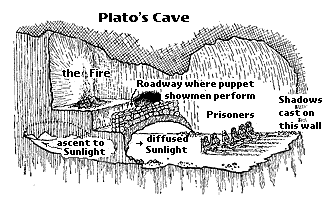
From Great Dialogues of Plato (Warmington and Rouse, eds.) New York, Signet Classics: 1999. p. 316.