

The Candidate
A couple of nights ago I wrote about having voted in this month’s election. I really should tell you one part of the story I left out…
As I was filling in the little ovals on the ballot, I realized for the first time that the (Republican) state representative from my (new) district is running unopposed. As I meditated on this little piece of information, I made the decision, somewhat impulsively I admit, to run for public office. I filled in the little oval next to the write-in space and then penciled in my own name.
So, there I was: an ordinary citizen one moment, a candidate for political office the next.
I “announced” my candidacy at work today. And as far as I know now, I’ll have two votes in my column come next Tuesday.
Scary Stuff
So, it’s Halloween ... supposedly the scariest day of the year.
My thought: Ha!
This evening I finished voting in the November election. (For those of you reading this from outside of Oregon, remember that we’re the one state that is exclusively vote-by-mail. I will put my ballot in the mail tomorrow.) As I complete my personal part of this electoral process, I look forward to next Tuesday, November 7th, as the most terrifying day of 2006. The stakes are high for the country. The stakes are high for Oregon. And the stakes are high for me. Let me explain ...
Nationally, we need to elect a congress, both House and Senate, that will stand up to George W. and his failed foreign policy. And bring an end to this fiasco in Iraq. This is an absolute must.
Additionally, the voters of Oregon need to reject the latest of the wildly-insane ballot measures that would lead to catastrophic cuts in state spending and cripple our education sectors and other highly-critical state-funded services.
Finally, and obviously, the outcome of the election is of personal import, because I work in public higher education and we receive a large portion of our support from the state’s general fund. The huge cuts that would result from the passage of Measures 41 and/or 48 would almost certainly dictate eventual job loss for me and perhaps the inability to ever be employed here in my working life again.
Watch out for those Oregon voters. Now they’re scary.
The Election
On November 7th, Oregon voters face a potential twin-towers of ballot measures. My opinion: NO votes on both Measure 41 and Measure 48 are crucial to the future of the state, as the effects could be more devastating to our education systems (and other state services) than was Ballot Measure 5 in 1990. Click on the links above to read what The Oregonian had to say when they weighed in on these matters. And then head on over the Defend Oregon Coalition website.
This is important! Really.
Freedom of Speech
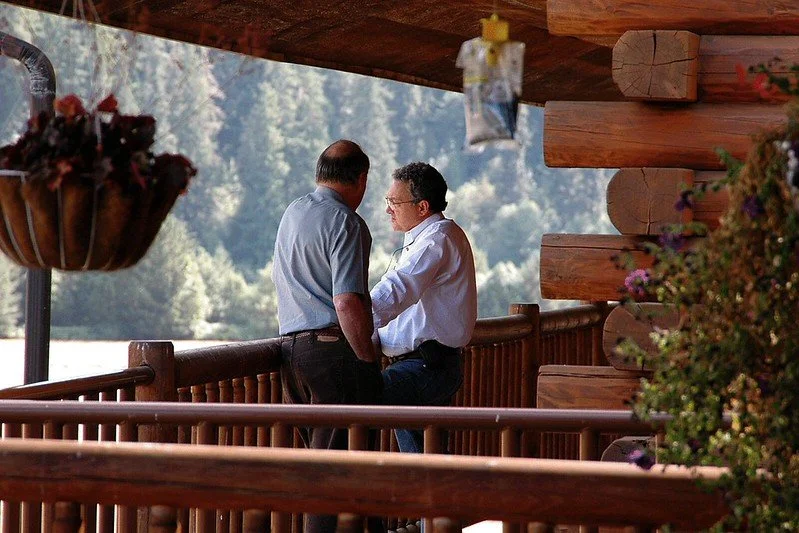
During Thursday and Friday this week, I attended a retreat of UCC faculty as part of our beginning-of-the-school-year inservice activities. The event was held at the Big K Guest Ranch in Elkton, Oregon (about 30 miles from here). The place is truly in the middle of nowhere. After driving about 18 miles north of (I-5 Exit 136) Sutherlin on Highway 138W, you take a right-hand turn onto a gravel road and proceed onward for another four miles…an experience bound to rattle your bones and car frame, even at 15 mph. However, the setting is quite idyllic, and a great spot for a group our size to get away and do some retreat-type work. The organizers constructed a very worthwhile agenda, and I was amazed at the effort and energy expended to make this a wonderfully-successful experience for everybody.
A lot of the time together was spent in small groups, examining topics relevant to both new and returning instructors. Even though I am not an instructor anymore [I was one of two administrators present (the other being the college president)], I found I was able to participate fully. And, the greatest benefit to me was getting to know faculty from my new, large division (as well as the entire campus).
On the final day, yesterday, we held discussions (during both the morning and afternoon sessions) on a variety of hypothetical ethical-dilemma situations. The final scenario involved a student who wore a t-shirt to class that had a (unidentified) racially-offensive message on it. The questions: what to do? How to handle this?
A variety of perspectives were offered. One person offered thoughts about a dress-code. Others provided suggestions aimed at trying to control student behavior and, hence, suppression of the t-shirt’s message.
I could not hold my tongue. At the end of the discussion (and our time together), I raised my hand. I offered the thought that a t-shirt was not offensive in and of itself, and that this was neither a dress code nor a student-conduct issue, but rather a free-speech one. Freedom of expression is one of our most cherished and important constitutional rights, I said, and that, especially in a college environment (where we are presumably devoted to a free exchange of ideas), we cannot stomp on such a fundamental American freedom. I observed that quite a number of campuses over the last couple of decades have attempted to restrict student behavior with speech codes, virtually all of which had been struck down by the courts on constitutional grounds. I tried to convey the message, and personal (legal?) opinion, that we cannot attempt to silence a student merely because his or her message might be offensive to some.
Of course, I likely sounded like an over-the-top civil libertarian. And, I know, I delivered this message with some degree of passion, but hopefully not so extreme as to offend my new colleagues. The ACLU has an excellent summary of this issue on their website, as well as descriptions of many specific cases involving freedom of expression (including t-shirts).
May 4th
