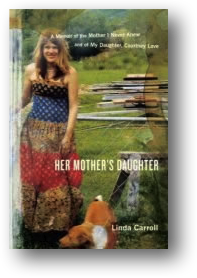
In the midst of everything else going on for me right now, I finally have finished reading Linda Carroll’s biography: Her Mother’s Daughter. As I have written about before, I’ve known Linda for over 25 years and identify her as one of the most influential people in my life – indeed, I consider her one of my family on this planet during this lifetime. (I’ve absolutely no idea if she has any thoughts along these lines, though.) She’s served as my counselor, confidante, friend, mentor and spiritual guide – helping me through some very difficult spots. I am incredibly fortunate to have met her and to have had her in my life for (at this point) nearly half my time on earth. Frankly, any attempt to think about this lifetime without Linda in it hardly seems like my life at all.
I first mentioned Linda in these pages after reading Borrowed Finery by Paula Fox. Fox is the famous author of novels and childrens’ books who, early in her life, gave Linda up for adoption. Linda finally tracked her mother down after the birth of granddaughter Frances Bean Cobain. Although quite elderly now, Paula is still alive and she and Linda continue to maintain a relationship begun, belatedly, in the mid-1990s.
In the time I’ve known Linda a lot has happened to her, both personally and in terms of her public notoriety. She is, after all, not only Paula Fox’s daughter, but Courtney Love’s mother. The stormy relationship between Linda and Courtney has been reported in the popular press, up until this time, exclusively through Courtney’s eyes. A number of unflattering and outrageous things have been said about Linda that are totally inconsistent with the good-hearted person that I know and love. Not that I ever really knew much of Linda’s story before reading the book, though; I have only had glimpses into small parts of her life. As my counselor, Linda has been focused on listening to the rhythms of my story, not the other way around. Most of what I know about Linda the person has come through my experience with her in various workshops over the years. The most recent group experience I had with her was about 7 years ago now, in a PAIRS (couples) course led by her and husband Tim.
Now that I’ve finished reading Her Mother’s Daughter, I’ve searched out some of the literary reviews and am discovering that they appear, well, mixed . Some praise Linda’s narrative style and general ability to draw the reader into the drama that has been her life. Others take a more critical stance, sometimes judging her life itself, apparently overwhelmed by the chaotic nature of Linda’s existence. For myself, I was amazed at the detail Linda was able to relate to me, the reader, describing experiences from an age when I would have no memories to draw on at all. Further, I was totally engaged with her writing style, finding it smooth and conversational, mirroring the “real person” that I know her to be.
Of course, upon reading the biography, I tend to agree that Linda’s life has been chaos. And in terms of order of magnitude of lifetime chaotic experiences, her biography rivals her mother’s. As much turmoil as I believe I’ve personally experienced, I admit that my story has had less overall drama than either Paula’s or Linda’s. Linda is on her fourth marriage; she gave birth to six children, one who died as an infant; an adopted child subsequently discovered another home for which he was a better fit; she escaped San Francisco by moving to Oregon, then moved to New Zealand and back to Oregon; her oldest child is Courtney, likely one of the most “out there” celebrities since Madonna’s younger days; and (not covered in the book) she once found herself the therapist for Katherine Ann Power, an activist from the 60s who spent most of her adult life underground.
Zounds: what a life.
I’ve lived my life parallel to a good portion of Linda’s drama, and I have sought out her big heart, attentive ear, and perceptive nature time and time again. She has never said she was not available to me. Whenever I’ve shown up, she’s always been totally present. Truthfully, I only had hints here and there that she was living the life she describes in this book. Even though her own existence has surely been an emotional roller-coaster, she has always been able to focus on me and my story and provide help when I sought her out. Simply, Linda is a human being of the highest caliber. The meaning of the chaos of her life, for me, I now understand, is that she’s always been able to assist me with my own frequently-chaotic existence.
A psychic I once consulted, who relayed to me some of my past-life experiences, reported that Linda and I had been twins at least two times in previous lifetimes. It is, at the very least, an entertaining thought. I know I feel very, very connected to her. My relationship with Linda is one of the most cherished things in my life. I glad she wrote her story so that I can know it: so that I can know her better than I do.
I first became acquainted with the writings of Nick Hornby in 2000 after seeing High Fidelity, the movie version of his first novel. John Cusack played the lead character, Rob Gordon, who, at least in the movie version, began by asking:
What came first, the music or the misery? People worry about kids playing with guns, or watching violent videos, that some sort of culture of violence will take them over. Nobody worries about kids listening to thousands, literally thousands of songs about heartbreak, rejection, pain, misery and loss. Did I listen to pop music because I was miserable? Or was I miserable because I listened to pop music?
Well, as you might suspect, the story line revolves around the “heartbreak, rejection, pain, misery and loss” of relationships. Rob spends a great deal of time in a self-discovery mode, visiting one former girlfriend after another to learn about what went wrong in his previous relationships. Although the Rob character is fairly self-absorbed, obsessing over such things as Top 5 Lists and the Perfect Compilation Tape (they didn’t have iPod playlists six years ago), I found him a rather endearing character as he bumbled his way through his romantic adventures. I was pretty taken with the movie (seeing it a couple of times in the theatre) and went ahead and bought the novel later, something I rarely, rarely do.
Hugh Grant starred in the movie version of About A Boy, as you might recall, and, as far as I know, Horby’s third novel How To Be Good has not (yet) been made into a film. A fourth novel, A Long Way Down, was published in 2005, and I just finished reading it.
The story in A Long Way Down is told from the perspectives of the four primary characters, one after the other throughout the entire book. There are not really four different “voices,” though, as Hornby seems to make little effort to provide identifiable narrative styles for the various players, just obviously unique views of the world.
The setting for A Long Way Down is London, and the main characters are Martin (a former morning television personality, down on his luck after sleeping with a 15-year old, going to prison, and losing his marriage and kids in the resulting scandal); Maureen (a middle-aged single female, whose only son is severely disabled and unable to take care of himself; she is the primary caregiver and has no other life); Jess (a confused and rebellious young female, daughter of a highly-placed British politician); and JJ (a young male American rock musician, whose band has just broken up). Not knowing one another, they, coincidentally, find themselves on the roof of a tall building on New Year’s Eve, all there with suicidal intent.
Well, with all those people up there at the same time, their individual plans obviously don’t work out. They collectively talk themselves down from the roof, making up the excuse that they need to find and confront Jess’ former boyfriend.
These four really aren’t very endearing characters, as was (John Cusack’s) Rob Gordon in High Fidelity, or (Hugh Grant’s) Will Freeman in About a Boy. Still, Hornby’s ability to spin a tale, I guess, is the reason I kept reading about these lonely losers. (Each was rather like an individual train-wreck about to happen, reminiscent of the title character in that new NBC series, “My Name is Earl.”) After their time together on that almost-fateful New Year’s Eve, they keep in touch, go on a vacation together, and generally support one another through each other’s hard times, even though, as portrayed, these folks were individuals I personally would not seek out as friends.
However, in the final analysis, they are their own support group. And even though they, well, suck at it, the story suggests that somehow it seems to work to have others in your life that care, if only a little bit, or are only moderately adept at demonstrating it. The group gave themselves ninety days to hang together, to see where their lives were at the end of that time. As the book ends, at the conclusion of that time period, none of them is in the same emotional space. Their lives are not “resolved,” but things are noticeably different.
I never have been suicidal myself. But, I have certainly had my down times, when I’ve needed someone to talk to, someone to support me. Sometimes, rarely, there isn’t anybody around to talk to. Usually, though, I’ve been able to find somebody to support me through difficult periods.
I have a new, young friend in need of support right now. She is experiencing the loss of a significant other, is scared about the prospects ahead, and feeling lonely. She has asked for my support, and I am delighted to provide what I can. We are all, ultimately, alone in this existence, but we don’t need to face everything alone. We need each other. We need to find each other. And, we should ask for help when we need it.
Our struggles, and our pain, are what make us human. They are what make us strong. We are all incredibly resilient, and this is how we grow. No matter what our level of pain, at some point, we are able to mend our broken wings and fly again.
Soundtrack Suggestion
Blackbird singing in the dead of night Take these broken wings and learn to fly All your life You were only waiting for this moment to arise
I can’t believe that winter break is almost over. For the last week the campus has been closed, so faculty and staff have been able to go their own ways to celebrate whatever version of the holidays they choose. My time has been spent, for the most part, in solitude: I have cleaned house, run errands, written job applications, sent out and replied to emails, taken naps and hot baths, gone on long walks, made up new playlists, Photoshopped pictures, driven to Albany for lunch, and, generally, tried to relax. (With only modest success on that last item, I might add, despite the apparently-leisurely, non-work schedule!)
Also, I just finished a novel that I spent a little time with each day: The Painted Drum by Louise Erdrich. I learned of this book by listening to NPR on Sunday morning, October 2, 2005 , and I immediately ordered a copy from Amazon.com . I admit I had never heard of Erdrich before, even though she has published several novels. I was intrigued, though, during the NPR piece, by the description of the story, as well as by Erdrich’s voice. The NPR website indicates that “novelist Louise Erdrich returns to the Ojibwe world in her latest work, but The Painted Drum also explores human relationships.” In my post of December 18th, I mention my attraction to works that explore the human condition, and this book certainly fits that category. I was totally drawn into the narrative, as Erdrich proves to be an incredibly-skilled storyteller.
Erdrich has published other novels with Native American themes and characters; this is not typically subject matter that I’d be attracted to. So, without having heard the brief description on NPR, I’m fairly certain that this book would not have leapt off the bookstore shelf at me. I am immensely gratified to have been listening to Liane Hansen that Sunday morning, though.
As I’ve indicated in another essay, I’m not really interested in doing book reports, per se . And, I’ll certainly leave literary criticism to those more suited for such activity, such as my good friend the Dean of Humanities. I found several things about The Painted Drum to be extremely compelling, however. The theme of loss was pervasive, exemplified, in part, by the deaths of a couple of young girls, a marriage torn apart by betrayal, and the diminishing eyesight of one character who had fought in the Gulf War. The complexities of the relationships, and the connections between, children and parents were also featured elements. And, too, the distance-closeness aspects of the relationship between Faye (one of the narrators) and Kurt, her free-spirited artist friend-and-lover, were explored. All these dimensions, and many more, are to be found in the context of this story of a mystical, magical drum, believed to be a “living thing.”
One of the reviewers of this book at Amazon.com says that “Louise Erdrich is a verbal artist. Through her carefully crafted prose, I could smell the dust rising from the prairie, hear the wind rustling the grass and feel the texture of the drum. The Painted Drum gives us a snapshot into the lives of people who must reconcile tradition with reality.” And I agree. Erdrich’s prose is absolutely lyrical. What hooked me was a paragraph she read during the NPR interview:
Life will break you. Nobody can protect you from that, and living alone won’t either, for solitude will also break you with its yearning. You have to love. You have to feel. It is the reason you are here on earth. You are here to risk your heart. You are here to be swallowed up. And when it happens that you are broken, or betrayed, or left, or hurt, or death brushes near, let yourself sit by an apple tree and listen to the apples falling all around you in heaps, wasting their sweetness. Tell yourself that you tasted as many as you could. (p. 274)
I had a phone conversation with my old friend J this afternoon, and, in recommending this book to her, offered to read this passage. My out-loud rendition, however, came up short. There is emotion and intensity in the above words that I dared not attempt. I held back, given our history I suppose.
Read this book. I doubt that you’ll be disappointed .
A Wedding in December is the fourth novel by Anita Shreve that I’ve read. (The others: All He Ever Wanted ; The Weight of Water ; The Last Time They Met.) The reason I keep going back to read Shreve is her ability to communicate about people, emotions and relationship. Yes, yes, if her books were movies, they’d be “chick flicks” — but I can’t help it, novels with this kind of depth and character development appeal to me. In an Anita Shreve work, I feel I get to know and care about the characters, and by the time I finish reading, I don’t want to let them go.
If you go to Amazon.com, you can find the remarks of some folks who were less than thrilled with this novel. I wasn’t disappointed, however. The story revolves around a reunion — a “Big Chill” kind of event, in a sense. Seven former high-school classmates gather together at an inn in the Berkshires to witness the wedding of Bill & Bridget — two who were high-school sweethearts, but did not end up together. Each of them, ultimately, married someone else. However, at their 25th reunion, they reconnect: Bridget a single mom of a teenage son; Bill still married, with a daughter. They resolve to finally pursue a life together, even though it is at the cost of Bill’s marriage. Bridget then gets breast cancer, and they decide to get married, to make public their commitment to each other. Nora, one of the former classmates and owner of the inn, hosts the event at this idyllic setting in the mountains.
But, this is not really intended to be a book review! What resonated with me, and why I am writing about this today, were the pervasive themes of “distance” and “closeness” in relationships, and how Shreve juxtaposed them. Nora & Harrison, Agnes & Jim, and Innes & Hazel are couples at great emotional and geographic distance. These all, are stories of love denied, love delayed, love hidden, love forbidden. In each case, there is evidence of great pain and sacrifice given the distance and unavailability of one for the other.
Then, there are Jerry & Julie, and Rob & Josh, couples who are currently “together.” Jerry & Julie’s relationship, however, seems to parallel the emotional distance of the other relationships.
The only two couples who are really “together,” and devoted to each other, are the ones for which the obstacles appear to be the greatest. Rob & Josh, of course, are gay men. Bill & Bridget have had to endure the dissolution of his marriage (and the rejection by his daughter) for them to be together — and then they become destined to tackle the challenges of Bridget’s cancer: a condition that may severely limit any real time (or really good time) they may have with each other.
Bill & Bridget waited 25 years to decide that they were meant for each other. They’re finally together, though, despite the obstacles. Nora and Harrison come together during the weekend, but it’s unknown, at the end of the story, whether or not they have a future. Agnes & Jim, Innes & Hazel: how will these couples do? Will they eventually seek out a way to be together after years and years of distance?
Here are my personal dilemmas: How long does one wait in this existence for one’s true love? A lifetime? When you give away your heart, how do you retrieve it? If you can’t really be with the one you love, is it actually possible to love the one you’re with?
I just finished reading Borrowed Finery by Paula Fox. The book is a memoir -- a series of short vignettes, actually -- by the now-aging Fox, author of several novels and children's books. From my perspective, Fox's early life was amazingly difficult, as she was early-on placed in an orphanage and then shuffled in and out of a variety of other living situations...all the while maintaining distant and strained relationships with both of her parents. And her parents! Her mother was cold, detached, unloving. Her father was slightly more emotionally available, but also highly dysfunctional and alcoholic. I find it amazing that Fox survived at all.
I have a 'round-about connection to Fox. (Am I allowed to claim that?) The daughter that she gave up for adoption, and speaks briefly of in the last chapter, is Linda Carroll. Linda is a therapist in Corvallis, Oregon (where I lived for twenty years), and someone I have known for more than a quarter century now. Well, not only have I known Linda a long time, I rank her as just about the most influential person I have ever known in terms of my own growth as a human being. Really, Linda's impact on my life has been profound. She was the one who helped me through a very difficult time in my post-divorce period...and, through the years, has always been at least one step ahead of me developmentally, ready to guide and teach.
Richard Bach has observed that "rarely do members of the same family grow up under the same roof." Linda, ever since our first meeting, has felt as if she is part of my family on this planet. So, I was very interested to read about the growing-up experiences of the person who gave birth to her.
Linda has her own extremely interesting biography...having been given up for adoption, of course, and then finding Fox not that many years ago (the mid 90s) in order to attempt the never-established mother-daughter connection. Further, Linda's own experience as a mother includes having given birth to singer-actress controversial-figure Courtney Love. (And, to extend the story, Courtney's daughter is her child with tragic-rock-figure Kurt Cobain.) Linda's book talking about her life and relationship with Courtney is due out in a couple of months, so I know I'll be among the first to read Her Mother's Daughter.