
Blogger Post, Life, Work TechnoMonk Blogger Post, Life, Work TechnoMonk

Exhausted Yet Hopeful

The energy it takes to engage in a serious job-search is considerable. I tend to be overwhelmed a lot of the time, probably because of the oppressive relentlessness of the process. There is always, always something to do. There is no such thing as a coffee break or day off when this is your life. And literally: THIS. IS. YOUR. LIFE.

For me, I have to admit that I am not only overwhelmed, but exhausted.

If one is attending to the “job” (of job-searching) as one should (and must), there is detail after detail to attend to. For me, I always have at least one application in process, or, if not, I know that there is yet another web search to perform in order to see if something has surreptitiously opened up and been posted while I wasn’t paying attention.

Right now, I have two interviews to prepare for that will happen next week. Of course, that is absolutely the kind of place any job-searcher wants to be in. The entire purpose of all the friggin’ paperwork in the first place is to get noticed enough to get the interview. So, I’m happy. Of course, one of these interviews is a two-day process, happening in two cities, and involves a presentation open to the entire community. I have needed to stop almost everything else in order to do the research for this presentation.

With these two interviews, I will be averaging slightly more than one interview a month over the last six months. While the goal of an offer and acceptance of a new position has not yet been reached, there is evidence here that I’m probably on the right track.

But, the rest of it. Oh, the rest of it. I have forms and letters for the next four application packets in process, with due dates that are coming up fast. There are letters of application and interest to revise and customize. There are resumé copies to print out (mine is 17 pages long; I use a lot of printer ink). There are copies of transcripts to duplicate, collate, and attach. There is an inventory of mailing envelopes to maintain. There are reference letters to ask for and people to keep in touch with.

And, always, always, always, there is the time that must be spent online visiting the sites that may yield the piece of information most desired: the posting of “the perfect job.” Ah, does such a thing exist?

This process is difficult for me, and I consider myself an expert at it. I have taught job-search classes, so, presumably I know all the “right” things. I have a killer resumé, and a stock form of an application letter that provides a lengthy, but engaging, narrative of my education and experience. So, I think I know what I’m doing.

I’m getting noticed. I’m being talked to. I just need the right “fit!”

Hope is the feeling you have that the feeling you have isn’t permanent. – Jean Kerr

Read More

Psychic Prisons

I’m in no way a student of The Classics. I regret to report that my formal, “classical,” general education has been woefully inadequate. So, when I now (presume to) speak about Plato’s Republic, and “The Allegory of the Cave,” well, you’re going to need to take what I have to say with not only a grain of salt, but maybe an entire wheelbarrow full!

I was browsing Gareth Morgan’s Images of Organization (1986, my copy of the first edition) today, still (always!) trying to make some sense of my world. (You know me: I can’t seem to shut off my mind!) In the chapter that examines the metaphor of “organizations as psychic prisons,” the discussion begins with a description of Plato’s cave allegory.

The Wikipedia summary of the allegory (copied, pasted, edited) goes thusly:
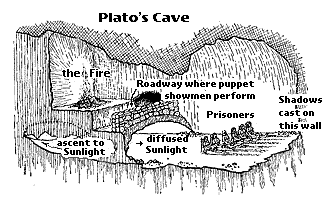
From Great Dialogues of Plato (Warmington and Rouse, eds.) New York, Signet Classics: 1999. p. 316.

Imagine prisoners who have been chained since childhood deep inside a cave. Their limbs are immobilized, and their heads are fixed as well, so that the only thing they can see is the cave wall. Behind them is an enormous fire, and between the fire and the prisoners there is a raised walkway, along which men carry From Great Dialogues of Plato (Warmington and Rouse, eds.) New York, Signet Classics: 1999. p. 316.shapes of various animals, plants, and other things. The shapes cast shadows on the wall, which occupy the prisoners’ attention. Also, when one of the shape-carriers speaks, an echo against the wall causes the prisoners to believe that the words come from the shadows. The prisoners engage in what appears to us to be a game — naming the shapes as they come by. This is sum total of their life: the only reality they know.

Now, suppose a prisoner is released and is able to stand up and turn around. At first, his eyes will be blinded by the firelight, and the shapes passing will appear less real than their shadows. Then, if he is dragged up out of the cave into the sunlight, his eyes will be so blinded that he will not be able to see anything. Gradually he will be able to see darker shapes such as shadows, and only later brighter and brighter objects. The last object he would be able to see is the sun, which, in time, he would learn to see as that object which provides the seasons and the courses of the year, presides over all things in the visible region, and is in some way the cause of all these things that he has seen.

I’m wondering if this allegory may be the source of the term “thinking outside the box” – for certainly the freed prisoner is absolutely forced to “think outside the cave” when confronted with a world so dramatically removed from his prior experience. What a total shock to the system to be freed, leave the cave, and discover what’s there to be found!

Is there a modern-day equivalent to the cave? Could our families, workplaces, and/or significant relationships ever be considered versions of the cave? Is it possible we are (or can become) so myopic in terms of how we view the world that we think the shadows on the wall are “reality”?

And, what if we removed ourselves, even for a little while, from the warm cocoon that is our family, job, or relationship, and took a look around at the rest of the world? What would be our experience? Would it be similar to the freed prisoner, who, if he ever went back to the cave, would undoubtedly have significant problems trying to communicate his experience “outside” to the others still imprisoned there? How would it be possible for “the enlightened one” to share his knowledge? What resistance would be met? What ridicule and contempt would he experience for, saying out loud, his newly-acquired version of reality? How could he ever function in the “old way” (seeing and naming the shadows), when he knows “truth”? And, how could the prisoners ever accept an entirely new perspective without the external experience themselves? Wouldn’t this type of new information, so different from their own, be viewed as a tremendous threat?

Aren’t we, everyday of our lives, trapped in the illusion that our experience is “real” – and the only thing? Aren’t we convinced that this is “the way the world works?” Aren’t we, more often than not, content to remain in the dark – neither risking exposure to alternate ways of thinking nor seeking new experiences? In what ways do we all have the tendency to be(come) psychic prisoners, trapped in a reality that gives us a totally skewed understanding of the universe?

[See Morgan, 1986, p. 200, for the discussion that was my inspiration for these questions.]

Soundtrack Suggestion

Chains, my baby’s got me locked up in chains.
And they ain’t the kind that you can see.
Whoa, oh, these chains of love got a hold on me, yeah.

Chains, well I can’t break away from these chains.
Can’t run around, ‘cause I’m not free.
Whoa, oh, these chains of love won’t let me be, yeah.

I wanna tell you, pretty baby,
I think you’re fine.
I’d like to love you,
But, darlin’, I’m imprisoned by these...

Chains, my baby’s got me locked up in chains,
And they ain’t the kind that you can see,
Oh, oh, these chains of love got a hold on me.

(“Chains” - Carole King)

Read More