LCC Board of Education Testimony — October 7, 2026
Here are my remarks made before the Lane Community College Board of Education on October 7, 2026
Members of the Board, President Bulger, President Hadley: Good evening.
My name is Jim Arnold. I am a retired college administrator and former part-time LCC faculty member.

I’m here tonight to speak about the College’s treatment of Richard Riordan. On Sunday, I emailed you my essay summarizing the federal court’s opinion. I hope you had time to review it.
To summarize, briefly:
Richard repeatedly criticized LCC administrators and you, the Board, over program cuts, budget decisions and the data used to defend them. The College responded by banning him from seven properties and blocking his registration until the end of the century.
On September 28th, U.S. District Judge Michael McShane ordered LCC to remove the enrollment hold and allow Richard to return to classes. Although the ruling was preliminary, McShane found that Richard was likely to succeed on his claim that LCC retaliated against him for speech protected by the First Amendment.
The court also found nothing in the record showing that Richard posed a threat. Judge McShane called LCC’s safety argument “anemic and unconvincing” and its sanctions “unreasonable and legally unsupported.”
My recommendations to you are straightforward.

First, commission an independent review to determine who approved the sanctions, what evidence they relied on, why Richard was NOT told what rule he had broken, and why he had no fair chance to respond. Publish the findings and require President Bulger to respond publicly.
Then act on the findings. Correct any unsupported claims in Richard’s file that could harm his education or future employment. Determine what consequences, if any, are warranted for the administrators responsible. And adopt protections requiring notice, access to evidence, a prompt hearing and a fair appeal before any extended campus ban or registration block.
But do not use the review as an excuse to delay what is already due: an immediate public apology from President Bulger and the Board to Richard and the community.
LCC cannot claim to value free speech while punishing criticism that makes its leaders merely uncomfortable. It is time to admit what went wrong, repair the harm and make sure it Never. Happens. Again.
Thank you.
LCC Board of Education Testimony — June 3, 2026
Here are my remarks made before the Lane Community College Board of Education on June 3, 2026
Chair Folnagy, members of the Board, President Bulger, President Olson: good evening. My name is Jim Arnold and you now know me as a member of the Budget Committee. Thank you, Trustee Rust, for your nomination and your support.
I sent you all an email about this earlier today, so you may be aware that I published a Guest Column in the Lookout inspired by our recent Budget Committee deliberations. Specifically, the catalyst was last week’s discussion about tuition and whether or not to revisit an earlier Board decision.

I wrote the article for a number of reasons. Partly, I wanted to provide some historical context. Many Oregonians, especially younger ones, have little or no awareness of Measure 5 or the profound effect it has had on the funding of public education. Many of the budget pressures we discuss today did not just suddenly appear. They are connected to decisions that were made decades ago.
And I wanted to step back and look at another large issue, for I believe that discussions about tuition are never really just about percentages. Beneath them is a more fundamental question about who benefits from higher education and who should bear the costs.
But also let me mention something else that stayed with me after last Wednesday’s meeting, which was not so much the outcome as the process.
Students came forward and spoke about the impact tuition has had on their lives. Committee members asked questions. Different viewpoints were expressed. People disagreed. Then the committee voted.
Now, that may not sound all that remarkable, but I think it is worth acknowledging. Public institutions are supposed to create space for such conversations. The process does not guarantee agreement, but it does give us an opportunity to surface often unspoken assumptions.
Having spent much of my life in higher education, I can remember a time when the public discussion was framed somewhat differently than it is today. Back in my early days, students certainly benefited from earning degrees and improving their career opportunities, but there was a widespread understanding that society benefited as well.
Over time, as we all know, more and more of the cost of instruction has shifted to students and their families. That shift did not originate at Lane Community College nor with this Board.
Understanding how we arrived here may not solve our budget challenges, but it can help us have a more informed conversation about them.
Thank you.
Recent Column Ignored Deeper College Issues
This is the unabridged version of the Guest Column I published in the Lookout Eugene-Springfield, December 2, 2025
After reading John Anderson’s recent essay in Lookout (November 26), I felt compelled to respond. His column closely resembled an email he circulated to various campus groups in November and, taken together, they present a very narrow picture of conditions at Lane Community College. His focus is almost entirely on the tone of criticism at Board meetings and on the affiliations of certain trustees. These concerns have their place, for sure, but they do not explain the deeper issues the college has been confronting for more than a year. Any serious discussion of what’s happening on campus needs to acknowledge the broader context.

What stands out in Anderson’s commentary is what it leaves unaddressed. Instead of focusing on the content of long-standing concerns, he chooses to discuss how various issues have been voiced. Tone matters, of course, but I’m fairly certain that that’s not the central issue. People speak passionately when they feel their questions are not being taken seriously, when planning is unclear, or when major decisions lack transparency. I attended the November 5 Board meeting he refers to and found the audience demeanor almost entirely civil and restrained. To the extent frustration was visible, I believe it reflected months of extreme stress within a campus environment that many employees now describe as increasingly perilous to navigate.
These issues are not abstract. After my most recent Eugene Weekly essay about LCC, a faculty member wrote me to say that many colleagues avoid speaking at Board meetings or attending union activities because they fear retaliation. They described low morale, the real possibility of a strike, and a sense that a no-confidence vote may be the only meaningful avenue left to express collective concern. For part-time faculty, job insecurity makes this climate even more stressful. This account is not unique. It echoes what many have been saying quietly for months and reflects a pattern that Anderson’s framing does not account for.
It is also inaccurate to suggest, as Anderson does, that criticism of the administration comes from only one constituency. Qualms about college governance, communication, and major decisions have surfaced repeatedly from many corners of the institution, including students. Some of these concerns are public; many are not. Over time, the pattern has become unmistakable. Anderson’s column instead mirrors the position consistently taken by the three-member Board minority who have resisted a fuller examination of administrative choices and their impact on students and staff.
Selective accomplishments, such as enrollment growth, cannot substitute for transparency or sound processes. In three Eugene Weekly columns this year, I have written about broader institutional concerns involving governance and decision-making practices. Program decisions have played a part in that story, especially where course offerings and academic pathways have been affected. During my years as an academic dean, I came to understand how essential predictability and clear communication are when building schedules and supporting programs. When course sections are reduced or altered without strong planning and transparency, the effects ripple quickly into impaired student progress, increased faculty workload, and departmental instability. These are not theoretical issues. They directly affect the community the college is meant to serve.

Anderson also argues that the Board is engaging in micromanagement. That characterization does not match the facts. Boards should not run day-to-day operations, but they are responsible for oversight when policy, academic direction, and institutional mission are involved. Trustees who ask for clarity or request information are not overreaching; they are fulfilling the responsibilities the public entrusted to them. When those requests do not appear on agendas or when major decisions proceed without Board involvement, the issue is not interference. It is a restriction of the Board’s proper role at a time when oversight is especially needed.
His reliance on charges about the faculty union, raised by the NAACP, also requires further context. Those concerns matter and deserve serious attention. But they do not address the substantive questions that faculty, staff, and community members (including myself) have been raising for more than a year. The criticism being voiced is about decisions, communication, planning, campus climate and leadership approach. It is not about the president’s identity. These issues require direct engagement, not dismissal.
Finally, here’s what I believe: Anderson’s focus on tone offers a convenient way to avoid the substantive issues the college must address. What LCC needs now is presidential leadership willing to directly engage the challenges before us, and a Board committed to ensuring that such leadership is fully and responsibly exercised. That combination of leadership and oversight is what will allow the college to move beyond its current difficulties and fulfill its mission to students and the region it serves.
No Confidence
This is the op-ed I published in the Eugene Weekly, November 26, 2025
Last spring (EW, April 16) I wrote that the Lane Community CollegeBoard of Education had become dysfunctional and needed new voices. When I followed up just recently (EW, October 9), I had hoped to report progress. I couldn’t. The same divisiveness remains and the stakes have only grown.
It now seems apparent that LCC’s problems go far beyond a Board unable to find itself. At the November 5 Board meeting, over two hours of public comment revealed deeper layers of concern. Speakers described an administration that, in their view, operates with limited transparency and contributes to a culture in which employees hesitate to speak openly. Several also stated that a divided Board has not provided the oversight the college requires.

President Stephanie Bulger’s leadership has strained relationships with faculty, staff, and some trustees. Rather than collaboration, many describe unilateral decision-making and limited inclusion in governance. One of the president’s stated goals early in her tenure was to improve campus climate. Multiple accounts now indicate that this has not happened. Instead, trust has deteriorated and the fear factor has increased.
Faculty union president Adrienne Mitchell’s open letter to the Board (posted to lccea.org on November 4) courageously documents many of these issues. She reports that employees have been pressured to resign or sign nondisclosure agreements and that faculty and administrators are afraid of retaliation for speaking up. After raising concerns, she was reportedly told by the president, “I don’t know how long you’ll be around here,” before facing a proposed layoff.
Her letter also highlights damaging operational decisions. The suspension of the Licensed Practical Nursing program last spring, enacted without public input or a Board vote, left thirty-seven qualified applicants without a viable local training path. Meanwhile, delays in promoting the new Bachelor of Science in Nursing program resulted in only eleven students enrolling instead of sixty.

As a former academic dean responsible for scheduling, I know course planning must be dependable and student-centered. Yet, this fall, more than 100 course sections were canceled, including core classes with active registration. Late cancellations derail student progress and weaken confidence in the institution. Faculty estimate tuition losses may reach $1 million. These reductions appear inconsistent with the adopted budget and limit student access.
Labor negotiations have also deteriorated. Talks are nearing impasse. According to the latest faculty-union bargaining update, there has been no substantive movement from the administration on compensation, benefits, workload, or job security. The administration’s cost analysis has been strongly disputed by faculty. With only two sessions remaining, mediation appears likely. While strike action is not imminent, some faculty have begun considering it as a last-resort option should conditions fail to improve. The central issue right now is the absence of meaningful progress.
Concerns extend to Board governance. For example, when several trustees requested an agenda item reaffirming Board authority over program and service reductions, it did not appear. Instead, an administrative memo supporting the president’s position was included. This outcome limited the Board’s ability to fulfill its duty to oversee operations at a critical time. In my October 9 column, I suggested that Trustee Mulholland step aside to demonstrate Board accountability. With the fuller scope of concerns now evident, it is clear governance issues extend beyond any one trustee. The problem lies with a governing body that has not acted decisively while the institution struggles.
Given the continuing lack of trust, the deteriorating labor posture, the failure to improve campus climate as promised, and the absence of collaborative leadership at a time when stability is essential, I see no viable path forward under current conditions. I recommend that the Board decline to renew President Bulger’s contract and begin an open, transparent leadership search grounded in accountability and partnership. This is not a punitive decision. It is responsible stewardship on behalf of the institution.
If the Board does not act unilaterally, I suggest that faculty consider a formal vote of No Confidence to publicly affirm that administrative leadership marked by fear and stalemate cannot continue.
Lane Community College remains one of Lane County’s greatest public assets. It educates our workforce, expands opportunity, and strengthens the local economy. At this critical moment, leadership must demonstrate the courage to act. The community is watching. The future of the college depends on it.
An Embarrassment to Our Community
This is the op-ed I published in the Eugene Weekly, October 9, 2025
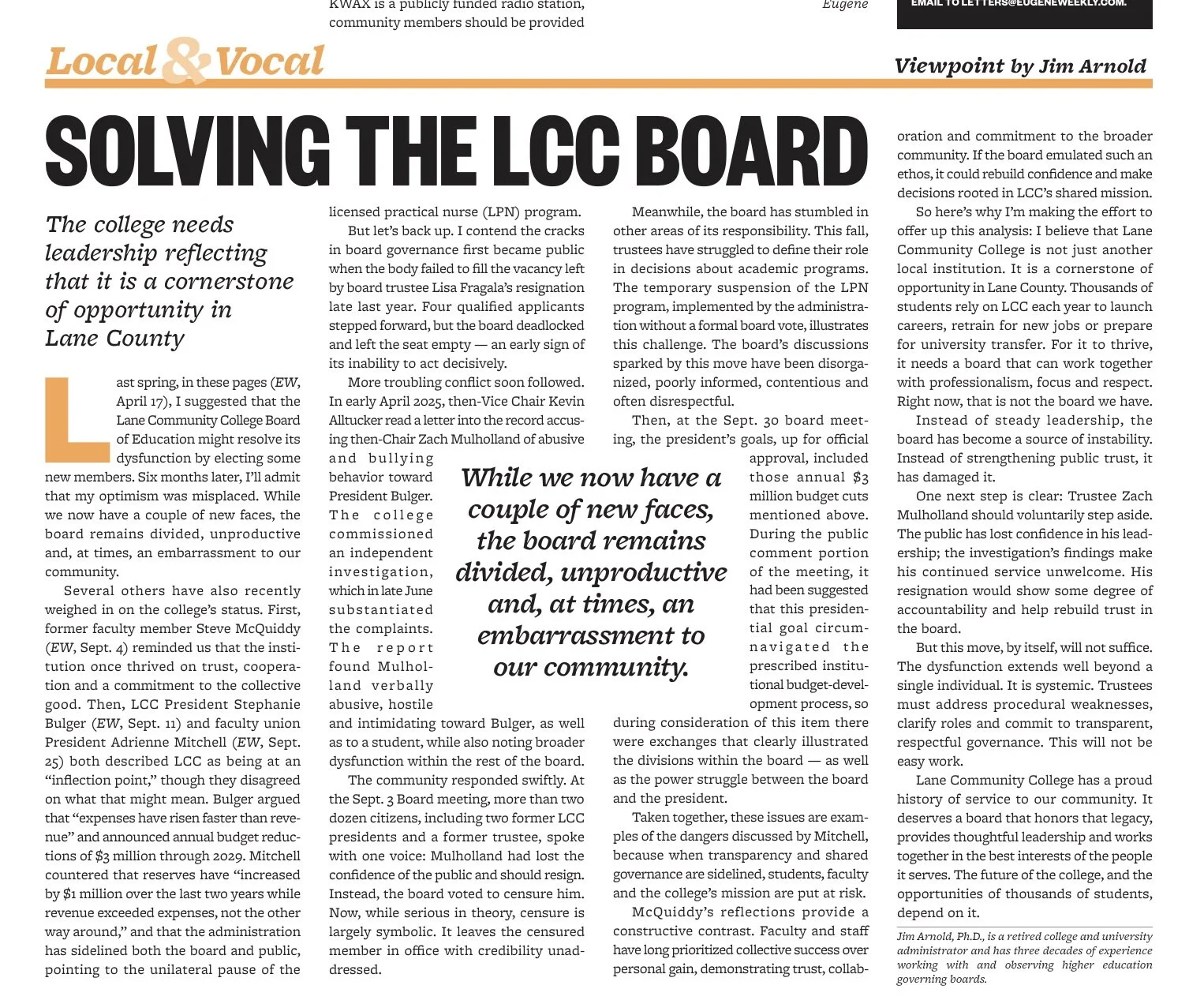
Last spring, in these pages (EW, April 17), I suggested that the Lane Community College (LCC) Board of Education might resolve its dysfunction by electing some new members. Six months later, I’ll admit that my optimism was misplaced. While we now have a couple of new faces, the Board remains divided, unproductive and, at times, an embarrassment to our community.

Several others have also recently weighed in on the College's status. First, former faculty member Steve McQuiddy (EW, September 4) reminded us that the institution once thrived on trust, cooperation, and a commitment to the collective good. Then, College President Stephanie Bulger (EW, September 11) and Faculty Union President Adrienne Mitchell (EW, September 25) both described LCC as being at an “inflection point,” though they disagreed on what that might mean. Bulger argued that “expenses have risen faster than revenue” and announced annual budget reductions of $3 million through 2029. Mitchell countered that reserves have “increased by $1 million over the last two years while revenue exceeded expenses, not the other way around,” and that the administration has sidelined both the Board and public, pointing to the unilateral pause of the Licensed Practical Nurse (LPN) program.
But let’s back up. I contend the cracks in Board governance first became public when the body failed to fill the vacancy left by Trustee Lisa Fragala’s resignation late last year. Four qualified applicants stepped forward, but the Board deadlocked and left the seat empty — an early sign of its inability to act decisively.
More troubling conflict soon followed. In early April 2025, then-Vice Chair Kevin Alltucker read a letter into the record accusing then-Chair Zach Mulholland of abusive and bullying behavior toward President Bulger. The College commissioned an independent investigation, which in late June substantiated the complaints. The report found Mulholland verbally abusive, hostile, and intimidating toward Bulger, as well as a student, while also noting broader dysfunction within the rest of the Board.
The community responded swiftly. At the September 3 Board meeting, more than two dozen citizens, including two former LCC presidents and a former trustee, spoke with one voice: Mulholland had lost the confidence of the public and should resign. Instead, the Board voted to censure him. Now, while serious in theory, censure is largely symbolic. It leaves the censured member in office with credibility unaddressed.