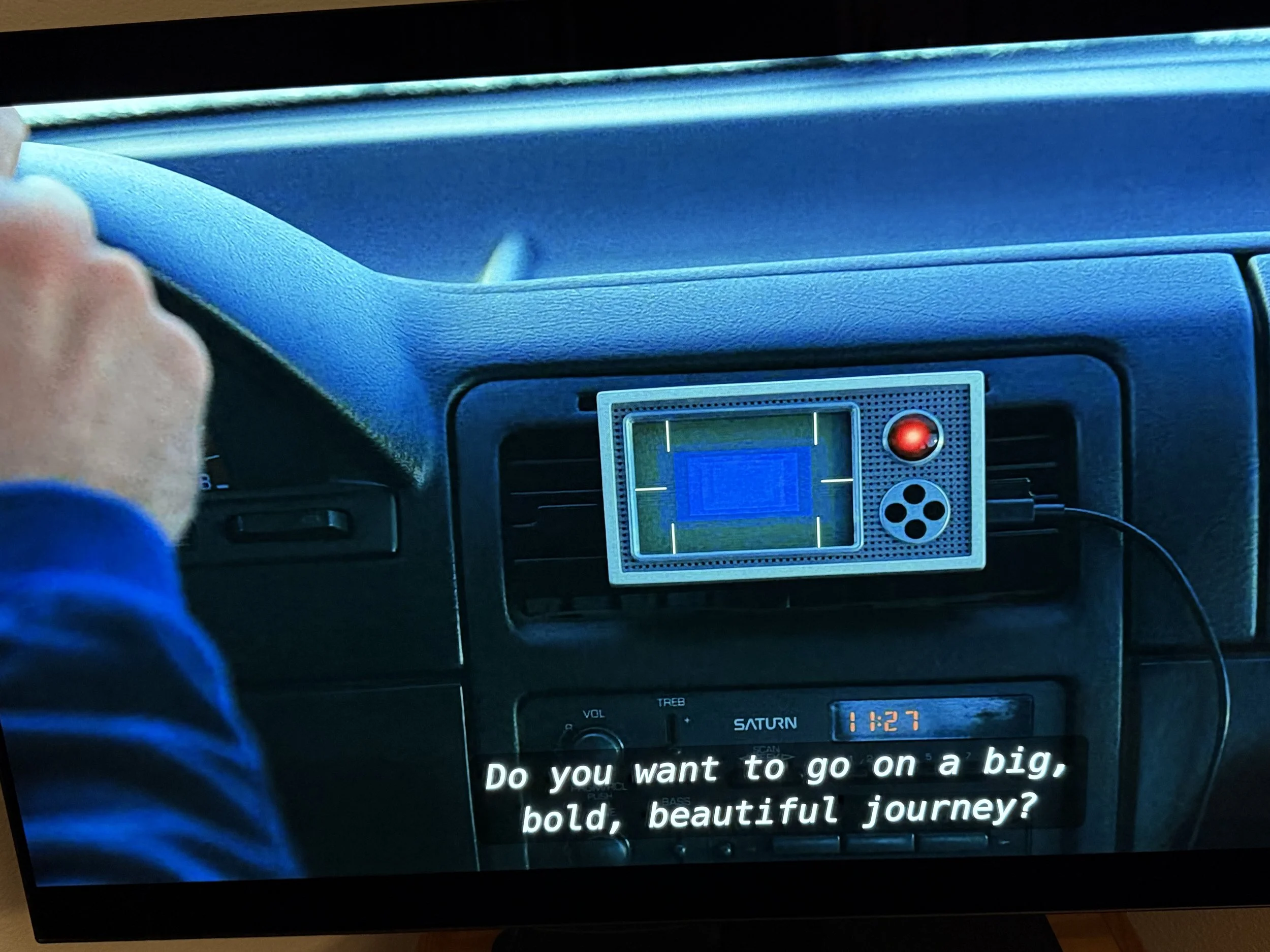
From there, the film settles into its central rhythm. The GPS directs David and Sarah to a series of roadside stops that turn out to be doors, both literal and metaphorical. Behind each door lies not so much a place as a moment in time. These episodes are drawn from the characters’ pasts, and what’s striking is how matter-of-factly they accept what’s happening. There is only a modicum of astonishment. David and Sarah step into these moments as if the past were still physically present, waiting to be revisited.
One door, for example, takes them to David’s high school on the night he is starring in the class musical, How to Succeed in Business Without Really Trying. He plays the lead role of J. Pierrepont Finch, with Sarah and his parents watching from the audience. During the show, David relives a painful romantic rejection, confessing his feelings to a costar offstage and then, in an impulsive moment, temporarily derailing the production by confronting her onstage with blunt observations about the life she will go on to lead.
In a later scene, they stop at a decaying roadside billboard with an opening that leads into a café. Inside, two conversations unfold at once. David’s former fiancée presses him for an explanation about the end of their engagement, while Sarah revisits the collapse of a relationship with a former boyfriend. Eventually, the two conversations merge, with all four characters seated at the same table. David and Sarah are given an unusually revealing view of how each has behaved in earlier relationships, and both are forced to acknowledge their own intimacy issues.
By this point, it’s very clear that this big, bold, beautiful journey is less about time travel than about self-examination. As David and Sarah move through these episodes together, the focus remains on how they respond to what they learn about one another. They watch. They ask important questions. They engage in remarkable amounts of self-disclosure. The film allows these moments to unfold slowly. The pace worked for me, though I can see why others might find it trying. This is not a movie in a hurry.
What the film seems most interested in is not whether David and Sarah will end up together, but what it means for two people to really see one another. By the time you’ve lived a while, introductions are never clean. Everyone arrives with baggage, earlier versions of themselves still visible around the edges. A Big Bold Beautiful Journey makes that idea concrete, and in doing so, captures something emotionally recognizable.
I was willing to go along with the unlikely premise and the deliberate pacing largely because the performances are so grounded. The connection between Farrell and Robbie builds through pauses, glances, shared silences and, often, moments of unusually deep honesty. That connection feels earned, not manufactured.