Within these pages, I continue to visit and revisit the themes of our culture’s relationship to cell phones and the general level of noise pollution we’re all subjected to on a daily basis. There are precious few places to go, it seems, to escape and find some peace and quiet.
I suppose part of my personal issue here is that I am a rather quiet guy myself…a quality that happens to go along with my reputation as a good listener. Everyone says so. For example, when we talk, I look you in the eye. And I pay close attention. I don’t interrupt. I strive to really grasp the meaning of what you’re trying to say to me. I ask questions of you to help deepen my understanding. I try not to insert my opinions where they’re inappropriate or unwanted. I really hope I don’t say anything to discount your ideas and/or feelings. And then: I’m just plain silent and attentive while you’re speaking.
Simply put, I’m a highly-skilled active listener. My training as a counselor, years ago now, has served me well in developing and maintaining a healthy set of communication skills. In fact, I have even been characterized as “scary” in this area. A female friend of mine once told me that I likely frighten other women away…since people are generally not very accustomed to being paid attention to so intensely. “Your ability to be present is very rare and actually a little scary,” she said.
Today, in the Sunday edition of the Marin Independent Journal, I found a reprint of an article from the Vallejo Times-Herald. The headline is “Performers Confront Cell Phone Offenders,” and the piece talks about entertainers’ issues with folks who show up to performances (plays, musical events, stand-up comedians, etc.) without turning off their phones. This is, of course, maddening for all concerned. For example, as an actor, how do you continue in your rhythm if a cell phone rings during a dramatic moment of a live on-stage performance?
My question for the day is: how does this very dynamic play out all the time in our own lives? How are we supposed to keep our personal rhythm when all anyone wants to do is pay attention to those electronic devices hanging from their belt, rattling around in their jacket pocket, or buried in their purse?
If we, as human beings, ever had the ability to really pay attention to each other, it seems to have totally evaporated. The article I read today contains a quote from comic Johnny Steele who characterizes this as a “national discourtesy epidemic.”
I absolutely agree. For all our gadgets that supposedly keep us connected, we are, in reality, totally disconnected. I submit that we just do not know how to be present with others: how to be present withjust one other person. I believe we’re always paying attention to something else.
I was having dinner the other night with a long-time friend who I hadn’t seen in a few years. I was trying to explain the stresses related to employment changes, and the physical challenges of my life, in recent times. I was unsuccessful in my communication efforts. During the conversation, I needed to halt at one point as the cell phone on his belt apparently vibrated: he held up his finger and then checked a test message that had just come in. And then, while trying to convey my mood and worries about these challenges, the message I got? My feelings don’t really matter: all I need to do is think of all the poor folks in Bangladesh who have it worse than me…and I should perk right up.
Truly, I believe, we’re a disconnected society, unable to care about or pay attention to each other. And I know it’s probably not the fault of cell phones, or TVs or computers. But regarding keeping us connected? They do just the opposite.
I’ve added two elements to my repertoire of health-improvement strategies. The first is a therapy. Sort of. The second is a (totally legal) substance.
First off: I had an appointment yesterday with a Certified Feldenkrais (fell′ – den - krice) Practitioner in yet another attempt to find a way through my chronic-muscular-pain issues. I have a bit of a difficult time describing the whole experience, however. As one website puts it:
The Feldenkrais Method is a little hard to define, because it really isn't quite like anything else. Most simply, Feldenkrais is a sophisticated method of communicating with the unconscious through movement.
The Feldenkrais Method is a form of somatic education that uses gentle movement and directed attention to improve movement and enhance human functioning. Through this Method, you can increase your ease and range of motion, improve your flexibility and coordination, and rediscover your innate capacity for graceful, efficient movement. These improvements will often generalize to enhance functioning in other aspects of your life.
The Feldenkrais Method is based on principles of physics, biomechanics and an empirical understanding of learning and human development. By expanding the self-image through movement sequences that bring attention to the parts of the self that are out of awareness, the Method enables you to include more of yourself in your functioning movements. Students become more aware of their habitual neuromuscular patterns and rigidities and expand options for new ways of moving. By increasing sensitivity the Feldenkrais Method assists you to live your life more fully, efficiently and comfortably.
Individual work is a hands-on process, with the practitioner providing feedback to the client’s body through gentle touch and verbal instruction. It’s not massage, and it’s not a chiropractic session, though there are superficial similarities. The website compares the Method to massage and chiropractic thusly:
The similarity is that both practices touch people, but beyond that [the Feldenkrais] Method is very different. In massage, the practitioner is working directly with the muscles, in chiropractic, with the bones. These are structural approaches that seek to affect change through changes in structure (muscles and spine). The Feldenkrais Method works with your ability to regulate and coordinate your movement; which means working with the nervous system. We refer to this as a functional approach wherein you can improve your use of self inclusive of whatever structural considerations are present.
I really liked the practitioner I saw. She is an energetic and enthusiastic young woman with an incredibly positive attitude. She has a gentle touch and great communication skills. I experienced her as an educator. Most importantly, she expressed a strong belief that she can help me with my chronic-pain woes (and she has a long list of testimonials to her credit, which tends to support her optimism).
I’m crossing my fingers right now, of course, as I do every time I try something new.
The second strategy I’ve come up with is, of all things, cherry juice!
I can’t remember where I first heard of this substance having possibilities for helping individuals like me, but when I went to the web to research this, information wasn’t hard to find. Here’s a site that claims “Cherry Juice Reduces Muscle Pain.”
So, right now, I’m drinking a little bit in the morning, a little in the evening. What can it hurt?
I think you’ll agree that Boomers’ bodies are showing definite signs of wear and tear … and that these fragile shells of ours need more and more attention as time marches on. Of course, those of us attending to such maintenance chores are the fortunate ones: we’re still here.
To help monitor and support my body, I see a primary-care physician; a urologist; a neurologist; a rheumatologist; an opthamologist; a physical therapist; a massage therapist; a bodywork therapist; a naturopath; and a practitioner of Traditional Chinese Medicine (TCM). I’ve moved three times in the last four years, and every time I’ve done so, I’ve needed to make it a first order of business to assemble a new team.
I am watchful of my cholesterol and blood pressure, and obsess about my PSA. I dread the twice-yearly DRE. I’ve had a colonoscopy and a cystoscopy. At one point, I needed to wait, for eight long days, on the results of a prostate biopsy. During one long emergency-room visit some time ago, I was (mis-) diagnosed with bladder cancer.
But, knock on wood: I have never needed the services of an oncologist. Or a surgeon. And my new physical therapist recently observed that I am “basically healthy.”
Still, when you get to be a sexagenarian, the probability of needing a highly-skilled medical specialist increases virtually every minute. And all of us have family, friends and loved ones who have been very ill or are no longer with us.
To help ensure that I delay the need for extreme intervention as long as possible, I spend (what I believe to be) inordinate amounts of time and energy every day focusing on this old bod. I walk, I stretch, I ice my back and shoulders. I soak in hot Epsom-salt baths. I engage in a rigorous regimen of vitamins, minerals, supplements and TCM herbs. I drink green tea and lots of water. I eat small portions of mostly-healthy foods. I don’t drink or smoke. I avoid sugar, preservatives, red meat and caffeine. I have regular bodywork and physical-therapy appointments. I read, and collect, books on a variety of health issues. I subscribe to an internet newsletter that provides me with regular updates on natural health and healing. And I check in with an online fibromyalgia support group on occasion.
I’ve been thinking that, pretty much, getting old is a full-time job. No wonder there’s such a thing as retirement! Who has time to work when there’s so much other stuff in life to pay attention to?
As I enjoy a leisurely holiday weekend away from my current place of employment, I’m thankful for my basic good health. And that I’m a Boomer. For if there’s anything good about being a member of this generation, it’s that you’re never, really, alone.
The last entry was about my rather ambitious level of physical activity during the weekend. Activity that came with a price. Silly me! As it turns out, there can be too much of a good thing. Since then, I’ve been dealing with the fallout from those outings. Oh, woe is me; my aches and pains have flared up.
Which has me asking, as always: what’s the deal with my body?
The medical establishment clearly does not have it together when it comes to understanding, diagnosing and treating this mysterious affliction called fibromyalgia. Theories about this disease (or is it a syndrome — who knows?) abound.
Right after the first medical opinion came in suggesting that fibromyalgia was the label for my condition, one of the first reference works I found was Fibromyalgia and Chronic Myofascial Pain (Starylanyl & Copeland, 2001). This book became the starting point in my search for answers to what ails this aging shell. The authors state that they “believe that there is often an initiating event that activates biochemical changes, causing a cascade of symptoms” (p. 11). There are many statements throughout the text that fibromyalgia “may be due to this” or “may be due to that.” And there is an incomprehensible preoccupation with the distinction between tender points and trigger points and their role in fibromyalgia and myofascial pain. The book is subtitled “A Survival Manual,” and that’s exactly what it is: a blueprint for living with chronic pain.
In an ambitious 2006 book (What Your Doctor May Not Tell You About Fibromyalgia), authors R. Paul St. Amand, M.D., and Claudia Craig Marek postulate their theory of “inadequate energy as the cause of fibromyalgia” (p. 32). They suggest that the bodies of sufferers do not produce enough ATP (adenosine triphosphate), which they label as the “currency of energy” (p. 31) in our cells. They claim to have “stumbled upon the treatment for fibromyalgia quite by accident” (p. 40). And that treatment, they say, is a substance called guaifenesin (an expectorant drug, often present in cough and cold remedies, and also available in pill form as a supplement).
In an equally-impressive analysis and argument, Dr. David Dryland (of Ashland, Oregon), just this year (2007), published The Fibromyalgia Solution. His hypothesis is that fibromyalgia victims suffer from fight-or-flight fatigue (an ubiquitous condition of modern living), which leads to sleep deprivation and a diminished supply of the neurotransmitter dopamine. In terms of possible treatment implications, Dryland suggests that two dopamine drugs (originally prescribed for Parkinson’s disease and/or restless-leg syndrome) are likely candidates to provide relief for many. These drugs go by the names of Mirapex and Requip.
What is going on here? Well, what I’ve just provided is a brief list of examples demonstrating that fibromyalgia remains a total mystery not only to me but to the entire medical world. And those of us who suffer with this illness, or think we do, are left to go from doctor to doctor, or one alternative practitioner to another, in order to find some relief from our ever-present pain.
This last week, in the space of three days, I revisited my Traditional Chinese Medicine practitioner and my body-work therapist. They are both very skillful and helpful in my quest for pain relief. I will keep seeking them out, especially when I’m in the kind of state I find myself in now. However, of all the approaches I’ve tried, in all the experiments I’ve performed on myself, the single most effective remedy I’ve found so far is the element magnesium (in the form of a supplement called Fibroplex.) I discovered this particular miracle because of an off-hand remark made last winter at a neurofeedback specialist’s office. He said, “Jim, you may want to try some of this” – as he went over to the shelf to pick up a bottle of the product. I purchased it, tried it, and I’ve felt much, much better ever since. Of course, it wasn’t thecure, it’s just the one thing that has made the most difference in my life in years. Since then, I’ve discovered much evidence to suggest that magnesium deficiency is commonly associated with a significant percentage of my current symptoms.
Now, another possibility has come along. A few days ago, good friend “V” in Oregon suggested that I take a look at the latest issue (November 2007) of Scientific American. In a persuasive article (pp. 62-72; the full article is not available online without a subscription) entitled “ Cell Defenses and the Sunshine Vitamin,” researchers Luz E. Tavera-Mendoza and John H. White outline the dangers to a human body without enough Vitamin D.
In short, the authors offer evidence to suggest the possibility of “widespread vitamin D deficiency contributing to a number of serious illnesses” (p. 64). And, as it turns out, fibromyalgia may be one of them. Yes, you guessed it: doing a Google search on the topic turned up several references, among them an article entitled “Vitamin Deficiency Causes Fibromyalgia!”
Who knows. Maybe this is the answer. At any rate, it seems easy enough to check out. I’ve now added 4,000 international units of D3 to my daily regimen of supplements.
For the time being, I’ve given up running and aerobics. Perhaps I am forever retired from the world of Jazzercise, who knows? Now I walk for my physical, mental, emotional and spiritual health.
Worms will not eat living wood where the vital sap is flowing; rust will not hinder the opening of a gate when the hinges are used each day. Movement gives health and life. Stagnation brings disease and death.
So far here in Marin, most of my daily walking-time has been spent on one particular bikepath near my apartment. It’s a good route and very accessible. It quickly became known to me after I moved here. And it quite rapidly evolved into my routine.
And, of course: now it has become boring as well. I have been caught in a rut with no new scenery, no variation from the norm.
So, this last weekend, I decided to change all that. You know, mix things up a little bit…and live on the wild side!
On Saturday I drove down the road a little ways to the Natalie Coffin Greene Park in the Town of Ross – and actually found a place to park this time. Spots are very limited there (24 spaces or so), so on my previous visits, I had always ended up turning around to find someplace else to park and hike (namely my old standby path).
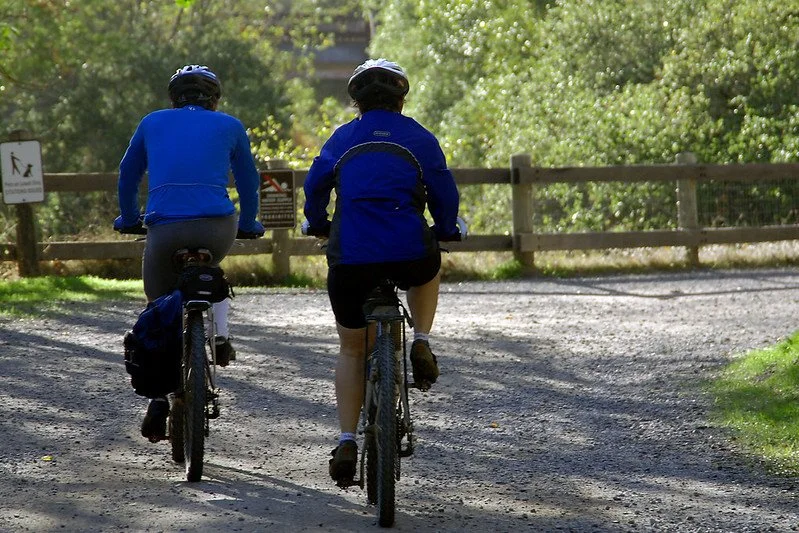
The trail leading from this park goes very quickly into the woods and splendid isolation along Phoenix Lake. It’s a beautiful place, rather hilly and secluded (except for other like-minded outdoor folk; see photo of bicyclists above), and I fell in love with the place immediately. I suspect that from now on I’ll wait my turn to park in the lot, just to be able to enjoy this amazing little getaway place so near home. (Perhaps it’ll be my new “Mt. Pisgah” – the favorite hiking spot of all time for me, right outside Eugene, OR.)
Then, on Sunday, I did something I had envisioned myself doing ever since I entertained the thought of moving to Marin: I walked the length of the Golden Gate Bridge. It was a cloudless and balmy afternoon, and I figured: it’s time! I discovered directions on the web about where to park, so I found my way to the Vista Point lot on the north side of the bridge. I walked the bridge from north to south, wandered around the visitor’s facilities at that end (i.e., the gift shop and café), then walked the span again back to my car.
What a totally perfect day to do this! I’ll have to go back again soon, though, when the photos will turn out with more “mood” associated with them.
Soundtrack Suggestion
I’m walkin’, yes indeed and I’m talkin’ ’bout you and me I’m hopin’ that you’ll come back to me, uh uh.