

On Leadership
Both this year, and my little holiday-break-from-reality, are about over. There are just a couple more days of laziness left before the whistle blows us all off to work once again on Tuesday morning. Ah, so.
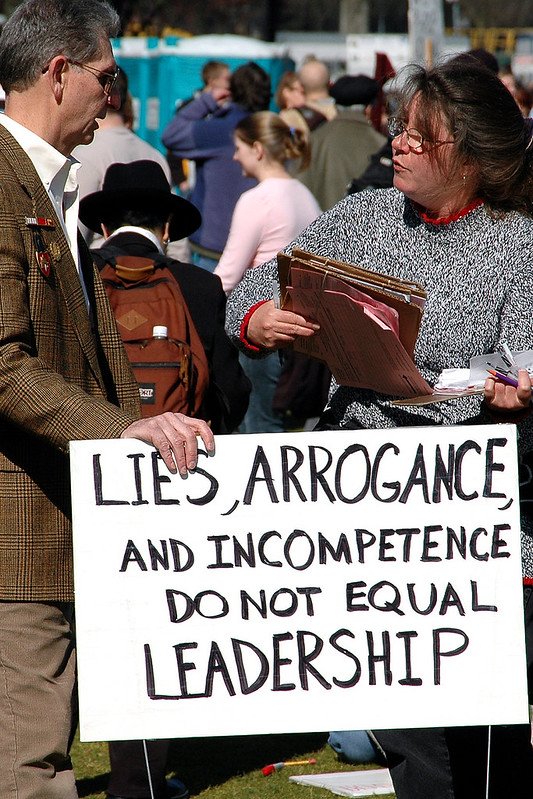
I’m including a photo here that I’ve been hoping to use in an entry sometime soon, so I’ll take this opportunity to post it now. I took this shot during a peace demonstration in Portland last March, and have entitled it “On Leadership.” It seems to me that the message sums up a lot of what’s wrong with this country: from the occupant of the White House, to leaders we experience on the local level, to those in our own work organizations. Any thoughts?
Teller’s Travail
So it was, on this mostly lazy day, that Teller wondered what could conceivably happen next. Just when he believed that things would certainly settle down on the Cascadia College campus (it was late December, final exams were over, and his faculty had scattered to the four winds, after all), stuff kept happening: events that were, unfortunately, consistent with the perpetual, overwhelming feeling of trying to function in a totally whacked-out (to use a technical term) environment. Sadly, Teller’s experience of the current “holiday break” seemed to be a continuance of the end-of-term craziness that he had just lived through.
For, even before the current semi-lull, there had been increasing intensity surrounding the conversations (that is to say, expressions of extreme doubt) about the institution’s leadership. One afternoon, for example, after the Thanksgiving holiday, Cascadia’s president distributed, to all staff, a draft version of the position description that would be used to recruit for the provost position sometime after the beginning of the new year. (Dr. Mennace, the current provost, was, at present, occupying the job on an interim basis.) Several of Teller’s faculty members had criticisms of the document, some of whom forwarded their concerns to the president. Many were just plain terrified that Dr. Mennace would not only apply for the job, but eventually secure it on a permanent basis. This prospect caused a huge amount of distress among Teller’s faculty, who, as noted previously, had significant distrust for just about everybody in the current administration.
Following the document’s distribution, Teller was approached by faculty members, often several times a day, about his intentions. Practically every single one of these interactions was not only to engage in a conversation about the status of his thinking, but also to encourage Teller to submit an application for the job. For although Teller was a member of the current administration, he had something that others in instructional leadership apparently did not: the trust of the faculty.
Naturally, Teller was flattered by all this attention. But he was not as elated as might be expected. The feeling of being wanted was, of course, exceptionally wonderful. However, the chaos that was the Cascadia College campus was not something Teller was convinced he could positively affect, even from the senior academic officer post: if he had the skills to provide assistance, to facilitate the change that was required, did he have the will? Did he have the energy?
Teller had become even more convinced of the continuing downward spiral of the institution during the previous twenty-four hours of this “break,” when one of his department chairs, a very talented person in the sciences, informed him that she was leaving Cascadia at the end of the current academic year. She had just accepted a teaching position in a neighboring state. This would be the second major loss to that department during the year, and Teller interpreted the development as yet another sign of the institution’s decreasing viability. When an organization keeps losing its best and brightest (and this was part of a pattern of continuing massive turnover, with three top-level administrators also leaving during the Fall quarter alone), when anyone who has an escape route uses it, then there is something definitely very rotten, as they say, in the State of Cascadia.

Of course, Teller continued to have his own struggles with the college’s leadership. For although Dr. Mennace was the chief instructional officer on campus (at least for the time being), he bore little similarity to Teller with respect to education, experience, philosophy or interpersonal skills. In terms of both personal and professional background, Teller and Mennace came from vastly different worlds. Whereas Teller was (among many things) a researcher, scholar, intellectual, therapist and consensus-builder, Mennace embraced a military model, viewing himself a field commander in a theatre of action. While Teller listened, Mennace gave orders. The following relationships seemed to apply: Teller/Mennace = comedy/tragedy; yin/yang; order/chaos. In other words: an obvious mismatch (given that there seemed to be no way to “complement” the Mennace paradigm).
Not surprisingly, the matter of leadership-style differences manifested themselves on a regular basis, and this had happened again during the holiday hiatus. In the case of a faculty member who was apparently skirting some safety rules, Mennace (being “the decider” that he is) expressed an inclination toward summary dismissal. Teller was nothing short of appalled, as he argued for a more (humane) developmental, due-process kind of approach.
Teller was extremely grateful that the holiday was finally here. Perhaps he could put these struggles aside for a bit. He was going home, to stay away from the office and the instability of the campus for an entire ten-day stint. Teller wanted to relax. To breathe. To spend some time with friends. And to prepare his own escape: he had some job applications he intended to complete.
On Integrity
I recently provided some observations about the Four-Fold Way and the difficulty level associated with the concept of surrender. Now, don’t get me wrong: I continue to think that letting go of outcome is truly a hard thing to do. Wow, yes, of course.
However, recent events have me thinking a lot about the difficulty of, and price associated with, maintaining one’s integrity – and what it means to continue to speak one’s own truth in the face of remarkable resistance. That’s what it feels like I’ve been doing lately, and, frankly, I’m exhausted.
In a meeting two weeks ago, I found myself, unexpectedly, on the hot seat. Our CEO dropped by, sat down (as a result of an impromptu invitation), and joined us in a group discussion; as fate would have it, I wound up being the featured attraction. I was asked, at least a couple of times, for my views regarding some of our challenges, and, since I was specifically prompted, I answered directly and honestly. I told about my personal experience of trying to function at the nexus of two warring factions (i.e., with great levels of difficulty and stress); of an organization that lacks trust in its leadership (two individuals specifically); and of a place that is “stuck” and in dire need of a focused, protracted healing process.
I spoke for almost an hour on this occasion, in front of a small group that included a handful of the organization’s leaders. I received verbal support from only one other person, and even that was quite tentative. I felt very much alone. Isolated. And somewhat afraid.
Just that one hour totally drained me. To speak out loud a reality that is in opposition to a group’s is very hard work. It reminds me a lot of the “obedience to authority” social-psychology experiments, conducted in the 1960s by Stanley Milgram. The primary value of Milgram’s work was documentation for the willingness of individuals to engage in activities contrary to their own consciences, simply upon the command of an authority figure. Of course, I feel the desire to conform to the press of the environment and “go along” – who among us does not want to live in harmony with others around them? Especially our “bosses?” Certainly I am not immune to such forces.
I would love to be able to tell people what they want to hear. To be able to do what they want me to do. To conform. To fit in. To belong. Who doesn’t want that?
To resist. To persist. Steadfastness. To remain true to oneself. Honesty. Integrity.
Difficult. Taxing. Necessary.
Addictive Organizations and the Four-Fold Way
If you’ve ever discovered the need to show up at work everyday by first forcing yourself out of bed, and then dragging yourself into the office because you’re dreading the day there: perhaps you’re working in an “addictive organization” (a concept I briefly outlined in my recent Analysis Paralysis post).
How does anyone really cope with life in an addictive organization? How is it possible to survive, much less thrive? What is your fate if you find yourself in one? Can you promote health and recovery…and actually, eventually, find a place of well-being there?
During the time I was engaged in my doctoral research, and anticipating using the addictive organization model as a theoretical framework for my dissertation, I corresponded briefly with Anne Wilson Schaef, the model’s developer. I had been tremendously impressed with her “organization as addict” metaphor and asked about any thoughts she might have regarding “coping with” or “recovery in” such an organization. She said that her plans were to write a follow-up book to The Addictive Organization (1988) and outline her ideas there. As far as I’ve been able to determine, though, she never produced that book…I can only hope it’s not because she thinks that recovery is impossible!
Now, given that it took an entire 232 pages to outline the many dimensions of an addictive organization, I suppose it would be reasonable to assume that any discussion of recovery in one would take at least as much space. However, coping with an addictive organization has been much on my mind lately, and I thought I might get started (here) on developing some salient points regarding this topic.
Although there are several dimensions of an addictive organization, certainly near the top of the list of characteristics (and among the most applicable to individual addicts) are the descriptors of denial, dishonesty and control. So, in this brief essay, let’s begin with just these three.
Denial means that the organizational problems are not openly acknowledged, or at least not accepted as “real” by those most able to address the dysfunction: the leadership. For issues to be worked on, they need to be identified, they need to be named. Statements such as “this is just the way things are” or “this is as good as it gets” or “we may have a few small problems here, but certainly not big ones” – when everyone really knows differently – is a sure sign of organizational denial.
Dishonesty is another key characteristic of an addictive organization. Like individuals who are addicted to substances or processes, those caught up in such an unhealthy organization exhibit their dishonesty on three levels: by lying to themselves, to those around them, and to the world at large. Believing that one can effectively impression-manage (e.g., the media) and “put up a good front” to those outside the organization, for example, are a couple of obvious manifestations of organizational dishonesty.
[I was once told, in private, by a college president, “I tell lies to everyone every day. There’s no other way to do this job.” While a striking example of personal honesty, the underlying message is one that reflects normal life in an addictive system.]
Finally, there is the element of control. This more accurately might be labeled the illusion of control, though, as it is, of course, ultimately impossible to control anything. However, the addictive organization harbors the notion that it is possible to control. When likened to a dysfunctional family that revolves around an individual addicted member, Schaef (p. 66) describes this symptom as “[t]he family tries to control the addict; the addict’s behavior is controlling the family; the co-dependent spouse is trying to avoid being controlled; and everyone is going crazy.” Further, Schaef notes (p. 66), that “whenever a system is operating on the illusion of control, it is an addictive system by definition.”
I believe that it’s possible to begin the grasp the severity of life in an addictive organization by simply (and quite briefly, as I’ve done above) understanding just these three characteristics. The questions that naturally arise include: What is there to do? How do I cope? How do I survive? How can I continue to show up every day, when this is what I always find?
I suppose that any discussion of “recovery” in a system defined as “addictive” would naturally include, at some point, a 12-step model; let me leave that discussion for another day, though. I would like to begin with countering the three points above by suggesting strategies that lie on the opposite ends of our behavioral continuum.
If the characteristics of denial and dishonesty are taken together (considering that denial is essentially a lie to one’s self), then a position contrary to that is honesty. Similarly, when the element of control is considered, an alternative could be termed surrender. So, I pose the question, what if I approached life in an addictive system with a personal stance of honesty and surrender?
When I consider this question, I am reminded of the Four-Fold Way orientation developed by anthropologist Angeles Arrien. Quoting directly and liberally from the description of this model on her website, I believe it is evident how such a philosophical and behavioral stance might successfully contend with the illness of an addictive system. The four elements are:
Be Present. The way of the Leader is to show up. Being present allows us to access the human resources of power, presence, and communication. We express this through appropriate action, good timing, and clear communication.
Pay Attention. The way of the Healer is to pay attention to what has heart and meaning. Paying attention opens us to the human resources of love, gratitude, acknowledgment, and validation. We express this through our attitudes and actions that maintain personal health and support the welfare of our environment.
Tell The Truth. (Honesty) The way of the Creative Problem Solver is to tell the truth without blame or judgment. Truthfulness, authenticity, and integrity are keys to developing our vision and intuition. We express this through personal creativity, goals, plans, and our ability to bring our life dreams and visions into the world.
Be Open To Outcome. (Surrender) The way of the Teacher (or Counselor) is to be unattached to outcome. Openness and non-attachment help us recover the human resources of wisdom and objectivity. We express this through our constructive communication and informational skills.