Do you believe that you know the truth when you hear it?
This morning, near the end of a long, otherwise-waste-of-time meeting, those of us in attendance were asked to provide feedback about a recent workshop experience. Now, given that I had been unable to attend that particular event, I was obviously unable to offer up any commentary.
So, I sat and just listened.
The first person to speak happened to provide some quite-critical remarks. But, he did it in a very gentle, thoughtful and articulate way, and it was obvious that he was speaking from the heart.
Ahhh, I said to my self, a truth-teller.
I was pretty amazed. This is not a group that, in my experience, can “tell it like it is.” It’s just not a safe enough environment in which to express one’s honest beliefs most of the time.
So, here’s something I know: there’s hardly anything in the world that’s quite as refreshing as an honest person speaking his or her own truth. (Especially when there may be some kind of risk involved.) You know: someone who just kind of lets it all hang out there, despite the possibility of consequences.
This happens to be the second time in a week I’ve witnessed an apparent truth-teller. Last Friday night, Bill Maher interviewed presidential candidate John Edwards on HBO’s “Real Time With Bill Maher.” Edwards is proposing a universal health-care system that would need more tax dollars to support. He openly admits that, regarding the most important issue he voted on in the U.S. Senate, the war in Iraq, he got it wrong. (!) And, he is against the current W. proposal for a “surge” and has a plan to disengage us from that debacle in about a year’s time.
Wow. A politician who admits a mistake. Someone who says he’d actually raise taxes. Pretty radical stuff.
Even Bill Maher was rather amazed, and observed that individuals who are that honest don’t typically get elected.
Edwards suggested we change all that in 2008.
So, what do you think? Does an honest politician exist? Is Edwards that person? Could this country possibly elect such an individual to our highest office?
The cover story of the January 15 edition of Time Magazineexamines the question of “what a surge really means.” It now appears as if we’re headed for another boost of troop levels in Iraq, doesn’t it?
Despite the clear will of the American people expressed during last November’s elections, and contrary to the advice of practically everyone that matters (except, I guess, Senator John McCain), W is going his own merry way yet again: obviously living in a fantasy world that hardly anyone else inhabits.
MORE TROOPS IN IRAQ!?!? HUH!?
Hey, George: you’re going the wrong way!
(I know, I know…there’s a punctuation error in the sign…it’s why I took the photo in the first place! See Eats, Shoots & Leaves for a thorough discussion of how we regularly – and publicly – botch punctuation.)
Both this year, and my little holiday-break-from-reality, are about over. There are just a couple more days of laziness left before the whistle blows us all off to work once again on Tuesday morning. Ah, so.
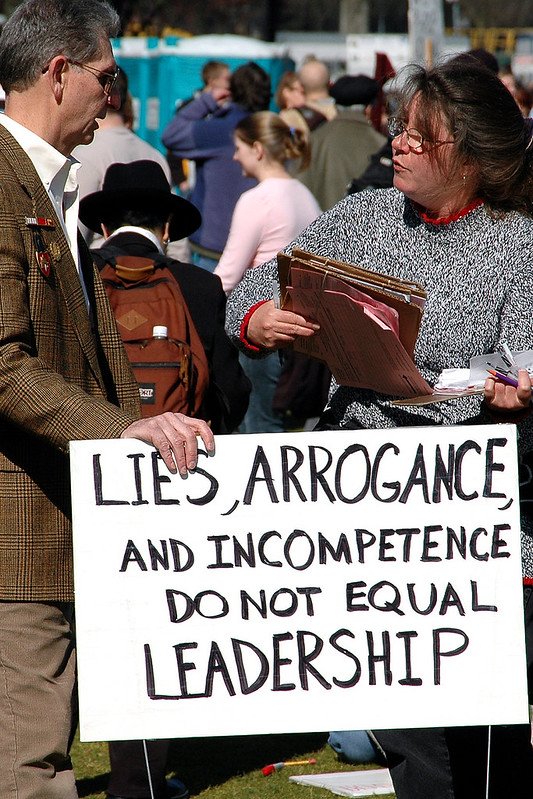
I’m including a photo here that I’ve been hoping to use in an entry sometime soon, so I’ll take this opportunity to post it now. I took this shot during a peace demonstration in Portland last March, and have entitled it “On Leadership.” It seems to me that the message sums up a lot of what’s wrong with this country: from the occupant of the White House, to leaders we experience on the local level, to those in our own work organizations. Any thoughts?
So it was, on this mostly lazy day, that Teller wondered what could conceivably happen next. Just when he believed that things would certainly settle down on the Cascadia College campus (it was late December, final exams were over, and his faculty had scattered to the four winds, after all), stuff kept happening: events that were, unfortunately, consistent with the perpetual, overwhelming feeling of trying to function in a totally whacked-out (to use a technical term) environment. Sadly, Teller’s experience of the current “holiday break” seemed to be a continuance of the end-of-term craziness that he had just lived through.
For, even before the current semi-lull, there had been increasing intensity surrounding the conversations (that is to say, expressions of extreme doubt) about the institution’s leadership. One afternoon, for example, after the Thanksgiving holiday, Cascadia’s president distributed, to all staff, a draft version of the position description that would be used to recruit for the provost position sometime after the beginning of the new year. (Dr. Mennace, the current provost, was, at present, occupying the job on an interim basis.) Several of Teller’s faculty members had criticisms of the document, some of whom forwarded their concerns to the president. Many were just plain terrified that Dr. Mennace would not only apply for the job, but eventually secure it on a permanent basis. This prospect caused a huge amount of distress among Teller’s faculty, who, as noted previously, had significant distrust for just about everybody in the current administration.
Following the document’s distribution, Teller was approached by faculty members, often several times a day, about his intentions. Practically every single one of these interactions was not only to engage in a conversation about the status of his thinking, but also to encourage Teller to submit an application for the job. For although Teller was a member of the current administration, he had something that others in instructional leadership apparently did not: the trust of the faculty.
Naturally, Teller was flattered by all this attention. But he was not as elated as might be expected. The feeling of being wanted was, of course, exceptionally wonderful. However, the chaos that was the Cascadia College campus was not something Teller was convinced he could positively affect, even from the senior academic officer post: if he had the skills to provide assistance, to facilitate the change that was required, did he have the will? Did he have the energy?
Teller had become even more convinced of the continuing downward spiral of the institution during the previous twenty-four hours of this “break,” when one of his department chairs, a very talented person in the sciences, informed him that she was leaving Cascadia at the end of the current academic year. She had just accepted a teaching position in a neighboring state. This would be the second major loss to that department during the year, and Teller interpreted the development as yet another sign of the institution’s decreasing viability. When an organization keeps losing its best and brightest (and this was part of a pattern of continuing massive turnover, with three top-level administrators also leaving during the Fall quarter alone), when anyone who has an escape route uses it, then there is something definitely very rotten, as they say, in the State of Cascadia.
Of course, Teller continued to have his own struggles with the college’s leadership. For although Dr. Mennace was the chief instructional officer on campus (at least for the time being), he bore little similarity to Teller with respect to education, experience, philosophy or interpersonal skills. In terms of both personal and professional background, Teller and Mennace came from vastly different worlds. Whereas Teller was (among many things) a researcher, scholar, intellectual, therapist and consensus-builder, Mennace embraced a military model, viewing himself a field commander in a theatre of action. While Teller listened, Mennace gave orders. The following relationships seemed to apply: Teller/Mennace = comedy/tragedy; yin/yang; order/chaos. In other words: an obvious mismatch (given that there seemed to be no way to “complement” the Mennace paradigm).
Not surprisingly, the matter of leadership-style differences manifested themselves on a regular basis, and this had happened again during the holiday hiatus. In the case of a faculty member who was apparently skirting some safety rules, Mennace (being “the decider” that he is) expressed an inclination toward summary dismissal. Teller was nothing short of appalled, as he argued for a more (humane) developmental, due-process kind of approach.
Teller was extremely grateful that the holiday was finally here. Perhaps he could put these struggles aside for a bit. He was going home, to stay away from the office and the instability of the campus for an entire ten-day stint. Teller wanted to relax. To breathe. To spend some time with friends. And to prepare his own escape: he had some job applications he intended to complete.
I recently provided some observations about the Four-Fold Way and the difficulty level associated with the concept of surrender. Now, don’t get me wrong: I continue to think that letting go of outcome is truly a hard thing to do. Wow, yes, of course.
However, recent events have me thinking a lot about the difficulty of, and price associated with, maintaining one’s integrity – and what it means to continue to speak one’s own truth in the face of remarkable resistance. That’s what it feels like I’ve been doing lately, and, frankly, I’m exhausted.
In a meeting two weeks ago, I found myself, unexpectedly, on the hot seat. Our CEO dropped by, sat down (as a result of an impromptu invitation), and joined us in a group discussion; as fate would have it, I wound up being the featured attraction. I was asked, at least a couple of times, for my views regarding some of our challenges, and, since I was specifically prompted, I answered directly and honestly. I told about my personal experience of trying to function at the nexus of two warring factions (i.e., with great levels of difficulty and stress); of an organization that lacks trust in its leadership (two individuals specifically); and of a place that is “stuck” and in dire need of a focused, protracted healing process.
I spoke for almost an hour on this occasion, in front of a small group that included a handful of the organization’s leaders. I received verbal support from only one other person, and even that was quite tentative. I felt very much alone. Isolated. And somewhat afraid.
Just that one hour totally drained me. To speak out loud a reality that is in opposition to a group’s is very hard work. It reminds me a lot of the “obedience to authority” social-psychology experiments, conducted in the 1960s by Stanley Milgram. The primary value of Milgram’s work was documentation for the willingness of individuals to engage in activities contrary to their own consciences, simply upon the command of an authority figure. Of course, I feel the desire to conform to the press of the environment and “go along” – who among us does not want to live in harmony with others around them? Especially our “bosses?” Certainly I am not immune to such forces.
I would love to be able to tell people what they want to hear. To be able to do what they want me to do. To conform. To fit in. To belong. Who doesn’t want that?
To resist. To persist. Steadfastness. To remain true to oneself. Honesty. Integrity.