

No Confidence
This is the op-ed I published in the Eugene Weekly, November 26, 2025
Last spring (EW, April 16) I wrote that the Lane Community CollegeBoard of Education had become dysfunctional and needed new voices. When I followed up just recently (EW, October 9), I had hoped to report progress. I couldn’t. The same divisiveness remains and the stakes have only grown.
It now seems apparent that LCC’s problems go far beyond a Board unable to find itself. At the November 5 Board meeting, over two hours of public comment revealed deeper layers of concern. Speakers described an administration that, in their view, operates with limited transparency and contributes to a culture in which employees hesitate to speak openly. Several also stated that a divided Board has not provided the oversight the college requires.

President Stephanie Bulger’s leadership has strained relationships with faculty, staff, and some trustees. Rather than collaboration, many describe unilateral decision-making and limited inclusion in governance. One of the president’s stated goals early in her tenure was to improve campus climate. Multiple accounts now indicate that this has not happened. Instead, trust has deteriorated and the fear factor has increased.
Faculty union president Adrienne Mitchell’s open letter to the Board (posted to lccea.org on November 4) courageously documents many of these issues. She reports that employees have been pressured to resign or sign nondisclosure agreements and that faculty and administrators are afraid of retaliation for speaking up. After raising concerns, she was reportedly told by the president, “I don’t know how long you’ll be around here,” before facing a proposed layoff.
Her letter also highlights damaging operational decisions. The suspension of the Licensed Practical Nursing program last spring, enacted without public input or a Board vote, left thirty-seven qualified applicants without a viable local training path. Meanwhile, delays in promoting the new Bachelor of Science in Nursing program resulted in only eleven students enrolling instead of sixty.

As a former academic dean responsible for scheduling, I know course planning must be dependable and student-centered. Yet, this fall, more than 100 course sections were canceled, including core classes with active registration. Late cancellations derail student progress and weaken confidence in the institution. Faculty estimate tuition losses may reach $1 million. These reductions appear inconsistent with the adopted budget and limit student access.
Labor negotiations have also deteriorated. Talks are nearing impasse. According to the latest faculty-union bargaining update, there has been no substantive movement from the administration on compensation, benefits, workload, or job security. The administration’s cost analysis has been strongly disputed by faculty. With only two sessions remaining, mediation appears likely. While strike action is not imminent, some faculty have begun considering it as a last-resort option should conditions fail to improve. The central issue right now is the absence of meaningful progress.
Concerns extend to Board governance. For example, when several trustees requested an agenda item reaffirming Board authority over program and service reductions, it did not appear. Instead, an administrative memo supporting the president’s position was included. This outcome limited the Board’s ability to fulfill its duty to oversee operations at a critical time. In my October 9 column, I suggested that Trustee Mulholland step aside to demonstrate Board accountability. With the fuller scope of concerns now evident, it is clear governance issues extend beyond any one trustee. The problem lies with a governing body that has not acted decisively while the institution struggles.
Given the continuing lack of trust, the deteriorating labor posture, the failure to improve campus climate as promised, and the absence of collaborative leadership at a time when stability is essential, I see no viable path forward under current conditions. I recommend that the Board decline to renew President Bulger’s contract and begin an open, transparent leadership search grounded in accountability and partnership. This is not a punitive decision. It is responsible stewardship on behalf of the institution.
If the Board does not act unilaterally, I suggest that faculty consider a formal vote of No Confidence to publicly affirm that administrative leadership marked by fear and stalemate cannot continue.
Lane Community College remains one of Lane County’s greatest public assets. It educates our workforce, expands opportunity, and strengthens the local economy. At this critical moment, leadership must demonstrate the courage to act. The community is watching. The future of the college depends on it.
An Embarrassment to Our Community
This is the op-ed I published in the Eugene Weekly, October 9, 2025
Last spring, in these pages (EW, April 17), I suggested that the Lane Community College (LCC) Board of Education might resolve its dysfunction by electing some new members. Six months later, I’ll admit that my optimism was misplaced. While we now have a couple of new faces, the Board remains divided, unproductive and, at times, an embarrassment to our community.

Several others have also recently weighed in on the College's status. First, former faculty member Steve McQuiddy (EW, September 4) reminded us that the institution once thrived on trust, cooperation, and a commitment to the collective good. Then, College President Stephanie Bulger (EW, September 11) and Faculty Union President Adrienne Mitchell (EW, September 25) both described LCC as being at an “inflection point,” though they disagreed on what that might mean. Bulger argued that “expenses have risen faster than revenue” and announced annual budget reductions of $3 million through 2029. Mitchell countered that reserves have “increased by $1 million over the last two years while revenue exceeded expenses, not the other way around,” and that the administration has sidelined both the Board and public, pointing to the unilateral pause of the Licensed Practical Nurse (LPN) program.
But let’s back up. I contend the cracks in Board governance first became public when the body failed to fill the vacancy left by Trustee Lisa Fragala’s resignation late last year. Four qualified applicants stepped forward, but the Board deadlocked and left the seat empty — an early sign of its inability to act decisively.
More troubling conflict soon followed. In early April 2025, then-Vice Chair Kevin Alltucker read a letter into the record accusing then-Chair Zach Mulholland of abusive and bullying behavior toward President Bulger. The College commissioned an independent investigation, which in late June substantiated the complaints. The report found Mulholland verbally abusive, hostile, and intimidating toward Bulger, as well as a student, while also noting broader dysfunction within the rest of the Board.
The community responded swiftly. At the September 3 Board meeting, more than two dozen citizens, including two former LCC presidents and a former trustee, spoke with one voice: Mulholland had lost the confidence of the public and should resign. Instead, the Board voted to censure him. Now, while serious in theory, censure is largely symbolic. It leaves the censured member in office with credibility unaddressed.

Meanwhile, the Board has stumbled in other areas of its responsibility. This fall, trustees have struggled to define their role in decisions about academic programs. The temporary suspension of the LPN program, implemented by the administration without a formal Board vote, illustrates this challenge. The Board’s discussions sparked by this move have been disorganized, poorly informed, contentious and often disrespectful. Then, at the September 30 meeting, the President’s goals, up for official approval, included those annual $3 million budget cuts mentioned above. During the public comment portion of the meeting, it had been suggested that this Presidential goal circumnavigated the prescribed institutional budget-development process, so during consideration of this item there were exchanges that clearly illustrated the divisions within the Board — as well as the power struggle between the Board and the President.Taken together, these issues are examples of the dangers discussed by Mitchell, because when transparency and shared governance are sidelined, students, faculty and the College’s mission are put at risk.
McQuiddy’s reflections provide a constructive contrast. Faculty and staff have long prioritized collective success over personal gain, demonstrating trust, collaboration, and commitment to the broader community. If the Board emulated such an ethos, it could rebuild confidence and make decisions rooted in LCC’s shared mission.
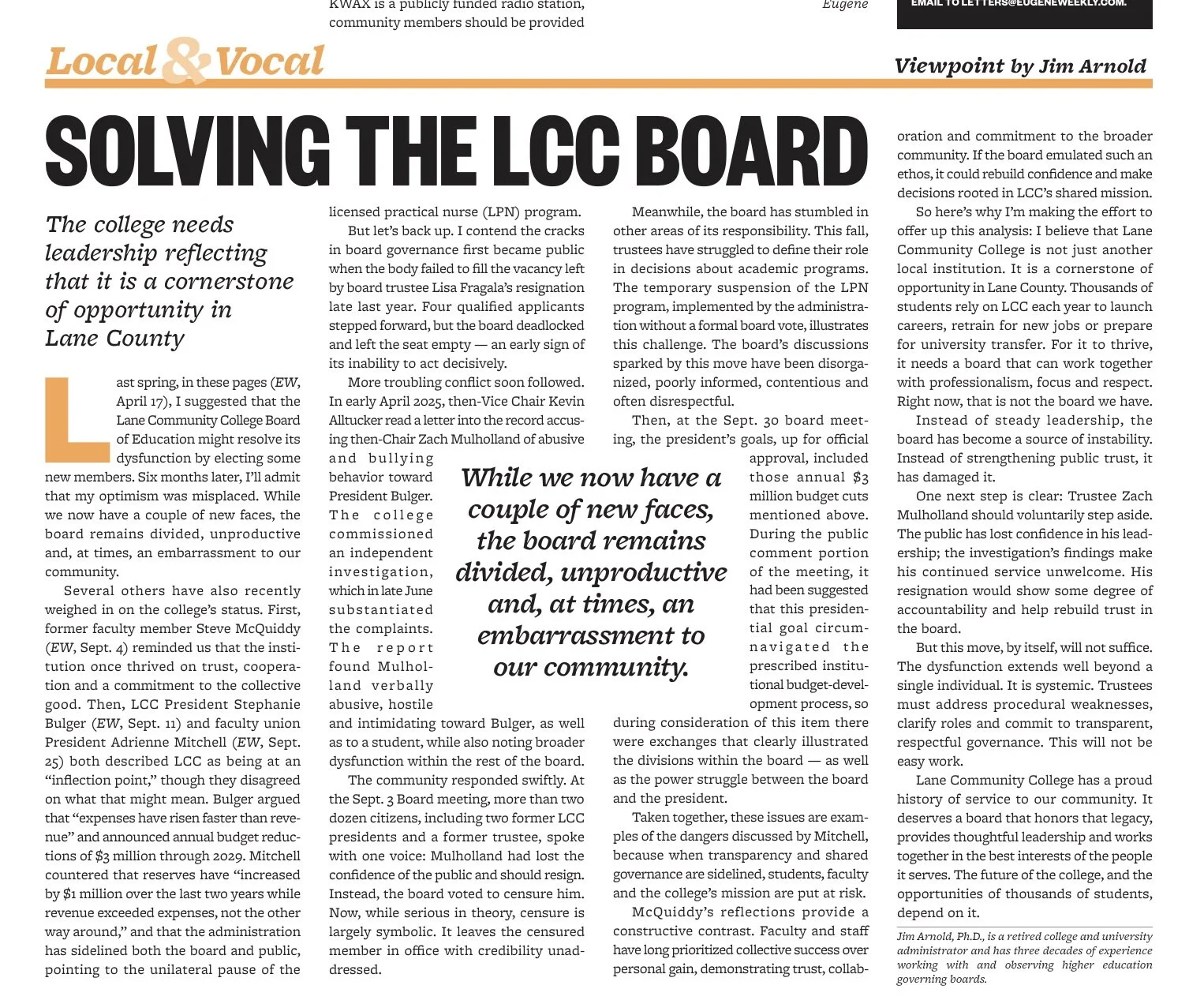
So here’s why I’m making the effort to offer up this analysis: I believe that Lane Community College is not just another local institution. It is a cornerstone of opportunity in Lane County. Thousands of students rely on LCC each year to launch careers, retrain for new jobs, or prepare for university transfer. For it to thrive, it needs a Board that can work together with professionalism, focus, and respect. Right now, that is not the Board we have.
Instead of steady leadership, the Board has become a source of instability. Instead of strengthening public trust, it has damaged it.
One next step is clear: Trustee Zach Mulholland should voluntarily step aside. The public has lost confidence in his leadership; the investigation’s findings make his continued service unwelcome. His resignation would show some degree of accountability and help rebuild trust in the Board.
But this move, by itself, will not suffice. The dysfunction extends well beyond a single individual. It is systemic. Trustees must address procedural weaknesses, clarify roles, and commit to transparent, respectful governance. This will not be easy work.
Lane Community College has a proud history of service to our community. It deserves a Board that honors that legacy, provides thoughtful leadership, and works together in the best interests of the people it serves. The future of the College, and the opportunities of thousands of students, depend on it.
LCC Board of Education Testimony — September 3, 2025
Here are my remarks made before the Lane Community College Board of Education on September 3, 2025
Chair Folnagy, Members of the Board, President Bulger, Colleagues:
Good evening. My name is Jim Arnold. I’m a Lane County resident, a retired university and college administrator, and someone who sincerely cares about the future of Lane Community College.

First of all, congratulations to the re-elected and newly-elected Board members. I think it’s especially great to see Jesse seated to the Zone 7 position, for which I was an applicant last December.
Tonight I stand here as an ally of both the college’s faculty AND, well, the Board of Education too, because I am very concerned about the wide gap between the bargaining positions of the LCCEA and the administration. I worked in higher education for decades and I know how essential it is to have a stable, respected, and fairly-treated faculty if we want our students to succeed.
The proposals brought forward by the faculty union are thoughtful, forward-looking, and clearly rooted in student success. They’re calling for more support for students — including better access to advising, tutoring, and mental health services. They’re advocating for inclusive facilities, safe classrooms, and working conditions that allow faculty to focus on teaching and mentoring students.
On the other hand, the administration is proposing to reduce job security, eliminate long-standing agreements, and reserve the right to reopen pay discussions at almost any time, under vaguely defined conditions. That kind of unpredictability doesn’t just harm morale — it makes it harder to recruit and retain good faculty.
Now, I offer these comments in the context of a recent finding that the administration has engaged in unfair labor practices. Of course, at the same time, one of the continuing priorities of the president is to improve campus climate. Frankly, I’ve really been trying to wrap my head around all that.
In closing, I urge you all, as a Board, to strongly encourage your bargaining team to move toward a settlement that reflects Lane’s espoused values of integrity, relevance, learning, support and transformation. Wouldn’t it be wonderful if LCC’s espoused values were the ones we actually enact. So, even in these resource-challenged times, my advice to you is to choose to invest in students and in faculty.
Thank you for your time.
LCC Budget Committee Testimony — May 21, 2025
Here are my remarks made before the Lane Community College Budget Committee on May 21, 2025
Chair Patterson, Members of the Budget Committee, President Bulger, Colleagues, and Friends:
Hello again. My name is Jim Arnold. I’m a Lane County resident and a retired community college dean. In my last full-time position, I had responsibility for six academic departments plus athletics. I managed the personnel and budgets for everything from physics to football. I have a deep appreciation for the financial woes we face in higher education.
I’m here to follow up on my comments from last week, offer a few observations, and make another recommendation along the way.
At the last meeting, I asked why the projected 3.1 million dollar deficit had not been shared with us sooner — especially since the earlier proposal from the Budget Development Subcommittee didn’t reflect a shortfall. I also urged this Committee to request a revised budget — one that’s balanced and doesn’t rely on reserves.

I appreciated Mr. Isaacson’s candor in expressing confusion — which echoed my own — about what changed so suddenly to throw the budget out of balance. The administration cited a variety of factors, including shifting assumptions, the need for various refinements, and a lack of time for more thoughtful decision-making. I, for one, was not entirely persuaded by these arguments.
I also heard other Committee members express real discomfort with budgeting for a deficit while relying on administrative mid-year corrections. Mr. Mital observed that this could be interpreted as a “not to exceed” budget — but I contend that setting an artificially high ceiling doesn’t make an unbalanced plan a responsible one.
Now, it seems the administration is hoping for approval of their budget tonight. My recommendation is simple: take a step back. Hit the pause button, engage your most curious selves and inquire: “is that the right thing to do?” I ask you to give the process another week for serious, transparent deliberation.
Adrienne Mitchell’s latest analysis — which was made available to you yesterday via email — includes various scenarios that show a balanced budget is within reach. These alternatives deserve an honest review before any final decision is made. Perhaps you could consult administration and ask, “what’s wrong with these numbers?”
So, in conclusion, a gentle reminder: it’s the Board of Education — not just the administration — that is ultimately responsible for adopting the College’s budget and deciding on any reductions. This Committee and the Board play a vital role in public oversight. You are not here to rubber-stamp a proposal without knowing what’s at stake. I believe that you are here to ensure transparency, accountability, and stewardship of the college’s future.
Thanks so much.
LCC Budget Committee Testimony — May 14, 2025
Here are my remarks made before the Lane Community College Budget Committee on May 14, 2025
Chair Patterson, Members of the Budget Committee, President Bulger, Colleagues, and Friends:
Good evening. My name is Jim Arnold. Some of you know me, but for those who don’t, I’m a former university and community-college administrator. In retirement, I’ve remained involved in higher education, including part-time faculty and classified roles here at LCC. I also served on the Budget Development Subcommittee here during the 21–22 academic year.
I come before you tonight to share a few brief observations, pose some questions, and to make a recommendation.
From what I understand, this year’s Budget Development Subcommittee — made up of faculty, classified professionals, and administrators — engaged in what’s been described as an extremely collaborative shared-governance process. Their final product was a balanced budget, approved by the College Council last month, that included a surplus of around $600,000.
