Given that I’m in a period of major transition now, and have been for quite some time, these selections seem particularly appropriate. Since I’ve picked these two up in the last few days, I’m feeling a tad more peaceful.
With the Chödrön book particularly, there is pearl after pearl. I’m keeping my highlighter handy as I go. In just the second chapter, I have rediscovered the words
“Life is a good teacher and a good friend. Things are always in transition…[t]o stay with that shakiness—to stay with a broken heart, with a rumbling stomach, with the feeling of hopelessness and wanting to get revenge—that is the path of true awakening. Sticking with that uncertainty, getting the knack of relaxing in the midst of chaos, learning not to panic—this is the spiritual path.” (Pema Chödrön, When Things Fall Apart, p. 10)
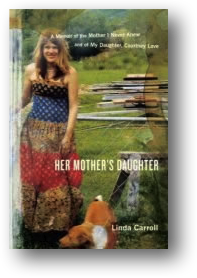
In the midst of everything else going on for me right now, I finally have finished reading Linda Carroll’s biography: Her Mother’s Daughter. As I have written about before, I’ve known Linda for over 25 years and identify her as one of the most influential people in my life – indeed, I consider her one of my family on this planet during this lifetime. (I’ve absolutely no idea if she has any thoughts along these lines, though.) She’s served as my counselor, confidante, friend, mentor and spiritual guide – helping me through some very difficult spots. I am incredibly fortunate to have met her and to have had her in my life for (at this point) nearly half my time on earth. Frankly, any attempt to think about this lifetime without Linda in it hardly seems like my life at all.
I first mentioned Linda in these pages after reading Borrowed Finery by Paula Fox. Fox is the famous author of novels and childrens’ books who, early in her life, gave Linda up for adoption. Linda finally tracked her mother down after the birth of granddaughter Frances Bean Cobain. Although quite elderly now, Paula is still alive and she and Linda continue to maintain a relationship begun, belatedly, in the mid-1990s.
In the time I’ve known Linda a lot has happened to her, both personally and in terms of her public notoriety. She is, after all, not only Paula Fox’s daughter, but Courtney Love’s mother. The stormy relationship between Linda and Courtney has been reported in the popular press, up until this time, exclusively through Courtney’s eyes. A number of unflattering and outrageous things have been said about Linda that are totally inconsistent with the good-hearted person that I know and love. Not that I ever really knew much of Linda’s story before reading the book, though; I have only had glimpses into small parts of her life. As my counselor, Linda has been focused on listening to the rhythms of my story, not the other way around. Most of what I know about Linda the person has come through my experience with her in various workshops over the years. The most recent group experience I had with her was about 7 years ago now, in a PAIRS (couples) course led by her and husband Tim.
Now that I’ve finished reading Her Mother’s Daughter, I’ve searched out some of the literary reviews and am discovering that they appear, well, mixed . Some praise Linda’s narrative style and general ability to draw the reader into the drama that has been her life. Others take a more critical stance, sometimes judging her life itself, apparently overwhelmed by the chaotic nature of Linda’s existence. For myself, I was amazed at the detail Linda was able to relate to me, the reader, describing experiences from an age when I would have no memories to draw on at all. Further, I was totally engaged with her writing style, finding it smooth and conversational, mirroring the “real person” that I know her to be.
Of course, upon reading the biography, I tend to agree that Linda’s life has been chaos. And in terms of order of magnitude of lifetime chaotic experiences, her biography rivals her mother’s. As much turmoil as I believe I’ve personally experienced, I admit that my story has had less overall drama than either Paula’s or Linda’s. Linda is on her fourth marriage; she gave birth to six children, one who died as an infant; an adopted child subsequently discovered another home for which he was a better fit; she escaped San Francisco by moving to Oregon, then moved to New Zealand and back to Oregon; her oldest child is Courtney, likely one of the most “out there” celebrities since Madonna’s younger days; and (not covered in the book) she once found herself the therapist for Katherine Ann Power, an activist from the 60s who spent most of her adult life underground.
Zounds: what a life.
I’ve lived my life parallel to a good portion of Linda’s drama, and I have sought out her big heart, attentive ear, and perceptive nature time and time again. She has never said she was not available to me. Whenever I’ve shown up, she’s always been totally present. Truthfully, I only had hints here and there that she was living the life she describes in this book. Even though her own existence has surely been an emotional roller-coaster, she has always been able to focus on me and my story and provide help when I sought her out. Simply, Linda is a human being of the highest caliber. The meaning of the chaos of her life, for me, I now understand, is that she’s always been able to assist me with my own frequently-chaotic existence.
A psychic I once consulted, who relayed to me some of my past-life experiences, reported that Linda and I had been twins at least two times in previous lifetimes. It is, at the very least, an entertaining thought. I know I feel very, very connected to her. My relationship with Linda is one of the most cherished things in my life. I glad she wrote her story so that I can know it: so that I can know her better than I do.
Listen to your life. It’s showing you everything you need to know about who you can become. (Messiah’s Handbook)
Isn’t it amazing how it's possible that life can turn on your next conversation — or unexpected phone call, email or piece of paper? One minute the world is this way, the next it is something entirely different. The phone call I’ve been waiting for, obviously, is a job offer. Although I’m gainfully employed, I’ve been searching for that “permanent” position for two years now. It hasn’t arrived yet.
But, that’s not the phone call that came this weekend. The voicemail from my landlords this morning was news that the house I’m renting from them is going to be sold. Out from under me. I’ll have some as-yet-undetermined time period after the sale to move out. But, it will very likely be in a month or little more. I was handed a piece of paper outlining the intent to sell, the terms of working with the realtor, and the notice that I’ll need to move my body and possessions to some other location. Soon.
Of course, I’ve had other conversations, phone calls, and pieces of paper that have totally shifted the universe. One of those, obviously, would be the notice I received that August night in 1983: “Mr. Arnold, I’m sorry, you are under arrest for driving under the influence of intoxicants…”
Another would be the email I received from Katrina in October 1999 that said: “Had my annual today. Found a lump. More tests Thursday... Needing good thoughts.”
Or, the emergency room doctor who (mis)diagnosed me with bladder cancer — but was very convincing in his (ultimately erroneous) opinion.
And, of course, there was the paper from the Board of Higher Education terminating my employment with the Chancellor’s Office in the Spring of 2004.
Now, today’s news is not exactly a life and death situation, though with my current energy level, this development seems pretty overwhelming. On top of my regular job, and my job as a job-hunter, I now have to find a new residence, pack up, and move while I continue to look for “real” work.
It would appear that I am being challenged. I am experiencing the opportunity to find out what I’m made of.
Why did I choose this? What am I supposed to be learning here?
Let me guess: it must be about one of my lifetime issues.
You may have caught on: I’m a worrier. I think a lot; I emote a lot. Not that I’m really obsessive, but perhaps there’s a tendency in that direction?
And, I’m a planner: organized and always thinking ahead.
These various elements of my personality seem to collide, in that it’s not a stretch for me to go, in my mind, to “catastrophizing,” that is, thinking about the future and saying to myself “this has disaster written all over it.”
I have an uncertain job situation. I have an infection. I have a muscular or nerve issue in my leg. I have a life alone. I spend all my “free time” trying to find a job. I have trouble sleeping. I need prostate surgery. I don’t have time to pursue my art.
Oh, my, I guess I could keep going…you get the picture, though: worry, worry, worry! (or, maybe: whine, whine, whine?)
Where’s the room for happiness in all that?
When I was about to lose my position with the Chancellor’s Office, a good friend asked me once, “well, what’s the worst that could happen?” Of course, I went straight to catastrophe and saw myself homeless, on a street corner, holding a cardboard sign saying “WILL ORGANIZE THINGS FOR FOOD.”
There’s a lot of uncertainty in my future right now. But, of course, isn’t there uncertainty in everyone’s? I just read that two tornadoes hit New Orleans today! Yikes! What in the world is going on?
But the question remains a good one. “What’s the worst?” Here’s where I think the question has its origin:
When some misfortune threatens, consider seriously and deliberately what is the very worst that could possibly happen. Having looked this possible misfortune in the face, give yourself sound reasons for thinking that after all it would be no such terrible disaster. Such reasons always exist, since at the worst nothing that happens to oneself has any cosmic importance. When you have looked for some time steadily at the worst possibility and have said to yourself with real conviction, “well, after all, that would not matter so very much,” you will find that your worry diminishes to a quite extraordinary extent. It may be necessary to repeat the process a few times, but in the end, if you have shirked nothing in facing the worst possible issue, you will find that your worry disappears altogether and is replaced by a kind of exhilaration.
As I continue the path to wellness: I spent the morning at the doctor’s office and pharmacy. The best guess is that my viral infection has morphed into bacterial. I’m currently on antibiotics and a cough-supressant. Now we’ll see what happens!
After I got home, I opened up the Messiah’s Handbook to see if there was any new wisdom for me there today. The first thing that appeared (though I did a little shopping around on other pages later, not knowing what to make of this one at first) was:
How easy it is to be compassionate when it’s yourself you see in trouble!
So, let me think about this a minute. Well, OK, I actually do see myself in some trouble. My position at work is a temporary one, and I’m feeling very insecure about that. I’ve been quite ill lately, and along with that, an emotional downturn certainly has me seeing the glass half-empty. I keep interviewing for jobs, and not getting them. And, I’ve felt some loneliness in the last year that has rarely crept up on me like this.
The question now is: has it been easy for me to be compassionate? Just because it’s me? Really, I’m not sure how compassionate I have been with myself. I possess an often self-critical tendency that does not necessarily seem consistent with compassion. Perhaps the lesson for the day is to focus more on self-love and acceptance.