If I Don’t See You Again
The power of music, whether joyous or cathartic, must steal on one unawares, come spontaneously as a blessing or a grace…
(Oliver Sacks, p. 299, Musicophilia: Tales of Music and the Brain)
I have satellite radio in my car.
Siriusly.
When I purchased my new Subaru last summer, the availability of this add-on was just too enticing to pass up. So, now, I almost always have my radio tuned to satellite rather than listening to FM, AM, CD or my iPod. Sirius Channel 6, devoted to tunes of the 60s, is where my dial is typically set.
Last week, while driving off-campus for lunch one day, the DJ on Channel 6 announced that Channel 3 is currently (and temporarily) assigned entirely, 24/7, to Neil Diamond music. Now I’m aware that Elvis (Channel 13), Jimmy Buffet (Channel 31), and the Grateful Dead (Channel 32), all have their own exclusive Sirius channels, but I thought to myself: Neil Diamond? Really? (Why not the Beatles!?)
Well, anyway, I was intrigued. Neil Diamond has always pretty much been a favorite of mine. I still remember quite vividly seeing him in concert on February 27, 1971, at Gill Coliseum in Corvallis, Oregon. At the time, I was a long-haired, bearded lad of 23, in my first year of grad school at Oregon State University. (And Neil Diamond had just turned 30 the month before…it’s amazing what you can find out on the internet if you just poke around a little.) Margaret and I had great seats, somewhere in the first ten rows, if I recall correctly. Toward the end of the concert he introduced and sang a new song that he said was going to be released soon: I Am … I Said.
I am, I said
To no one there
And no one heard at all
Not even the chair
I am, I cried
I am, said I
And I am lost, and I can’t even say why
Leavin’ me lonely still…
It was released exactly a month later, on March 27, and of course, was a huge hit. I swear: I have always loved that song from the moment I first heard it.
But, I digress.
I immediately tuned into Channel 3, and yes, there he was, Neil himself, talking about the writing of one of his songs. I caught the narrative mid-stream, so I wasn’t sure which song. He was rambling on about this particular piece, and he claimed he didn’t know what it was really about during the time period he was writing it. It was a rather long intro, and then the song played. I had never heard it before, and I remember thinking: how can I not be familiar with this (a Neil Diamond) song?!
Well, as it turns out, he has a new album out called Home Before Dark. Amazon.com informs me that it was just released on April 29, and his website lets us know that this is his 46th album and the only one to debut at Number 1.
The song that I first listened to in the car that noon hour is entitled “If I Don’t See You Again.” It so moved me that it’s the inspiration for this little essay here today.
I don’t know what your experience will be when you hear this song (or what your experience might already have been), but my reaction was (and still is) highly emotional. Quite literally, from the simple opening chords, right until the end, this song seemed to touch me to the core. I can barely remember my drive that lunch hour as I was transported to some other dimension for those seven and a quarter minutes. And, after it played, I could barely remember any of the words…I just had this feeling…
What is the song about? Well, for me, the kicked-in-the-gut reaction it produced suggested it was entirely about loss. While listening I was awash in a huge, familiar physical-emotional response: familiar because of its association with times in my life when things have changed dramatically…when I’ve had to leave people or places behind. Of course, the last four years of my life have been almost entirely about change and loss, so I’ve come to view myself as somewhat of an expert in these areas.
I guess there might be other interpretations, but I’d say this song is about losing a love. And what life brings on when that happens. A tear came to my eye as I listened…the words and the melody poking through an emotional wall I seem to have built up in myself in recent months: a barrier that has apparently prevented me from completely dealing with the depths of the sadness brought on by the loss of a love, and a familiar life, in Oregon.
I can’t seem to get enough of this tune. While it caught me unawares last week, I was immediately hooked. I downloaded it from iTunes that same night, and have been playing it ever since. Exactly what’s going on here, I’m not sure. I just know that my attraction to this song is a powerful one.
And how coincidental that it comes along at this particular time. It was also last week that I was talking to some former colleagues in Oregon, mentioning both my blessings of a new life now made in California, as well as still carrying an overarching belief that Oregon is where I belong.
I suppose this is not very complicated at all. This tune is one that, for whatever reason, touches my soul, and speaks to me about the people and places I no longer have around.
And reminds me of the question that all-too-frequently pops into my mind during unguarded moments: what if I don’t see you again?
Soundtrack Suggestion
Who am I kidding I’m going nowhere
I can’t even get through an hour without you
Should be ashamed
Just want to hear you calling my name
Two of us missed connections
Guess we must have somehow missed
something more
’Cause we’re here alone
I know we’re together
But too far apart to know how to get back home…
If I don’t see you again
Somehow we both made it through
I woulda gave up on life
Before I gave up on you
You went and turned me around
Could be was something you said
I couldn’t make out the sound
I didn’t care what it meant
If I don’t see you again
If I don’t see you again
If I don’t see you again
(“If I Don’t See You Again” – Neil Diamond)
Baby Boomers: Citizens Not Seniors
Turning 60 is not an insignificant milestone. It sure has me thinking a lot lately, given that I’m now about three months into my seventh decade.
And it appears that I’m not the only one with the implications of baby-boomer aging on my mind.
Last month, in an op-ed piece entitled “Second Acts,” Boston Globe columnist Ellen Goodman told a small part of the Al Gore story…in essence arguing that, in the aftermath of his loss to George W. Bush, Gore was able to rediscover his true calling. Goodman believes that he “found himself by losing himself – literally losing – and being liberated from ambition.”
Further, Goodman suggests that Gore is blazing a new trail for the baby-boomer generation. “Consider the new sixtysomethings,” she says…
…Next Friday, Hillary Clinton turns 60 and her second act is running for president. And when the new Harvard president, Drew Gilpin Faust, 60, met with her Bryn Mawr classmates last summer? Many were talking about leaving their “extreme jobs” just as she was installed in hers.
Baby boomers are the first generation that can look forward to such a lengthy and (fingers crossed) healthy stage of later life. They are as likely to be talking about what they want to do next as about where they want to retire. Never mind all those declarations that 60 is the new 40. In fact, 60 is the new 60.
For me, at age 60, it’s certainly not the case that I’m talking about retirement. As always, in my life, it’s about what to do next.

Not that the question of “what to do next” is, I hope, going to come up very soon (given that I’ve, just recently, totally changed my life yet again). It’s just that, like Gore, in losing, I seem to have found a new direction. Hopefully one that will sustain me for some time to come.
As I’ve written about before, I was forced to reconsider my life almost from the moment the Governor of Oregon dismissed the entire State Board of Higher Education on November 13, 2003. With that single act, after nine years as a policy-wonk type, I needed to find someplace else to land, something else to do. As with our former Vice President, who found a different ladder to climb after some time in the wilderness (how’s that for mixing metaphors?!), I too spent some years out there in the wild, trying to come to grips with the realities of loss and seeking to find a way to let go. Specifically, my path of soul-searching consisted of three years and two temporary jobs at different dysfunctional institutions. Although they took a high personal toll, the growth-providing experiences I had from 2004 to 2007 laid the foundation for finding my version of the “extreme job” …which ultimately came within a month of my 60th birthday.
Not that my current place is the be-all and end-all. Surely it isn’t. When I was recently providing an outline of my non-linear, wayward life to the young woman who now cuts my hair, she seemed genuinely curious about all those twists and turns. At one point, I disclosed that I had very few regrets, but that “if I had it all to do over again,” I might try to focus my life more on writing and photography. When she suggested that “it’s not too late…”, I balked. I indicated that I can write and do photography and pursue my current professional path: that changing directions entirely, at this point, might just take more energy than I have.
But, who knows? I don’t know how long I’ll live. And if there’s one thing I’ve learned thus far, it’s that you can never know what tomorrow will bring. As Ellen Goodman states, “…under the old compact, sixtysomethings were supposed to get out of the way and out of work. They were encouraged by financial incentives and prodded by discrimination. Now we are drawing blueprints for people who see themselves more as citizens than seniors.”
In all honesty, I don’t have any idea when the next fork in the road will present itself to me. For now, though, despite all those aches and pains, I am a citizen, not a senior.
If you come to a fork in the road, take it.
Yogi Berra
Update(s) on November 24, 2007:
I just thought you might like to know…
Shortly after I posted this article, I received an email asking for permission to reprint it. The request came from Frédéric Serrière, editor of theMatureMarket.com website. I gave the green light, and today I discovered that this piece had, indeed, been published. You may find it by clicking here.
Another note…
I have also been mentioned on The Platinum Years Network blog: first here, then here.
Life In Slow Motion
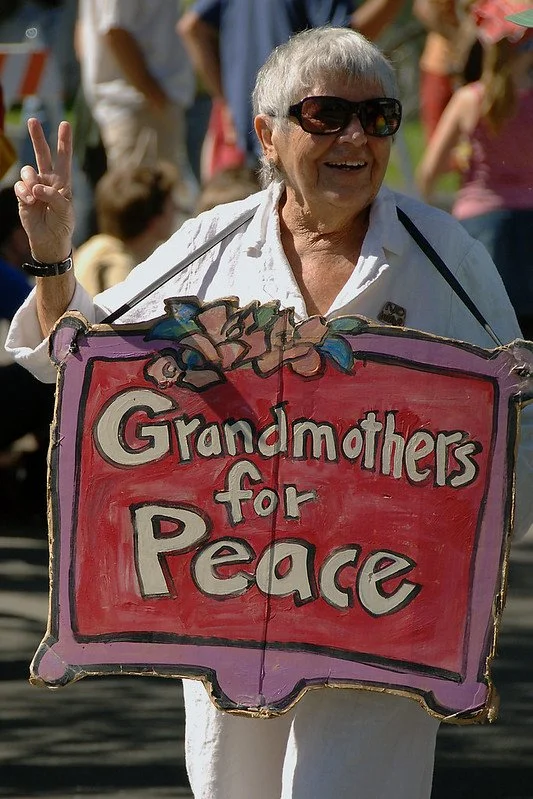
After receiving last week’s bad news, I desperately attempted to keep some semblance of normalcy in my life. For example, last Sunday I drove over to Berkeley to attend the city’s “How Berkeley Can You Be?” parade and festival. It sounded like it could be an afternoon of great fun, and I had expectations of displays of outrageousness from the citizenry there…reminiscent of the annual “out-there” behavior exhibited during the Eugene Celebration.
Now, perhaps it was my state-of-mind, but I was pretty disappointed. There were a smattering of laughs and “Berkeley-like” folk around (see the accompanying grandmother-for-peace photo), but my experience of the event was quite different from the all-out kind of effort that Eugene (for example) puts into its identity-defining celebrations. It seems to me that Eugene is more Berkeley-like than Berkeley is these days! Who woulda thunk?
My mood for this last week has been semi-dark. I seem to have been struggling with continuing issues of loss and change…or at least that’s the best explanation I have right now for the cloud I’m living under.
On one of my early-evening walks this week, I was trying to enjoy both the sunshine warming my face and the music coming from my iPod when, all of a sudden, I found both my hands clutching my chest as if I had pain there. But, it wasn’t really pain; actually, just momentarily, I was gasping for breath. I guess, maybe, I’d been forgetting to breathe. How weird.
But given my thoughts, not really too unusual. I had been dwelling on the loss of a friend to cancer; and the losses of jobs, attachments, familiar sights, and highly-significant people in Oregon: in essence, evidence of a total lack of control. While the changes I’ve made have also brought me meaningful gain, it’s the losses that have been my preoccupation. So much is gone. So much different.
This last week, I’ve been in a sleep-walk, a trance, moving in slow motion. As if this life I call mine is only some kind of surreal caricature of another’s.
Soundtrack Suggestion
While I was watching you did a slow dissolve…
Did I imagine they held us hypnotized
Did I imagine or do the walls have eyes…
Life in slow motion somehow it don’t feel real…
Snowflakes are falling I’ll catch them in my hands
Snowflakes are falling now you’re my long lost friend
(“Slow Motion” – David Gray)
Osmosis
Osmosis ( äz-mō'-sĕs ).
Function: noun.
Etymology: New Latin, short for endosmosis.
1: movement of a solvent (as water) through a semipermeable membrane (as of a living cell) into a solution of higher solute concentration that tends to equalize the concentrations of solute on the two sides of the membrane.
2: a process of absorption or diffusion suggestive of the flow of osmotic action; especially : a usually effortless often unconscious assimilation <learned a number of languages by osmosis — Roger Kimball>.