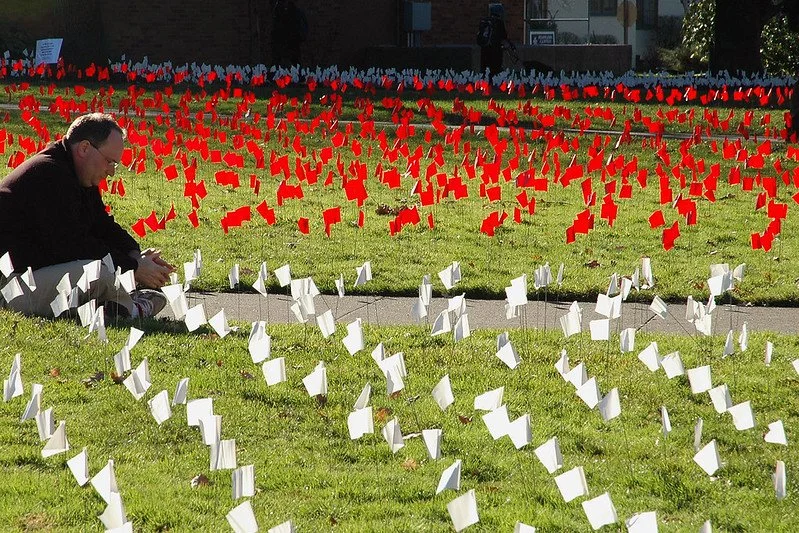
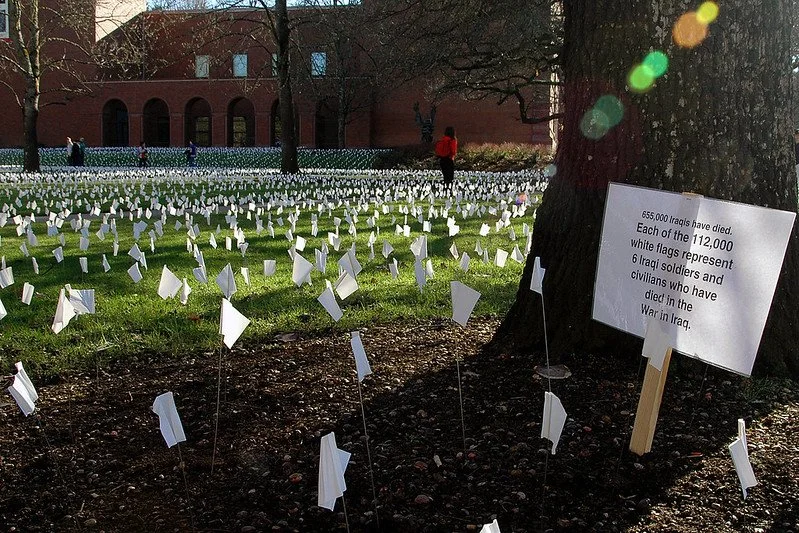
These are the words of a University of Oregon (UO) student I spoke to earlier this week as I walked among the 112,000 white flags and 3,000 red flags conscientiously and strategically placed to cover much of the main portion of the UO campus. Each of the white flags represent 6 Iraqi soldiers and civilians who have died since the U.S. involvement began four years ago, and each of the red flags represent one fallen American soldier.
The display lasts only this one week. I urge you to see it in person, before Sunday, if at all possible.
Here’s how the Daily Emerald reported the story on Monday. And here’s an online slideshow, from the Emerald, if you’re interested in some of their photos.
It wasn’t that long ago I went to the movies almost every Saturday afternoon. In recent times, though, that behavior has all but disappeared as the product from Hollywood seems to be more and more drivel-of-the-mindless-type all the time. Until Friday (two days ago), the last movie I saw in a theatre was sometime early last summer before I moved south.
But when I was in Eugene on Friday, I decided it was time, again, to take in a first-run film…so I went to see Stranger Than Fiction on its opening day. This was a rather odd choice of a movie for me, as anything with Will Ferrell in it is bound to be rather juvenile, isn’t it? I mean, after all: Talladega Nights: The Ballad of Ricky Bobby ? Give me a break!
Despite these thoughts, though, I had seen the movie trailer and it seemed oddly intriguing. Also, it had other interesting cast members such as Dustin Hoffman and Emma Thompson, actors that generally appeal to me. So, given that I was in the mall right across the street from the theatre, I said, what the heck…
This movie tells the story of Harold Crick (Ferrell), a single guy, who (rather like me, I’m afraid) “lived a life of solitude. He would walk home alone; he would eat alone. When others’ minds would fantasize about their upcoming day, Harold just counted brush strokes…” (well, no, I don’t count strokes as I brush my teeth, thank you very much).
The passage, in quotes above, is from the voice (Emma Thompson’s) that Harold begins to hear in his head one morning while he is brushing, a voice that narrates the events of his life as they happen, a voice that speaks, according to Harold, “about [him], accurately, and with a better vocabulary…”
The incessant voice is quite annoying, and it was heading in the direction of totally immobilizing him (as it was the only way to stop the running narration). That is, until one day, the voice observes, “little did he [Harold] know that events had been set in motion that would lead to his imminent death” … an observation that, naturally, tips Harold over the edge. He’s going to die? Imminently ??
Having already sought help from a psychiatrist (played by Linda Hunt) – who simply wants to medicate him – Harold then decides to seek assistance of another type, this time literary help in the form of literature professor Jules Hilbert (Dustin Hoffman). The dominant questions become, after Jules finally decides to pursue the investigation:
is Harold’s life a comedy or tragedy? and
what are the possibilities, among living authors, for the identity of the narrator’s voice?
Naturally, as it turns out, Harold is the character in a novel being written by the Emma Thompson character, author Kay Eiffel. And it is Eiffel who must figure out a way to kill off Harold, as all the heroes in all her books always die in the end.
Along the way, however, in a totally romantic-comedy manner (and coincident with the decision that his life is a tragedy), Harold has an incredible thing happen to him. He meets bakery-shop owner Ana Pascal (deliciously portrayed by Maggie Gyllenhaal), and begins to think about her all the time. Although love has (apparently) never been a part of his life before, it becomes a dominant element now.
Despite all this, Eiffel continues to struggle mightily with just the right way to end Harold’s life. As die he, inevitably, must.
As Roger Ebert points out in his review of the film, the question of how (or even whether) to kill off Harold “is the engine for the moral tale.” Ebert continues…
How rare to find a pensive film about the responsibilities we have to art. If Eiffel’s novel would be a masterpiece with Harold’s death, does he have a right to live? On the other hand, does she have the right to kill him off for her work?
I suggest you go see Stranger Than Fiction and wrestle with the issues raised. I don’t think you’ll regret the time you spend engaged in your pondering mode.
The popular TV show Grey’s Anatomy is filmed in Seattle, and maybe its Pacific Northwest roots are part of the appeal for me. (This season the show made a move to 9:00 p.m. on Thursdays, so it is on ABC an hour before ER airs at 10:00 p.m. on NBC; I tape them both and watch them on the weekend). Aside from its obvious (and frequent) quirkiness, the show has real and touching moments that occasionally tend to unearth some truths about life and relationships.
Last Thursday’s Sometimes a Fantasy really caught my attention. Most episodes are filled with several different story lines, with some, not uncommonly, continuing from week-to-week. And the story of Izzie’s loss resumed this time. She had fallen in love with a heart-transplant patient who had asked her to marry him. However, shortly after he popped the question (and after Izzie had made an ethically-questionable call about his care), he died. Izzie’s story was juxtaposed with one about Megan, a young girl who came to the emergency room with multiple injuries. Although she was bruised, beaten, scarred and had stapled a wound on her arm with an office stapler, she claimed to feel no pain. The ultimate diagnosis for her was “chronic insensitivity to pain.” (Who knew there was such a thing!?)
So, he we had: Megan, dramatically physically damaged, who claimed to “feel no pain.” And Izzie, who stood immobilized outside the hospital, unable to motivate herself to return to work, when asked where it hurt, said “everywhere .”
The array of possible human experiences always tends to amaze me. In this dramatization, one person feels immense, debilitating, chronic, paralyzing pain, and the other, none at all.
During the operation on Megan, the surgeon observes that “everybody wants a life without pain. What does it get you? She needs to be on a poster somewhere to remind people that pain’s there for a reason.”
I know, I know. This is a TV show. But the writing this week seemed incredibly good…and provided a degree of wisdom than one typically does not encounter during prime time.
Of course, these observations extend my previous commentaries. You know that I think about pain a lot ; and an episode of a medical drama focusing on the topic is bound to attract my attention and dwell in my thoughts. Six days ago, in an attempt to address my chronic myofascial pain issues (including my long-standing chronic lower-back pain), I allowed a doctor to inject me 19 times with small amounts of Marcaine in my first major attempt at trigger-point injection therapy. Although I experienced some short-term relief that day, by the evening I was back to “normal.” And, as my back pain has been the predominant factor in my existence the last couple weeks, I drove to Eugene to see my chiropractor on Friday.
If “pain’s there for a reason,” I ask, “what is it ?”
On April 30, 1970, President Richard Nixon announced to a national television audience that he was ordering troops into Cambodia. Although the stated purpose of this so-called “incursion” was to hasten an end to the ongoing slaughter in Vietnam, many Americans, myself included, thought this a wholly-unwarranted expansion of the war effort.
I was in the last semester of my undergraduate college days at this time: politically-active and fervently anti-war. I had received a draft notice in June of 1969 and spent 22 days in the Air Force until a chronic knee condition led to a medical discharge. Although I was (because of my discharge) no longer at risk of losing my life to this insane activity, I had spent four long college years with the specter of the military draft – and the prospect of a gruesome, lonely death in a jungle a million miles away from home. For me, the war was personal.
Richard Nixon had been elected, at least in part, on the basis of his “secret plan” to end the war. Yet, here he was, less than two years later, ordering an obvious escalation.
I was pissed. I remember spending the remainder of the evening after Nixon’s speech composing a letter to the editor of my local newspaper. My writing skills were not too finely developed then and my letter was not the most eloquent piece of prose. But what I lacked in style, I hope I made up for in passion: Nixon was wrong. He was a madman. He had to go. The war must end.
Many, many people agreed with me. Unrest on the nation’s campuses, especially, took a dramatic turn. On May 4, 1970, my letter was published in the Eau Claire (WI) Leader-Telegram, the same day that four full-time college students (Allison Krause, Jeffrey Miller, Sandra Scheuer and William Schroeder) at Kent State University were gunned down by Ohio National Guard troops on their own campus. Another nine students (Joseph Lewis, John Cleary, Thomas Grace, Robbie Stamps, Donald Scott MacKenzie, Alan Canfora, Douglas Wrentmore, James Russell and Dean Kahler) were wounded; one was paralyzed for life, the others seriously maimed.
The students of the University of Wisconsin - Eau Claire, in the days immediately following the Kent State massacre, rallied. I, for one, picketed the Science building where I had spent the majority of my time as a chemistry student. On May 6th we held a campus-wide protest, gathering on the lawn right outside the student union building. And we planted four trees in memory of the dead in Ohio. The plaque from that memorial service is still there today, as are three of the four original trees.
May 4, 1970, was thirty-six years ago. On this day, today, let us not forget the madness that can afflict us as a nation.
Let us also not forget that we always have a voice. Let’s remember that protest can lead to change. We must know that when we perceive injustice in the world, we can stand, march, shout and be heard. We can make a difference.
Thought for the day: We have the ability to put an end to the killing. All it takes is the will.
Soundtrack Suggestion
Tin soldiers and Nixon coming, We’re finally on our own.
This summer I hear the drumming, Four dead in Ohio.
Gotta get down to it Soldiers are gunning us down Should have been done long ago.
What if you knew her And found her dead on the ground How can you run when you know?
Gotta get down to it Soldiers are gunning us down Should have been done long ago.
What if you knew her And found her dead on the ground How can you run when you know?
Tin soldiers and Nixon coming, We’re finally on our own.
This summer I hear the drumming, Four dead in Ohio.
I spent the night of the science fair sleeplessly. The energy expenditure of the day was considerable, though I guess my adrenaline concentration stemming from the experience was too high to be ignored. Fatigue has turned into utter fatigue as insomnia continues. I’m guessing that this condition only serves to enhance my typical, transitory, post-event post-partum depressive tendencies.
I know that I’m exhausted and overly-emotional. And, as happens to me in this kind of space, I tend to socially withdraw a bit and reflect on my existence. What am I doing here? Is this really my life? What can I change? How can I change?
I was touched by a couple of folks who gave me huge compliments today on my leadership ability. Their comments were exceptionally kind and generous, I thought.
Am I that generous with others? Oh, I would like to think so; but I’m not always so sure. Extending sincere appreciation to those around you, I believe, is a mark not only of exemplary leadership, but of generosity and simple humanity. In whatever form it takes, saying out loud words like “I appreciate you” is a powerful thing. The message can be as significant and affirming as “I love you.”
Can we live without being loved and appreciated? Yes, I guess so, but it makes the difficulty level of life much more significant.
I frequently think of the May 2002 episode of “ER” that marked the passing of character Dr. Mark Green. (Yes, Jim, again with a TV show!?) Why this comes to mind for me at this particular moment, I’m not sure, except that is has to do with the concept of “generosity.”
In this episode, Mark is near death and he makes the decision to spend his final days in Hawaii. With him are daughter Rachel, wife Elizabeth, and their baby daughter Ella.
The most moving moment, and the one that has kept flashing into my psyche over the years, is his final piece of advice: “Be generous Rachel,” he says, “with yourself, with your life, with your love. Just be generous.”
I would love to be known as a man of integrity – and generosity. For now: I’m working on it.
Soundtrack Suggestion
And the seasons they go round and round And the painted ponies go up and down We’re captive on the carousel of time We can’t return we can only look behind From where we came And go round and round and round In the circle game