I read both fiction and nonfiction. I love to escape into stories, made-up or real-life. I’m particularly a fan of the memoir (which really should come as no surprise given that a lot of these “musings” are intensely autobiographical in nature). So, here I am to report that I’ve just finished reading a particularly compelling one (memoir, that is).
I became acquainted with author Alice Sebold when I read her first novel The Lovely Bones. Although the book, a bestseller, was published in 2002, I probably picked it up around 2005 or so. Bones is the tale of a 14-year-old girl who has been raped and murdered – and who narrates the entire story from her vantage point beyond the grave: in heaven.
I remember thinking: this is an interesting approach.
For whatever reason, I found this novel to be totally intriguing: though certainly in a dark way. The book was anything but a “quick-read” for me.
On a trip to our local Borders store, just recently, I discovered that Sebold had written another book prior to Bones. In 1999, she published a memoir entitled Lucky(as in “lucky to be alive”). This work is a first-person account of her rape: a tragic event that happened on the last day of her freshman year at Syracuse University. The story includes a chronicle of her eventual identification (a few months later) of the rapist; the subsequent trial and conviction; and the progress of her life in the aftermath. The narrative also provides such details as: the status of her relationships with family and other men; her issues with heroin addiction; the gradual awakening to, and acceptance of, her post-traumatic stress syndrome; and the practically unbelievable development when one of her college roommates is raped, on Alice’s own bed, a couple of years later.
So, you’re probably asking: why is this is a story I’d be interested in? What could possibly make this book worth my time?
Good questions.
Just let me say that Sebold is an excellent story-teller. Although this is a very difficult topic to discuss, she pulls it off with incredible sensitivity and skill. And even though it’s autobiography, which goes into excruciatingly-gory detail, especially with the rape scene at the beginning of the book, it rather reads like a novel. I was completely drawn into her narrative. Wondering what will happen next…how will she find her way through this devastation…how can she put herself back together?
Naturally, Sebold’s life has had many twists and turns because of this crime. That she found the strength to look in the mirror, step back, and try to explain, to us, what she sees – well, this speaks to me of a person of incredible courage.
I am truly inspired by her ability to communicate through the written word, and her willingness to expose herself to the world in this way.
For me: as I write, I aspire to similar courageousness. I believe that it is through stories about the human condition that we learn more about ourselves. And that the lessons these stories offer, help us to live with our pain.
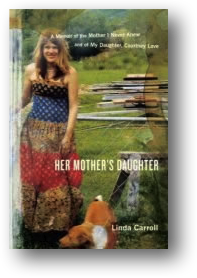
In the midst of everything else going on for me right now, I finally have finished reading Linda Carroll’s biography: Her Mother’s Daughter. As I have written about before, I’ve known Linda for over 25 years and identify her as one of the most influential people in my life – indeed, I consider her one of my family on this planet during this lifetime. (I’ve absolutely no idea if she has any thoughts along these lines, though.) She’s served as my counselor, confidante, friend, mentor and spiritual guide – helping me through some very difficult spots. I am incredibly fortunate to have met her and to have had her in my life for (at this point) nearly half my time on earth. Frankly, any attempt to think about this lifetime without Linda in it hardly seems like my life at all.
I first mentioned Linda in these pages after reading Borrowed Finery by Paula Fox. Fox is the famous author of novels and childrens’ books who, early in her life, gave Linda up for adoption. Linda finally tracked her mother down after the birth of granddaughter Frances Bean Cobain. Although quite elderly now, Paula is still alive and she and Linda continue to maintain a relationship begun, belatedly, in the mid-1990s.
In the time I’ve known Linda a lot has happened to her, both personally and in terms of her public notoriety. She is, after all, not only Paula Fox’s daughter, but Courtney Love’s mother. The stormy relationship between Linda and Courtney has been reported in the popular press, up until this time, exclusively through Courtney’s eyes. A number of unflattering and outrageous things have been said about Linda that are totally inconsistent with the good-hearted person that I know and love. Not that I ever really knew much of Linda’s story before reading the book, though; I have only had glimpses into small parts of her life. As my counselor, Linda has been focused on listening to the rhythms of my story, not the other way around. Most of what I know about Linda the person has come through my experience with her in various workshops over the years. The most recent group experience I had with her was about 7 years ago now, in a PAIRS (couples) course led by her and husband Tim.
Now that I’ve finished reading Her Mother’s Daughter, I’ve searched out some of the literary reviews and am discovering that they appear, well, mixed . Some praise Linda’s narrative style and general ability to draw the reader into the drama that has been her life. Others take a more critical stance, sometimes judging her life itself, apparently overwhelmed by the chaotic nature of Linda’s existence. For myself, I was amazed at the detail Linda was able to relate to me, the reader, describing experiences from an age when I would have no memories to draw on at all. Further, I was totally engaged with her writing style, finding it smooth and conversational, mirroring the “real person” that I know her to be.
Of course, upon reading the biography, I tend to agree that Linda’s life has been chaos. And in terms of order of magnitude of lifetime chaotic experiences, her biography rivals her mother’s. As much turmoil as I believe I’ve personally experienced, I admit that my story has had less overall drama than either Paula’s or Linda’s. Linda is on her fourth marriage; she gave birth to six children, one who died as an infant; an adopted child subsequently discovered another home for which he was a better fit; she escaped San Francisco by moving to Oregon, then moved to New Zealand and back to Oregon; her oldest child is Courtney, likely one of the most “out there” celebrities since Madonna’s younger days; and (not covered in the book) she once found herself the therapist for Katherine Ann Power, an activist from the 60s who spent most of her adult life underground.
Zounds: what a life.
I’ve lived my life parallel to a good portion of Linda’s drama, and I have sought out her big heart, attentive ear, and perceptive nature time and time again. She has never said she was not available to me. Whenever I’ve shown up, she’s always been totally present. Truthfully, I only had hints here and there that she was living the life she describes in this book. Even though her own existence has surely been an emotional roller-coaster, she has always been able to focus on me and my story and provide help when I sought her out. Simply, Linda is a human being of the highest caliber. The meaning of the chaos of her life, for me, I now understand, is that she’s always been able to assist me with my own frequently-chaotic existence.
A psychic I once consulted, who relayed to me some of my past-life experiences, reported that Linda and I had been twins at least two times in previous lifetimes. It is, at the very least, an entertaining thought. I know I feel very, very connected to her. My relationship with Linda is one of the most cherished things in my life. I glad she wrote her story so that I can know it: so that I can know her better than I do.