Teller had (a little over a year ago now) moved on from all that Cascadia nonsense. He had paid attention to: those dreams, the Morse code in his head, his common sense, his failing health, and, most of all, his Higher Self. After expending most all his available life energy to escape that soul-sucking spot on the globe, he finally found another little college and a new life…in a land that millions called “golden.”
Teller had been here in this garden of the rich and beautiful for awhile now, and he often found himself wondering if his existence was now going to be forever defined by these new environs: a place known far and wide for its wealthy residents, outrageous real-estate prices, and seductive proximity to The City. A rather strange place, this: with a small town look-and-feel; self-obsessed; hosting a populace preoccupied with their hugely-inflated senses of privilege and entitlement.
For Teller, the past was past. With the unhealthiness of Cascadia behind him, a semblance of personal well-being had returned. Some robust color was actually, at times, evident in his cheeks…with little evidence remaining of that sickly, ashen hue he had once frequently exhibited.
His life had changed immensely, though, and he missed his home state, his adopted family: almost everything (and everybody) that was comfortable and familiar. And, in the week leading up to today, the day he would mark as the beginning of his sixty-second year, he had been having some rather disturbing thoughts. He had had a history of troubled times in August, in the days surrounding the anniversary of his birth, and this year was somewhat reminiscent of earlier periods.
Just last night, for example, after sleeping for a couple of hours, he awoke. For some reason he was acutely aware of his left foot…the body part that had, for over three years now, been afflicted with peripheral neuropathy. But, tonight, something felt uncomfortably, markedly different. It was about midnight, and he turned on the bedroom lamp to examine his foot.
Teller gasped. With a sharp intake of breath that led to profound dizziness, he saw that he had a really serious problem. For, now, he had just four toes — as the little one had apparently fallen off. The remaining digits were all as black as charcoal. They looked like shaved pieces of charcoal. His big toe was missing the nail, and appeared as if it had been whittled (or, perhaps, chewed) to a point; it was now only about half as long as the second toe. The second toe was twisted at a ninety-degree angle and oozing some kind of greenish, purplish, pussy-looking substance. Toes three and four were merely black and bleeding — from what looked like a series of long, razor-made cuts.
In shock, Teller slowly glanced at his other foot. It seemed mostly normal, but the toes had a distinct grayish cast, as if, perhaps, they were making their way toward the charcoal-like character of the left foot. They were definitely more tingly than they usually were.
His hands. He wondered. He looked. Yes, his fingers, all of them, were numb and turning color as well.
He stumbled into the bathroom, dragging his left foot, leaving a bloody, pussy trail on the carpet, and turned on the light. And immediately noticed his eyes. The circles under them were nothing short of a death look. Truly. How could anyone with this appearance still be alive?
This time his gasp turned into a SCREAM, not caring if the neighbors were awakened…and, at that point, Teller, himself, woke up.
Sweating. Scared. Relieved: this was just a dream!
Teller spent the rest of the night blessedly dream-free. But when he got up early to watch the sunrise on his birthday, it was with an enhanced sense of age and aging. Questions about what he had made of his life predominated. Mostly, Teller’s thoughts turned to those he had loved, and those who had loved him.
Teller, though he had loved, and loved dearly and deeply, was mostly a loner, and found himself, again on this birthday, still alone. And lonely: afflicted with a presumably chronic, and life-long, state of solitude. Not a condition as serious, or as ugly, as those blackened, decaying extremities, but a state of being that overwhelmed him just the same.
He reflected on his dream of bodily decomposition. A body that was living, but not quite all alive. Teller meditated on his desire to share body and soul with the soulmate he still believes is out there. Somewhere.
Teller embarked on his the rest of his birthday day asking himself, still: where do I fit? With whom do I fit? Will I ever fit?
Soundtrack Suggestion
night time slows, raindrops splash rainbows perhaps someone you know, could sparkle and shine as daydreams slide to colour from shadow picture the moonglow, that dazzles my eyes and i love you…
I’ve had a couple of interesting interactions recently…
First: on my daily bike-path walk the other day, I ran into one of my new California friends. She wrote me soon afterward to report that I had looked “positively vibrant” during our little chat.
Second: a more casual acquaintance, and an infrequent reader of these pages, asked me in an email, with a somewhat judgmental tone (in my opinion), “aren’t you rather obsessed with your health?”
To the first person, I replied, “ahhhh…summer” … and though I believed her observation was a bit of an overstatement, I was secretly thankful that someone had really noticed me.
To the second, I reacted rather defensively…saying, no, I considered myself to be just about perfectly attentive to matters of my health. Given that I’ve spent years dealing with chronic pain, beginning in my twenties and continuing on to the present day, the old saying “if you have your health, you have everything” has profound meaning in my life.
For when a body is dealing with such issues, one can hardly say that “health” is present. Admittedly, I do spend a lot of time and energy focused on my health. It seems that it’s a condition of my existence.
Despite any projected “vibrancy” of late, however, I continue to struggle with body-wide muscular pain. And although I’ve made significant positive progress in recent months (mostly I credit the Feldenkrais Method and Anne, my local Feldenkrais practitioner), in the past couple of weeks I have been dealing with a minor setback, and the old questions such as “how did this happen?” and “why me?” come up in my mind again and again.
Regarding the matter of how did this happen?, I think I have more clarity than ever. So that’s today’s topic.
I consider my present health woes to have begun on November 13, 2003, when the Governor of the State of Oregon took the unprecedented action of firing the Board of Higher Education. I have reported on this situation before, and I knew immediately that my life was about to change, likely dramatically. The Board, after all, was my employer, and if the composition of that body was going turnover in such a wholesale manner… well, what (and who) was now in place to insulate me?
What resulted was that my entire world did shift. Within a very short time it was clear that I would be losing a job I’d held for nine years, and that I had nowhere, really, to go. I became extremely anxious. I asked myself: was I to be one of those older, displaced professionals no longer able to find gainful, skill-and-experience-appropriate employment?
Was I destined to soon become intimately familiar with that common question, “would you like fries with that?”
Of course, I’ve chronicled a lot of what subsequently happened to me here. I did lose my longtime position with the Oregon University System, but I was, fortunately, picked up for one, then another, “interim” arrangement at two Oregon community colleges. Though for three and a half years, my life was entirely focused on searching for “permanent” employment, while going to work everyday in highly-unstable, non-supportive, temporary environments.
During that time, I faced rejection over and over again in my job search. Although I seemed to have little trouble securing interviews…I had significant difficulty obtaining an offer for a permanent job. I came in second an amazing number of times. And then I ended up, in my interim appointments, working for not only unsupportive people, but for individuals who were overtly hostile and abusive. A short time into my first interim position, for example, I was lambasted and humiliated in a public meeting by the big boss. It set up a situation that entirely disallowed any possibility of comfort, security, support, or long-term prospects at the institution.
And then, if my professional life weren’t unstable enough, I continued to subject myself, in my personal life, to a relationship that involved several (and, sadly, predictable) episodes of painful rejection.
In sum, I spent a considerable portion of nearly four years dealing with repeated rejection and utter lack of support in both my personal and professional lives. (And, in fact, the personal-rejection scenario stretched back over more than twice as many years.)
During this entire time, my body was paying attention. I believe, now, that the resulting non-stop anxiety due to lack of support is the source of my current physical woes.
Moshe Feldenkrais, in a chapter entitled “The Body Pattern of Anxiety” (in The Elusive Obvious) discusses the human condition in terms of our instinctual reaction to threats. For example, he discusses what we know today as “fight or flight.” Feldendkrais (1981, p. 56) states that “an animal, when frightened, either freezes or runs away. In either case there is a momentary halt….with a violent contraction of all the flexor muscles…”. Further, he considers the case of a newborn infant, a being who is “practically insensitive to slow and small external stimuli” … but who “if suddenly lowered, or if support is sharply withdrawn, a violent contraction of all flexors with halt of breath is observed.” Feldenkrais notes further that “the similarity of the reactions of a newborn infant to withdrawal of support, and those of fright or fear in the adult is remarkable” (p. 57, emphasis added).
This makes so much sense to me! I believe these observations provide a logical explanation for the chronic-muscle-pain issues I deal with on a daily basis.
I had lived a professional existence where my experience was one of rejection and almost complete lack of support. And in the case of my personal relationship, the support I enjoyed at any particular moment was at risk of being withdrawn at any time.
My body tensed, ever ready for the next piece of bad news. And it stayed that way. I apparently lost the ability to ever relax my muscles at all…from head to toe, I became totally knotted up. I was a wet dishrag: stretched, squeezed, twisted, and left-to-dry on the rack. Over and over and over again.
I suspect any body that is stretched, squeezed and twisted, in a time frame with no predicable end, is one that is going to end up in pain.
Amazingly, I have finally found an environment that is much more personally supportive. And thanks to the supplement Fibroplex, the personal health benefits of which I have previously documented (here and here), along with the “neuromuscular re-education” that I’m engaging in with the Feldenkrais Method, I believe I’m gradually unknotting these old, fatigued, anxiety-ridden, twisted-up muscles.
It is a slow, tedious, and necessary process…if I ever expect to live mostly-pain-free ever again, that is.
I guess I’ve been watching girls since…well, how long now? I imagine since sixth grade. At least that’s when I had my first girlfriend…so I must have been noticing them some by then.
And, all these years later, wouldn’t you know, I’m still doing it. Watching them, that is.
I took the Larkspur Ferry into the city this past Saturday for an afternoon of wandering-around photography. I hadn’t really pre-planned this activity for the day. I did something entirely rare for me: I made the decision to do this spontaneously after my haircut appointment that morning. I quickly packed up a camera body and lens into one of my most compact bags, and drove over to Larkspur Landing to catch the 11:40.
The weather was absolutely perfect here in Marin, with a similarly favorable forecast for the city, so I took a chance and dressed only in shorts and a t-shirt. (For those of you who know San Fran, you realize visiting the waterfront attired thusly is a risk.) Specifically, I had on khaki-colored shorts from REI, a faded-red souvenir t-shirt from Taos, N.M., and a Nikon-logo baseball cap. (This information is relevant later.)
When I boarded the ferry, I didn’t have much of a clue where I wanted to sit. Perching myself inside on such a magnificent day seemed a little weird, so I scoped out the entire selection of seats and finally settled on a spot on the upper deck, outside, in the rear of the boat. (I guess that’s called the stern?)
Shortly after I settled in, I noticed three women (I guessed them to be about my age) sit down on the bench directly to my left. We were in the same row, all facing the water, so I didn’t have a great view of them; but I knew they were there all the same. One of them, especially, caught my eye…as she was dressed in (what I’d call) an elegant black dress. It was a very hot day already (in the 80s, headed for the 90s), so I was asking her, in my head: what possessed you to wear that today? Another of them was wearing a large dressy hat, which also drew my attention.
For about half the trip, we all sat that way, facing aft. But then I realized that, by sitting in direct sunlight on this very hot day, I was perspiring rather profusely and sitting in a small puddle of my own sweat. (More than you wanted to know, I’m sure.) So, I stood up to air myself out. In doing so, I turned myself around, facing the other direction (fore), and was able to both brace myself on the bench and observe where the boat was headed. Of course, this allowed me to watch these lovely ladies, out of the corner of my eye, as well.
Well, watch was all I did. I couldn’t help but notice the rings (or lack thereof): Hat Lady had ringless fingers; Black-Dress Lady had rings, but they presented an ambiguous situation; the third had, what appeared to be, a wedding band. Ms. Hat Lady had a small digital camera and she spent some time taking pictures through a side window that protected us from the wind and spray. The three of them talked and were generally enjoying themselves, it appeared. Although it would have been nice to engage them in conversation…well, that never happened. Frankly, I didn’t have an opening line: for what was I, dressed the way I was, going to say to Ms. Elegant-Black-Dress Lady? I couldn’t come up with a thing.
But, there they were: attractive women, my age. And surreptitiously watching them was a good way to pass the time for the final part of the voyage. (NO, I didn’t ogle them…I did not make myself obvious.)
We reached the city, everyone went ashore, and I figured that was the last I’d ever see of these three.
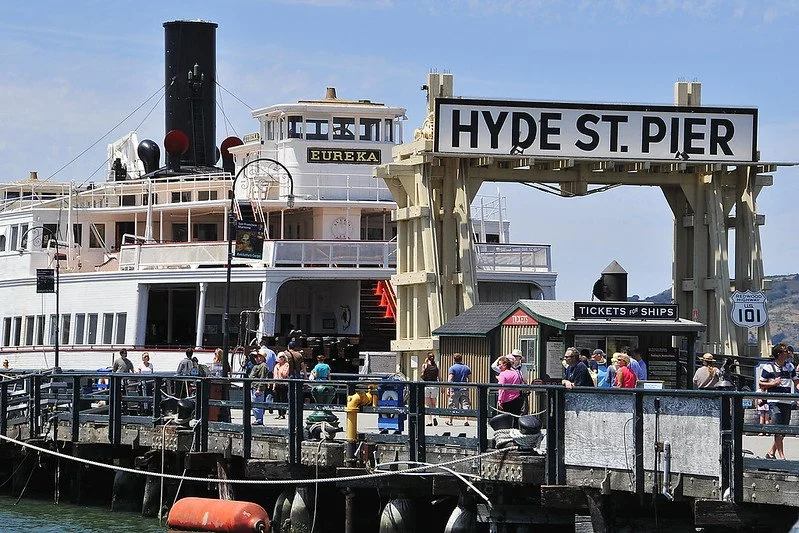
Once inside the Ferry Building, I took my camera out of the bag, strapped the bag around my middle (it’s a fanny-pack type), and walked north on The Embarcadero. I took the entire four hours (before the return ferry ride) to wander up to the Hyde Street Pier and back. Not that I didn’t rest at times along the way. I had a muffin at a Peet’s Coffee shop. I also stopped at The Cannery to have ice cream and listen to music.
The solo musician in the courtyard when I was at The Cannery played a wonderful acoustic version of Death Cab for Cutie’s “I’ll Follow You Into the Dark.” Although the lyrics speak of an entirely different kind of lady in black, I was reminded of my traveling companions on the ferry…
In Catholic school as vicious as Roman rule I got my knuckles bruised by a lady in black And I held my tongue as she told me “Son fear is the heart of love So I never went back…
By the time it came to take the 4:40 ferry back home, I was tuckered out. I got to the Ferry Building early, of course, and watched my fellow travelers arrive at the loading area.
Ultimately, though (lo and behold!), I saw that the ladies were taking the same ferry back.
I boarded the boat and sat in almost the same place as I had earlier, only closer to the rear…where I could get some shots of the city as we departed (see photo above). As I was still in photographer mode, the view of the cityscape was what I was most interested in; I didn’t see my attractive “lady friends” (well, you know what I mean) anywhere around.
Oh, well…
As we slowly departed the dock, I took pictures for about the first five or ten minutes. I totally ended my photo activity, though, when the wind and water spray got to be just too much. I decided I needed to have another seat (even if inside) to escape the elements and keep my camera dry…so I headed away from the extreme rear of the boat and proceeded inward (foreward). I got a just a little ways, past about four rows of seats, when, all of a sudden, the boat experienced a minor lurch, tilted a bit, and I literally stumbled and tumbled into the nearest seat.
I checked quickly to see that my camera and bag had survived the fall, then looked up at my new surroundings. Seated directly across from me: guess who?
I’m not a stalker. Honest! It actually happened this way!
As I noticed these three women, I’m sure my eyes widened a tad. Partly because I was initially asking myself: did anyone notice my clumsy landing? Though I was also quickly thinking, upon recognition: oh, it’s you!
I’m sure I also offered up an embarrassed smile. I had performed a totally inelegant landing, directly across from Ms. Elegant-Black-Dress Lady.
They couldn’t help but notice my arrival, of course. It was as subtle as a fart in an elevator. However, they all returned my smile. And, I don’t remember exactly how it started, but, after a little bit, we began a conversation. I believe one of them asked me if I did photography for a living…and that got us rolling.
They learned that I was a college dean and did this for fun. Elegant-Black-Dress Lady told me that she and Hat Lady had been friends since they were eighteen. I told her that I’d had lunch with a friend last weekend with someone I’d known since I was twelve…and that, since I was 60, that was a while ago now. Whereupon she immediately disclosed that she was 63. I said, “I thought we were just about the same age.” She asked, “what gave it away?”, and I replied, simply, “the familiarity.”
She smiled and said, “how diplomatic.”
I learned that Ms. Elegant had just moved to Sacramento last year from Philadelphia, for a new job. And that shortly after the move she had lost her longtime canine companion: a Labrador retriever. She learned that I had just moved from Oregon and lost a relationship shortly thereafter. She made sure I understood the profound nature of her loss, and that she was still grieving. I listened empathetically.
I admitted to Ms. Elegant that I’d noticed her on the trip into the city…that her black dress had caught my eye right away. I told her I wasn’t sure about wearing black on this hot day, but that, certainly, I thought it was a very classy look. (It seems I’ve reached a point in my life when I can look at a woman over 60 and think: hot!)
We all talked about being college students in the Sixties. They know that I was in the Air Force for three weeks in 1969 and took nine semesters to complete my undergraduate degree. We all agreed that, despite the tumultuousness of the times, there was no better time in history to be a college student in the U.S.
I didn’t ask their names, and they didn’t offer. I don’t know where they work, although Ms. Elegant, I learned, has an employer-supplied vehicle. Black, of course. When one inquired what I do with my photos, I gave Ms. Elegant a business card that has my Flickr web address on it. So, she has (they have) my name and contact information; I don’t have any clue about them.
Because I was having such a great time, I missed the photo opportunity of San Quentin from the water…and the arrival at the pier in Larkspur. And, even though I had camera in hand, I didn’t even think to ask if I could take their picture. A considerable oversight on my part. Sigh…
Still…it was a thoroughly delightful afternoon: primarily because of my unexpected tumble that led to the conversation with three new lady friends, anonymous though they may be.
Girl watching certainly has it payoffs. Even though the entire experience is, often, all too fleeting.
Soundtrack Suggestion
My life is brilliant My love is pure. I saw an angel. Of that I’m sure. She smiled at me on the subway… You’re beautiful. You’re beautiful. You’re beautiful, it’s true. I saw your face in a crowded place, And I don’t know what to do…
Recently I received one of those “chain-letter-type” emails from a friend in Nevada (I was one of 25 who received the mailing); the message contained a series of silly personal questions, with the request that you delete the friend’s answers, fill in your own responses, and then send them out to a whole new series of contacts. I’m still thinking about whether I’m going to subject anybody I know to this exercise, so I haven’t forwarded the letter as of yet. However, one of the questions that got me thinking was: “what do you want to do before you die?”
My Las Vegas compatriot offered up a very good (and succinct) reply: “live.” Now, this is something I’ve been saying since my 30s: I’m going to live until I die. So, I smiled when I saw this answer.
However, that goal is pretty non-specific. It doesn’t say anything, exactly, about what you’re (I’m) going to do, or how you’re (I’m) going to do it. Or when. Or why.
So, how might I respond to this question? And say something that has a tad more meat? Well, I guess I’d offer: I’d like to take about a zillion more photographs.
For over thirty years now, I’ve been more-or-less obsessed with getting out there in the world, a camera hanging around my neck, and snapping away. Even after this much time, having attempted and then moved on from the life of a professional photographer long ago, and having changed the rest of my life, personally and professionally, over and over (and over yet) again, photography is one thing I just can’t let go of. As much as anything, I’d say this passion defines who I am.
Yes, for sure: I’m an academic. After four college degrees, how could that not be the case? I’m a researcher. A writer. A counselor. An administrator. A TechnoMonk. Yes, there are many different labels I could apply to myself, all of them apt.
The thing is, most days I wake up thinking, not about my day job, nor about my consulting work (the activities that pay the bills), but rather about picture-taking and camera equipment.
Weird.
I admit that even my other preoccupations, namely health and chronic-pain issues, are intimately linked to my thoughts about photography. I often describe my art as “wandering-around photography” – which means that I find a setting and simply walk about with my camera, seeking to discover some image that’s there waiting for me.
Obviously, I can’t really engage in such physical activity without a certain level of health. So, the healthier I am, the more I can wander around, and the more I wander around, the more photographs I can make. All the time and energy I throw into maintaining and improving my physical health are really investments to help me find the time and energy to pursue this one true passion.
I’m mystified by the individuals who, upon retiring, eventually seek to return to their former work because they don’t know what to do with themselves. That would never be the case with me. There are not enough hours in the day, not enough days in a lifetime, to do all the things I can imagine doing. I am a high-performer in my day job, but what that activity is really geared to is allowing me to finance the more interesting parts of life.
Yes, I’m going to live until I die. And during that time I’ll be wandering around: with the camera’s viewfinder glued to my left eyeball.
I think you’ll agree that Boomers’ bodies are showing definite signs of wear and tear … and that these fragile shells of ours need more and more attention as time marches on. Of course, those of us attending to such maintenance chores are the fortunate ones: we’re still here.
To help monitor and support my body, I see a primary-care physician; a urologist; a neurologist; a rheumatologist; an opthamologist; a physical therapist; a massage therapist; a bodywork therapist; a naturopath; and a practitioner of Traditional Chinese Medicine (TCM). I’ve moved three times in the last four years, and every time I’ve done so, I’ve needed to make it a first order of business to assemble a new team.
I am watchful of my cholesterol and blood pressure, and obsess about my PSA. I dread the twice-yearly DRE. I’ve had a colonoscopy and a cystoscopy. At one point, I needed to wait, for eight long days, on the results of a prostate biopsy. During one long emergency-room visit some time ago, I was (mis-) diagnosed with bladder cancer.
But, knock on wood: I have never needed the services of an oncologist. Or a surgeon. And my new physical therapist recently observed that I am “basically healthy.”
Still, when you get to be a sexagenarian, the probability of needing a highly-skilled medical specialist increases virtually every minute. And all of us have family, friends and loved ones who have been very ill or are no longer with us.
To help ensure that I delay the need for extreme intervention as long as possible, I spend (what I believe to be) inordinate amounts of time and energy every day focusing on this old bod. I walk, I stretch, I ice my back and shoulders. I soak in hot Epsom-salt baths. I engage in a rigorous regimen of vitamins, minerals, supplements and TCM herbs. I drink green tea and lots of water. I eat small portions of mostly-healthy foods. I don’t drink or smoke. I avoid sugar, preservatives, red meat and caffeine. I have regular bodywork and physical-therapy appointments. I read, and collect, books on a variety of health issues. I subscribe to an internet newsletter that provides me with regular updates on natural health and healing. And I check in with an online fibromyalgia support group on occasion.
I’ve been thinking that, pretty much, getting old is a full-time job. No wonder there’s such a thing as retirement! Who has time to work when there’s so much other stuff in life to pay attention to?
As I enjoy a leisurely holiday weekend away from my current place of employment, I’m thankful for my basic good health. And that I’m a Boomer. For if there’s anything good about being a member of this generation, it’s that you’re never, really, alone.