A Twist in the Path
I have written before about my old-geezer struggles with benign prostatic hyperplasia (BPH, i.e., “enlarged prostate”), PSA tests, biopsies — and intense discussions with my physicians about interpreting the numbers. August 1999 was the month when a routine blood test yielded a distinctly- elevated PSA, resulting in a referral to a urologist. As it turned out, that appointment was merely the first of many over the intervening years, resulting, so far, in 29 blood tests for PSA, two prostate biopsies, a decade of taking Flomax, and a November 2009 emergency room visit for urinary retention that resulted in catheterization for six days. (Now, that was a memorable Thanksgiving!)

Over 15 years of testing, my PSA numbers have risen steadily (sometimes dramatically), my prostate gland has continued to grow, and my symptoms have become progressively worse. In the course of all those doctor visits, one fact became increasingly evident: should I be so fortunate to keep on living, I would eventually need surgical intervention for my condition.
And, so, that time finally came. During the summer and fall of last year, living with this condition became more and more problematic, and even a double-dose of my medication didn’t provide adequate relief. Reluctantly, very reluctantly, I came to acknowledge that the procedure known as a “TURP” (transurethral resection of the prostate) was imminent.
On December 6, 2011, almost six weeks ago now, I entered Marin General Hospital to have the operation. So, dear reader, be on guard. I’ll be writing more about this journey in coming posts.
[The story continues here.]
Injury, Recovery, Fitness, Health & Change
The Fourth of July this year promised to be a good-weather day for the entire Bay Area, so I took advantage of this prediction and hopped on the 11:40 ferry into the city to spend a few hours doing my walkabout-photography thing. It was a verynice day to do this, as it turned out, so I was feeling pretty pleased with myself (for both the photos and the exercise) as I boarded the 4:30 back to Larkspur. However, despite the incredible, sunny, 70-degree downtown weather, the water in the bay was very choppy, and it was offering up a lot of sea spray as I sat in the back of the boat during the first few minutes of the trip. I decided I didn’t want to endure this for the entire ride and got up to change seats. Just as I stood, the boat took a particularly big jump in the water, and I was tossed onto my backside: my right shoulder hitting one of the solid plastic benches that are permanently affixed to the deck.
As I clumsily pulled myself up, I was in agony. I thought that I’d probably pulled a muscle (or something); I could barely move my arm. I sat there in over-the-top pain for the remainder of the trip, not knowing much except that I’d be making a stop at the emergency room right away. At the ferry landing, I filed an incident report with the ship’s captain, then drove myself, one-armed, to the hospital. Upon examination, and x-ray, the ER staff determined that I had broken my scapula (shoulder blade). Yikes!
I drove home with my arm immobilized in a sling. I endured some pretty incredible, constant pain for the first couple weeks or so. I hibernated for awhile, and stayed away from work, but eventually I started moving again. Within ten days of the incident, I had seen an orthopedist, had a CT and MRI to gather more information (and determined that my shoulder didn’t need surgery), and had kept my first appointment with a physical therapist.
It took about thirteen weeks, a quarter of a year, to get mostly back to “normal.” To facilitate the healing process, I was a model physical-therapy patient, doing my routines at least 2 or 3 times every day. My recovery was “uneventful”, as the orthopedist said, and I feel fine now.
Well, mostly.
The side effect that I didn’t anticipate seems to have been due to my greatly reduced level of physical activity during the recovery period. (At least this is my current working hypothesis.) I have been feeling more and more anxious for several weeks now, including dealing with some pain in my chest (a long-standing anxiety symptom for me). I think the longer I was inactive due to my injury, the less able I was to cope with my myriad, underlying anxiety issues. Of course, the worry haunted me for a quite awhile that this pain wasn’t merely anxiety, but indicative of a heart problem. Hence, I went to see a cardiologist and took a stress EKG test (the one involving a treadmill), along with a stress heart echo (sonogram). According to these procedures, my cardiac function is fine. Whew!
I just joined a local fitness center, and I have my first appointment with a personal trainer this week. I need to get more active, and it seems this would be good way, what with winter coming on and all. (My walking routine typically suffers in bad weather.) Exercise has always been the best way for me to cope with my anxiety and depression woes.
It really is time for a change. Wish me luck.
Soundtrack Suggestion
If you knew that you would be alone,
Knowing right, being wrong,
Would you change?
Would you change?
If you knew that you would find a truth
That brings up pain that can't be soothed
Would you change?
Would you change?
(“Change” - Tracy Chapman)
Social Media & Whatever Happened to the Class of '65
It was a little over two years ago when I first signed up for Facebook and then wrote about my initial experiences and impressions here. At that time, I admitted I had little idea what was I was doing or what it meant to be so affiliated. However, I also reported that, quite rapidly, as a result of Facebook and Twitter, I felt “less alone” in the world.
Time has marched on, and I believe I have a much better handle on the whole social-media scene now than I did then. Over the last couple years, I’ve tweeted and Facebooked (yes, I used that as a verb) much more than anything else I’ve done online, including posting essays here. My level of online activity really hasn’t diminished at all … it just changed direction. The biggest reason, I suppose, is that Facebook and Twitter are much more interactive: there is simply more two-way communication with other people than there ever was with this blog. A lot of the time, this site has been like a very long (and sometimes boring) lecture; Twitter and Facebook have the capacity to be more conversation-like.
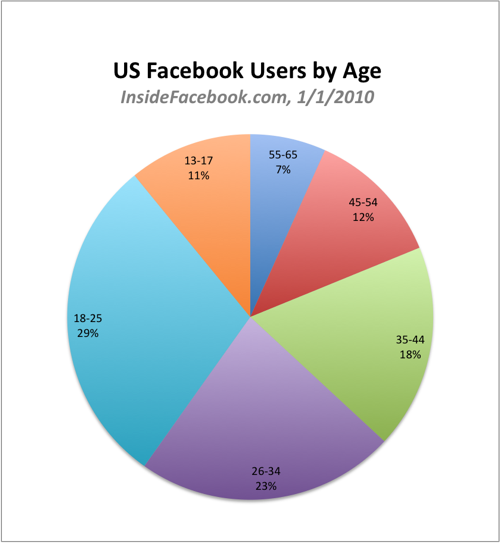
Not everyone is with me here, though … as I am repeatedly reminded. There are tons of people my age who remain as uninterested in online social networking as I once was, and totally stay away from such activity. In fact, I may be the oldest person among my (as of today) 657 followers on Twitter and my 107 friends on Facebook. Earlier this year, I learned that just 7% of all Facebook users are in the 55-65 age bracket (see graph).
So, it would appear that my level of online activity just might put me in the top few percent, or even fraction of one percent, of my contemporaries in terms of social-media savvy.
Apparently, I’m not alone in recognizing my relative uniqueness.
Last weekend was the 45-year reunion of my high school class (in Rice Lake, Wisconsin). I did not attend the gathering because of its rather inconvenient timing (this was the first time we’ve ever held a reunion other than in the summer months). However, I still happened to play a part in the events of last Saturday evening. During the MC’d program after dinner, it was proposed that a class website be set up as we all do the five-year countdown toward our 50th (gasp!) reunion in 2015. One former classmate suggested that the best person for the job would be ME, and, by acclamation, I was elected to make such magic happen.
Hence, being so honored (?), I wrote a few emails, tried to figure out what the heck the expectations were, and just generally spent some time figuring out what we (that is, I) might do.
My decision, supported by those I’ve consulted with, was to construct a group for us all on Facebook, using their just-released (four days ago) “new groups” feature. It is now up and running. (I don’t waste time: give me an assignment, and I do it!) Two days ago I sent out an email to everyone (who submitted an email address to our reunion organizers) announcing the availability of the new group (with some simple instructions about joining Facebook). Right now, we have thirteen members. (I think we have about 200 surviving classmates at this time.)
So, now there’s a small core of us waiting to see how many former classmates will join us in this social network. (I think it would be nice, perhaps amazing, if this experiment actually works!)
Soundtrack Suggestion
When I think back on all the crap I’ve learned in high school
It’s a wonder I can think at all…
(“Kodachrome” – Simon & Garfunkel)
Update on October 11, 2010:
I should acknowledge…
Of course, the title of this entry is somewhat a rip-off of the title of the 1976 book What Really Happened to the Class of ’65? by Michael Medved and David Wallechinsky.
Doctoring in the Western World
Please note:
This long essay (it’s at least four times optimum blog-post length) makes my personal case against the “medical establishment.” I do not take on the insurance companies here, though, but rather the doctors who provide front-line health care for us all.
Although I deal at length with the PSA blood test in the discussion below, I totally omit mention of the controversy currently raging about this procedure.
Caveat lector: this post would likely merit an “R” rating near the end...
I’m one of those old geezers for whom the TV commercials advertising such products as Flomax and Proscar are made: I have an enlarged prostate [benign prostatic hyperplasia (BPH)]. BPH is characterized by a number of urinary symptoms, one of the most obvious being the number of times I have to get up during the night to relieve myself. (For a list of other symptoms, click here.)
As I have monitored my condition over the last 12 years, with the assistance of various urologists in the cities I have lived, I have regularly (at least every six months) undergone the blood test for prostate specific antigen (PSA), the front-line screening protocol for prostate cancer. During this time, as my prostate has grown in size, my PSA has risen slowly, steadily, but not dangerously. I keep track of the results by means of an Excel spreadsheet and graph, and even furnish my doctors with a least-squares plot of these data at every appointment. At one point, back in late 2002, there was an unusual spike in the one of the readings, and I was advised to have a prostate biopsy. This procedure is a very invasive and uncomfortable one, but I went ahead, in early 2003, and did it anyway. After eight full days anxiously waiting, I finally was informed that the result was negative. Since that time I have simply continued to monitor the slow, steady, predictable rise of my PSA level.
Well: except that that all changed recently. In both January and March of this year, my PSA tests have yielded significantly higher readings – data that do not fit neatly within the paradigm of my least-squares analysis. After the January result, my urologist reacted as I did: one test alone means nothing. Let’s wait a bit (a few weeks) and do it over again.
And that’s what we did, though the second test in March indicated a slightly elevated level compared to the January number. It was at this point that he stated that it was time for concern and said, “you know where we go from here.” He meant a biopsy, of course, and I declined, indicating that I wanted to wait for one more blood (PSA) test before undergoing that procedure again.
However, he was very insistent that we do a biopsy, and I was just as opinionated that it was not yet time. I told him that I had one more hypothesis to test out before I would submit to the procedure. Simply put, my theory is: my PSA number is inflated due to a new dietary supplement I had started taking. Last October (over two months prior to the January blood test), I began a product called ArthroZyme, advertised as an anti-inflammatory agent, to see if it would help me out with the chronic muscle pain that has plagued me for the last few years. The active ingredient in this product is a proteolytic enzyme called serratiopeptidase. And, as it turns out, PSA itself is itself a proteolytic enzyme. I believe it is much more than coincidental that immediately after I began taking a proteolytic enzyme supplement I start testing differently for a specific proteolytic enzyme. I believe the two phenomena are connected and that this is the simplest possible, and most likely, explanation. I contend that this hypothesis is one that merits serious consideration, and that I should, therefore, simply stop taking the supplement and re-test.
As it turned out, I was only able to leave the urologist’s office in early April after hearing the strongest language he could muster that I was making a mistake and the he strongly recommended this test. NOW.
Of course, I don’t think I’m being at all unreasonable.
I’m the guy, after all, who was told, by TWO doctors, in no uncertain terms, one night in an emergency room, that he had bladder cancer. But I didn’t, as the cystoscopy (now there’s an invasive procedure), performed a couple of days later in a doctor’s office, conclusively demonstrated.
I’m the one who submitted to a biopsy back in 2003 on the basis of a PSA spike. And I didn’t have cancer, then, either.
I’m the one who has been totally discounted by my primary care physician, to the point of being told that my body aches and pains were “psychiatric” in origin and that the supplements I take (and rely on) couldn’t possibly be doing me any good.
And, I’m the person who was kept waiting for a half hour in a neurologist’s office after having experienced the intake nurse botch the explanation of my test results – only to finally talk to the doctor and learn that the (MRI) result in question was inconsequential.
In short, my trust of most medical professionals is exceptionally low, based on a history of negative experiences, how I’ve been treated by said “professionals,” and the inability of so-called “Western medicine” to get a cancer diagnosis right or to provide any kind of explanation for what’s going on with my chronic pain.
In the urologist’s office, I had to ultimately, assertively, take charge of the meeting and say, “look, this is how it’s going to be: I’m stopping the supplement and we’re going to re-test in a few weeks.” I took away with me a lab order for the blood test and an appointment card for early June.
THEN: last week I showed up for a previously-scheduled appointment with my primary care physician. After a very cursory greeting, he immediately launched into a lecture on how irresponsible he thought I was being by ignoring the urologist’s advice. In fact, he went directly to his computer screen and read to me, word-for-word, the report forwarded to him from my urologist. The write-up was clearly written to make certain that there was no doubt that I was ignoring sound medical advice, but the most irritating and distressing element of the exercise was that he read it to me with an intentional and highly-exaggerated condescending attitude. He was clearly trying to shame me into changing my mind by giving me the message of (a) how stupidly, (b) how crazy, or (c) how both, I was behaving.
“Interesting,” I said. And then I showed him the latest PSA graph, the supplement bottle containing the proteolytic enzyme I had stopped taking, and offered my explanation. I indicated to him that I was merely applying the well-known principle of Occam’s Razor: “The simplest explanation for a phenomenon is most likely the correct explanation.”
To which he, again, with an air of annoying superiority, replied, “that would be fine, except that what you offer is NOT an explanation at all, and you’re taking unnecessary chances with your life.”
I had experienced this kind of situation with him before, of course. The first true break in our relationship came about when he labeled my physical symptoms as likely “psychiatric” in nature. During the appointment at which that language was used, I let it go; I confronted him on his condescending behavior the next time I saw him, however. And he apologized at that time.
He apparently really doesn’t get it, though. Now the same kind of attitude was being exhibited over my PSA result. I sat silent for a half minute or so, took a deep breath, and then said,
“Look, I really don’t think this relationship is working out. I have much different expectations of physician behavior than you have been able to provide. Some of the qualities I expect from you are clear communication, respect, decency, dignity, honesty, and support. I resent your snobbish, superior, condescending attitude and your assumption that you know what’s “right” for me. Let me tell you, I’ve spent a lifetime becoming an expert not only on my body, but on knowing my inner self...and believe me, the numbers you have cataloged away in your little computer there are not me. I know me. You don’t. Not at all. And, you’re apparently exceptionally reluctant to allow me the freedom to make decisions about this body myself. I think it’s best to part ways, and I’m wondering if there’s any physician you know of that would be open-minded enough to take on a patient who knows what self-care is and is seeking a doctor who will serve as a consultant to that self-care.”
And I wasn’t done yet...
“Look” (I said yet again; I was repeating myself), “I’ve got the lab order for the PSA test right here in this folder. And I’ve got my next appointment with the urologist scheduled. I’ve got time scheduled away from work in June for a trip, but the plans are soft. I can easily change them and stay here and be available for a biopsy. I’m testing a hypothesis. A reasonable one, I think, but I know I could be wrong. I’ve got the plans all laid out. I’m taking care of myself. What the fuck is your problem?!”
This guy, taken in tandem with the urologist a couple of weeks earlier, had obviously struck a nerve with me: pushed my buttons big time. I immediately started reflecting on all the pre-med students I had competed with in math and science classes in college – along with my complete and utter disdain for them at the time. They were all about their course grades and med-school admission. They were exceptionally good memorizers of content, but, generally speaking, amazingly poor critical thinkers. They always got A’s, but I always got a higher A, especially in those courses that really meant something: organic chemistry, physical chemistry, etc. I pretty much kicked their collective butts. Pre-med? HA!
During my time in my primary care doc’s office, I became angry, resentful, (defensive, of course), and as assertive as I’d ever had to be in that kind of environment. I was appalled that I hadn’t changed doctors when he had labeled me a nut case the year before.
He ultimately apologized. Again. He said that he did listen to me and support me. And he said that he really didn’t know of anyone that practiced medicine any differently than he did...that everyone he knew was as skeptical of dietary supplements as he was, and suspicious of patients who experimented with unproven “natural” substances who sometimes ascribed to them “magical properties.”
I left the appointment by reiterating that I had a plan, that I was sticking to it, and that, despite his insinuations, I was neither stupid nor crazy. I said, simply, I knew how to take care of myself, and I was doing just that.
Now: could I be wrong about all this? Could I be merely delaying the inevitable cancer diagnosis by insisting on testing my theory? Might I simply be afraid of undergoing a painful, invasive procedure? Might I be terrified that I really do have prostate cancer?
The answers to the above: YES, of course. To any or all of them. But, it seems to me that I have a legitimate theory, one that I’m entitled to test out. The blood will be drawn next week and we’ll soon see if the PSA level drops. Or not.
Could I die? Well, yes. We’re all going to die, right? Have I put my life at risk by testing out a reasonable hypothesis? I rather doubt it, but, as I remind the doctors, it is my life to risk. In the matter of my body, I get to choose. Pure and simple, I get the final word here. It’s my body. It’s my choice.
Dear Doctor: If you are unable to partner with your patients in their care, then you have little business doing your business. Go be an auto mechanic, where the computer diagnostics these days are amazing, and quite often accurate, I’m told. Or, at least, do something else. And, for sure, if you can’t treat me with any more dignity, respect, or support than you’ve been able to muster so far: please go fuck yourself.
Soundtrack Suggestion
I told the witch doctor I was in love with you
I told the witch doctor I was in love with you
And then the witch doctor, he told me what to do
He said that ....
Ooo eee, ooo ah ah ting tang
Walla walla, bing bang
Ooo eee, ooo ah ah ting tang
Walla walla, bing bang...
Ooo eee, ooo ah ah ting tang
Walla walla, bing bang
Ooo eee, ooo ah ah ting tang
Walla walla, bing bang
(“Witch Doctor” – David Seville)
Update on June 12, 2009:
I need to be honest: my theory was wrong. I still think the hypothesis had merit, and that I was right in testing it out, but after stopping the supplement for two months, my PSA remained the same. I have now consented to a prostate biopsy, presently scheduled for June 22.
Stay tuned.
Update on June 24, 2009:
Here is the email I sent out to a bunch of folks this afternoon...so, in case you haven't heard yet...here is the (good) news:
Greetings!
(Sorry about this group email, but it’s most efficient in getting the word out to those of you I promised the news right away...)
Yes, the news is good: the biopsy (just performed yesterday) is negative. No cancer!
After a terrible day yesterday (this procedure is way not fun), I woke up this morning with the pain gone and an optimistic attitude. I had this sense that I would get the news today (it was promised by Wednesday, tomorrow), and that it would be good. My intuition was right on, it seems. The doctor called at 1:40 p.m. and I do not have to see him again for another six months...what a relief.
Thanks for all your kind words and loving support. It (you) made a huge difference for me!
-jim
Really: Who Are You?
Introduction
I have a new friend who lives far, far away. She is so distant, in fact, that it’s entirely possible we may never meet in person. She knows me through Twitter, this blog, frequent emails, and the occasional IM session. She has a lot of information about me available to her, of course, as I’ve laid out the good, bad, and ugly details of my life on the internet for three and a half years now. Reportedly, she’s read a lot of this material; and I know she reads my long and intimate emails as carefully as I read hers.

I feel as if I’ve recently been significantly challenged by her, though. It’s as if she’s digested everything about me, including the two “This I Believe” essays (“On Being Present” and “Listening and Leadership”) and is saying to me, “yeah, yeah, yeah, Jim ... I know that’s what you believe.” And that she’s read the other stories, rants & raves – ridden the emotional waves – and is still waiting on me for more: “yeah, yeah, yeah, Jim ... I know that’s what’s happened to you.”
And, now, she’s asking me, “tell me more, Jim ... what do you really believe? Who are you, really?”
And, so, this essay is the result of the attempt to organize a few thoughts along those lines. I’m not sure that what you’ll find here are actually answers, though ... you’ll have to decide that for yourself. For even after you read this, in all probability you’ll still be left wondering ...
By providing this analysis of “who I am,” of course, I’m anticipating that the portrait I paint is consistent with the information you’ve already seen ... and, in fact, that an inductive analysis of the mass of qualitative data provided in these pages would lead to the broad themes I outline below. Please! ... do not think, however, that this is a “scientific approach” to talking about my life’s mission; it decidedly is not. In fact, what I’m doing here is reaching down into the bowels of my being and attempting to convey some ideas about what I believe about life, and how I go about living this life.
I’ve had a little bit of practice writing in this area. When I began studies for my counseling master’s degree, one of the essays I was required to produce was entitled “The Nature of People.” This was an assignment that required all of the newbie aspiring counselors to outline, as explicitly as we could, how we believed people “worked” (i.e., if you’re going to help people with their problems, you must have some underlying philosophy about their basic “nature”). I toiled and toiled away on my assignment for a few weeks, then had one of the doctoral students critique my draft.
“Well, Jim, this looks like a good start,” he said. (As, head down, I returned to the typewriter.)
So, perhaps, what I’ve outlined for you here is merely another good start. Let’s see, shall we? Of course, I’m aware of the risks of self-disclosure on this level: you may end up thinking that my entire belief system is wholly superficial, no more profound than “All I Really Need to Know I Learned in Kindergarten.” (I confess: I offer no new ideas here.) Even more on point, though, might be the observation that everything I have ever needed to know about living, life, and the spiritual path, just might have been gleaned from an old bootlegged Ram Dass audiotape (“The Seasons of Our Lives,” from the late 1970s) – a recording that I’ve listened to over and over again throughout the years. [Much of that material is also to be found in Dass’ book Grist for the Mill (Unity Press, 1977).] Then, you’ll discover below that I’ve pulled some quotes from Angles Arrien’s Four-Fold Way: a worldview that has been influential in my thinking about what a life’s work entails.
Therefore: here I go with some ideas about “who I am” by examining “why am I here?” For the purposes of this essay, I’m going to treat the questions as equivalent; that is, by examining why I am here, I’m suggesting that this is who I am. I’ll let the philosopher in you, the reader, argue (or not) with that premise. It will be obvious that I’m not speaking from any “religious” orientation ... in fact, this a highly eclectic spiritual (and/or philosophical) model I espouse. And, of course, since this is an essay for a blog, the points I outline here are mostly short and to the point. (Who likes book-length blog entries, anyway?!)
Why Am I Here?
I believe that we humans are spiritual beings who take form on this earth for a purpose: that we are incarnated and take on bodies to “do our work.” And that everyone’s work is different. I am certain of my purpose, and simply put:
I am here to learn and grow.