

My Graduate Education Philosophy
Graduate education is a unique experience which most of us undertake -- at most -- once or twice in a lifetime. Of course, I happen to be the exception who proves the rule in that I’ve been enrolled in and completed three different graduate programs in fairly disparate fields: organic chemistry, counseling, and higher education administration. My perspective on the graduate student experience is influenced by all of these academic undertakings, as well as the many individuals I have met along the way. In this brief essay, I would like to share with you some of my thoughts on the role of teachers and students in graduate education. I shall begin by explaining my views on graduate school as a socialization process and then outline some expectations for both my students and myself along this academic journey.
When I was a graduate student in organic chemistry, I was certain that the graduate school journey was wholly an intellectual one. In the natural sciences there exists, for each discipline, a rather explicitly defined body of knowledge for which students are held accountable. A not inconsiderable portion of that information was, of course, introduced during the undergraduate major, and I saw graduate school as a time to fill in the gaps, to exercise my intellect, to explore ideas on the cutting edge, to choose a specialty, and to add to the body of knowledge in that discipline. It was expected that one possess (or rapidly develop) an identity as a researcher during one’s graduate school tenure -- and presumably for life. In this incarnation I was a physical organic chemist specializing in free-radical addition reactions as well as quantum-mechanical calculations of hypothetical molecular systems.
Additionally, in the natural sciences, nothing short of total individual commitment to one’s discipline is expected. One shows up to the laboratory early and goes home late; there is always one more problem to solve, one more reaction to run, one more hypothesis or idea to test and/or discuss with a colleague. My most vivid memories of life as a chemistry grad student, for example, are of the times my major professor and I would walk across the street to the nearest coffee shop, “talking shop” the whole of break time, drawing chemical structures on napkins, and offering various hypotheses about what’s happening with our experiments or calculations. Faculty communicate their expectations by living their lives this way. Science is a way of life: nothing less than a seven-day-a-week, twenty-four-hour-a-day commitment to knowledge seeking.
My experience while pursuing a counseling degree was quite different, as you might imagine. In contrast to the purely intellectual pursuits of a scientist, the counselor focuses, to a large degree, on emotional tasks -- both for self and clients. As a student in a counseling program, I found that only about a third of the training was theory; we also concentrated much of our effort on skill development and personal growth. Compared to the life of a scientist, a much more balanced lifestyle was expected for a counselor. A healthy individual, and especially a healthy counselor, was one who modeled and nurtured growth in all dimensions of human existence: intellectual, emotional, physical, and spiritual. Coffee breaks with counselors were not inclined toward theoretical ramblings, but were often truly intimate and emotionally-charged interpersonal exchanges.
As widely different as these two graduate school programs were for me, they did have something in common. During the time I spent in each, the expectations of what it means to be a professional in the field were clearly communicated. It wasn’t part of the formal curriculum (there was no course entitled “On Being a Chemist,” in other words), but it wasn’t difficult to infer the messages being sent. My interpretation of these cues was that scientists were totally dedicated to the advancement of knowledge; counselors were charged with helping to alleviate suffering in the world. Further, scientists specialized and worked around the clock, often paying little attention to other people or things in life; counselors took a holistic approach and paid more attention to the entire person. In sum, much of what I learned in these two programs had as much to do with professional philosophies, and the lives of chemists or counselors, as the knowledge base that was being taught; in each instance I was being socialized into the profession. It is in graduate school, after all, where a student is first immersed in and introduced to the culture of the profession -- which includes all the beliefs, values, assumptions, skills and expectations that apply to the particular field of study when one is finally out there in the “real world.”
The socialization experiences I had in obtaining my two master’s were probably about as different as two programs offering advanced degrees could get. However, I like to think that, between the two, I have evolved into a fairly balanced individual; today I exercise my intellectual and emotional sides and nurture the physical and spiritual dimensions of my being, too. The socialization experience I had in my higher education doctoral program was probably closer in emphasis to my chemistry program in that it was touted as an intellectual and research journey -- despite my a priori belief that administration is more of a calling to serve others (which is how I define counseling). The study of higher education lacks, however, that defined body of knowledge which characterizes a discipline, and, at least in my doctoral program, was not presented in humanistic terms but rather in a somewhat dispassionate, theoretical manner. In truth, I left the program in a rather confused state in terms of professional socialization, a condition which I attributed to the messages provided (or, rather, not provided) by the program’s faculty. Fortunately, I possessed an identity as an administrator in higher education before attempting to formally study the field. Perhaps the best thing I have to say about the professional socialization I experienced is that it did not tamper much with an identity that was already there. As a professor in a college/university leadership program, I hope to avoid leaving the students in confusion about their future role(s) -- and model for them the scholarly, intellectual dimensions of the field, as well as a calling to service, which is my personal orientation toward administration. In short, I’ll strive to nurture both the cognitive and affective dimensions of my graduate students.
Given this view of graduate education as a socialization experience into a profession, then, certain aspects of the process necessarily follow for me. That is, I believe that both teachers and students have certain responsibilities that they should aim to uphold in order to make the experience as successful an educational endeavor as possible. I outline below what I strive for myself and what I ask -- and expect -- of students. In terms of personal expectations, I briefly emphasize here four areas: caring, commitment, communication, and cooperation.
Caring. I try to demonstrate to my students that I care for them as individuals. This stems from my belief that learning and personal growth is next to impossible in an environment where an individual feels intimidated, overwhelmed or, in some other way, unsafe. As best I can, I attempt to make the classroom “warm.” I do this by smiling, frequent eye contact, calling students by their first name, and frequent humor. I also encourage students to call me by my first name (some get the hang of it, some don’t), and use self-disclosure at times, to let students see me as a normal human being -- rather than as an unapproachable professor.
Commitment. I have a strong personal commitment to intellectual achievement as well as personal growth in all non-cognitive dimensions and I try to model this for my students through actions and words. I hope that this commitment is clearly conveyed -- and that my enthusiasm is contagious! I view myself as a serious scholar, one dedicated to the “life of the mind.” But I also like to stress that living in one’s mind all the time is fraught with pitfalls. We need to feel our way through this human experience, too. Above all, I demonstrate my commitment to my students in that attention to their needs comes first. Despite a variety of competing priorities in my life, I have always structured my time so that my students and class preparation are number one.
Communication. Successful communication is the key to all positive relationships and involves both effective verbal and listening skills. I believe that my success in the classroom begins by speaking at the students’ level. As best as I can, I try to put myself in their position and approach the topic at hand from their vantage point. If I use vocabulary that is too advanced, or if I assume knowledge not mastered, then I am not communicating successfully with those students. Although my ultimate goal is for them to achieve at a higher level than where they started, I cannot expect them to do this if I do not respect them where they are and nurture their growth. I do this, in part, with appropriate use of language.
I also demonstrate good communication -- and nurturing behavior -- when I listen. My listening skills, I believe, are one of my greatest strengths as both a counselor and as a teacher. To understand where a student is intellectually, as well as emotionally, requires patience. And one must demonstrate the ability to closely listen to what the student is saying, as well as what they may not be saying. In my experience many teachers would be more effective if they would concentrate on improving their listening skills.
Cooperation. As both a counselor and a teacher I have always been impressed with the power of small groups. Whenever possible, I draw upon the knowledge, expertise, and range of ideas within a class so that we can all learn from each other. As a classroom leader, I strive to empower the group and have them direct their own learning. I prefer to structure class activities that involve group dialog and, at times, group projects. And if for some reason the course is not working or moving along as I envisioned it, I invite the group to design their own learning experience by assisting me in revising the syllabus for the remainder of the term. One of my first rules in both my counseling and teaching roles is: if what you’re doing isn’t working, try something different. In attempting that “something different” during the progression of a semester, I use information supplied by the group.
The preceding four areas are the ones I am the most conscious of as I attempt to assess my work with students, both in and out of the classroom. I know, however, that I don’t always succeed in being the most patient instructor or the best listener to a student who is in need of attention. The comments I receive from students on the evaluations every semester tell me that I do a pretty decent job in these areas, though.
Of course, as I have mentioned, I have expectations for my students. Most agree that I set fairly high standards -- and that they are about the same regardless of the level of student: underclassman, upperclassman, or graduate student. There is just one key word that I use when describing the role of the graduate student: responsibility.
First, students must be responsible for the basics of good student behavior, that is, showing up (wasn’t it Woody Allen who said that showing up is 80% of life?), paying attention, and doing the work. I don’t believe that students can be very serious about their academic experience without at least observing these three basics. But beyond these elementary requirements, I expect students to take a high level of responsibility for their own learning. My students need to participate actively. Passive learning (such as me talking and them listening) is not a common practice in my classroom. My students need to communicate with me and each other and to search out their own “truths” -- and if they can’t find those, then they need to, at the very least, begin to identify the questions that are most important for them. My approach to the classroom can often lead to frustration unless students understand what I’m trying to do. I don’t supply the answers; but I do try to develop really good questions. Unless students see themselves as responsible for their own learning -- and unless I can communicate this philosophy to them -- then semesters can be very long periods of time to endure.
Finally, in the area of students’ responsibility for their own learning, I encourage and expect them to use their graduate school experience to experiment with new ways of thinking and behaving. Where else in American life today is it still as safe to take risks as it is on a campus? Even if the new ways are ultimately rejected, such information is invaluable for a person. I view the experience of being human as an art form, and I encourage free expression and new ways of looking at the world for my students.
Learn to take risks. Be free. Ask questions. Find your own truths. This is what graduate school is all about.
A Touch of Class
I had lunch with a group of folks from work recently. The ceremonial get-together (to honor a few of our colleagues) occurred at a rather classy French restaurant (The Left Bank) in downtown Larkspur, California. Larkspur is the tiny San Francisco suburb where I currently reside, in Marin County, which, according to Wikipedia, was the county with the highest per capita income in the country per the 2000 census.
It was one conversation in particular during this event that got me to thinking...and still has me deep-in-thought. What’s on my mind is the whole matter of “social class.”
The two individuals on my left were engaged, for a time, in a dialog about places they’ve lived and visited; both of them are extremely well-traveled. So, when such places as Hong Kong, Paris (or even Philadelphia!), were brought up...well, there simply wasn’t anything for me to contribute to the conversation. I’ve been to a lot of the states in the United States, and lived in five of them, but I’m most definitely not a world traveler. I obtained a passport for the first time ever this year, though it remains unused and stored in my sock drawer. (And, I’ve never been to such obvious American places as Philadelphia or New York.)
Then, when lunch was served, they talked about the food. One of them had, like me, ordered the salmon. When asked how it was, she said, unenthusiastically, “oh, it’s ok.” (My reply would have been, “it’s wonderful!”) The other one commented similarly on his lunch and speculated about the spices used in its creation. (I wouldn’t ever have a clue about such a thing.)
In terms of “worldliness,” these two individuals, both about my age, clearly eclipse me. I felt out-classed because I was. Although a casual observer would likely place us all in the “upper-middle-class” of American society because of our education, occupations, and income levels, by sitting next to these two, and listening in on their conversation, I was aware of what I’d call a “class distinction.”
Both of my parents were high-school graduates, and I was the first in my family to attend college. Subsequently, after my bachelor’s degree, I proceeded over the course of my lifetime to earn three more graduate degrees. In terms of educational attainment in this country, I must place in the top couple of percentage points: I am not only highly educated, I am (admittedly) overeducated.
However, I continue to be aware, in situations like this lunch-time conversation, that my roots, and class origins, are decidedly not “upper” anything. I remain small-town working-class at my core: my educational achievements alone having contributed to an enhanced class status. I possess a set of life experiences and financial deficiencies that have apparently kept me stuck with the outlook and narrowness of the lower-middle-class.
Surely a person more worldly than me has: Traveled. Experienced. Tasted. More.
My lack of worldliness is a source of embarrassment for me, and it’s something I try desperately to conceal...you know, other than when I am confessing to it here.
Soundtrack Suggestion
Oh lets get rich and buy our parents homes in the south of France
Lets get rich and give everybody nice sweaters and teach them how to dance
Lets get rich and build a house on a mountain making everybody look like ants
From way up there, you and I, you and I
(“You and I” – Ingrid Michaelson)
Decanal Decorum
You never can tell. About anything, really. Don’t you think life is mostly a matter of random encounters and chances?
Which is a rather odd introduction to a little story of laughter and embarrassment during a time of high stress...
Last Tuesday evening I was attending the monthly meeting of the Board of Trustees of my college. I was there because one of the programs within my area of responsibility was going to be eliminated by action of the Board.
It was all high drama. People wanted to have a say in the decision...and many signed up to offer their personal testimony. Although the action item had originally been placed toward the end of the agenda, it was moved up to the beginning so the Board could take its vote while interested members of the public were still in attendance. The testimony and ensuing discussion took almost three full hours.
I was sitting in the back of the room. The furniture in the peanut-gallery section is notoriously uncomfortable, so I had arrived early to get a chair (and a location) that would suit me best. As the meeting got going, more and more people filled the room until it was a standing-room-only situation.
Ultimately, two young women were standing very close to me. I was very conscious of how tightly we were all packed in, and the high likelihood of encroaching on someone else’s personal space. The room started to get warmer and warmer, but the temperature was just right for me as I was sitting next to a very large (but closed) window – which kept cool the air in my region of the room.
At one point, as one of the speakers was just finishing up, another of the audience members came over to me and wanted to see if the window by me would open. I resisted, saying (quietly), “yes, but even if it does open, I’ll freeze.”
The very attractive (approximately 20-year-old) coed standing right next to me, who had not acknowledged me during the entire proceeding thus far, jumped right in. She put her hand on my shoulder and said (or, more accurately, announced) , “oh, don’t worry, I’ll keep you warm.”
I snorted. Giggled way too loudly. And blushed wildly
Another speaker had already taken the microphone. Several people, in a semicircle around us, all turned our way, put their fingers to their lips, and went “shhhhhh!”
My face turned even more red, I’m sure.
When things settled down, I turned to my new, attractive, young friend and said, sincerely, “that was very funny.”
So much, though, for The Dean bringing any sense of Decorum to the room!
Soundtrack Suggestion
I don’t like you
But I love you
Seems that I’m always
Thinkin’ of you
Oh, ho, ho, you treat me badly
I love you madly
You’ve really got a hold on me
(“You Really Got A Hold On Me” – The Beatles)
Go Bruins
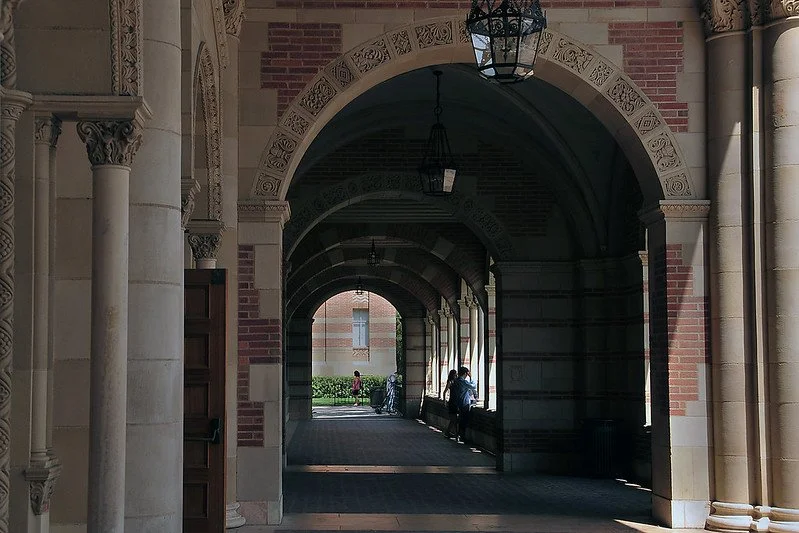
Royce Hall, University of California Los Angeles