

Addictive Organizations and the Four-Fold Way
If you’ve ever discovered the need to show up at work everyday by first forcing yourself out of bed, and then dragging yourself into the office because you’re dreading the day there: perhaps you’re working in an “addictive organization” (a concept I briefly outlined in my recent Analysis Paralysis post).
How does anyone really cope with life in an addictive organization? How is it possible to survive, much less thrive? What is your fate if you find yourself in one? Can you promote health and recovery…and actually, eventually, find a place of well-being there?
During the time I was engaged in my doctoral research, and anticipating using the addictive organization model as a theoretical framework for my dissertation, I corresponded briefly with Anne Wilson Schaef, the model’s developer. I had been tremendously impressed with her “organization as addict” metaphor and asked about any thoughts she might have regarding “coping with” or “recovery in” such an organization. She said that her plans were to write a follow-up book to The Addictive Organization (1988) and outline her ideas there. As far as I’ve been able to determine, though, she never produced that book…I can only hope it’s not because she thinks that recovery is impossible!
Now, given that it took an entire 232 pages to outline the many dimensions of an addictive organization, I suppose it would be reasonable to assume that any discussion of recovery in one would take at least as much space. However, coping with an addictive organization has been much on my mind lately, and I thought I might get started (here) on developing some salient points regarding this topic.
Although there are several dimensions of an addictive organization, certainly near the top of the list of characteristics (and among the most applicable to individual addicts) are the descriptors of denial, dishonesty and control. So, in this brief essay, let’s begin with just these three.
Denial means that the organizational problems are not openly acknowledged, or at least not accepted as “real” by those most able to address the dysfunction: the leadership. For issues to be worked on, they need to be identified, they need to be named. Statements such as “this is just the way things are” or “this is as good as it gets” or “we may have a few small problems here, but certainly not big ones” – when everyone really knows differently – is a sure sign of organizational denial.
Dishonesty is another key characteristic of an addictive organization. Like individuals who are addicted to substances or processes, those caught up in such an unhealthy organization exhibit their dishonesty on three levels: by lying to themselves, to those around them, and to the world at large. Believing that one can effectively impression-manage (e.g., the media) and “put up a good front” to those outside the organization, for example, are a couple of obvious manifestations of organizational dishonesty.
[I was once told, in private, by a college president, “I tell lies to everyone every day. There’s no other way to do this job.” While a striking example of personal honesty, the underlying message is one that reflects normal life in an addictive system.]
Finally, there is the element of control. This more accurately might be labeled the illusion of control, though, as it is, of course, ultimately impossible to control anything. However, the addictive organization harbors the notion that it is possible to control. When likened to a dysfunctional family that revolves around an individual addicted member, Schaef (p. 66) describes this symptom as “[t]he family tries to control the addict; the addict’s behavior is controlling the family; the co-dependent spouse is trying to avoid being controlled; and everyone is going crazy.” Further, Schaef notes (p. 66), that “whenever a system is operating on the illusion of control, it is an addictive system by definition.”
I believe that it’s possible to begin the grasp the severity of life in an addictive organization by simply (and quite briefly, as I’ve done above) understanding just these three characteristics. The questions that naturally arise include: What is there to do? How do I cope? How do I survive? How can I continue to show up every day, when this is what I always find?
I suppose that any discussion of “recovery” in a system defined as “addictive” would naturally include, at some point, a 12-step model; let me leave that discussion for another day, though. I would like to begin with countering the three points above by suggesting strategies that lie on the opposite ends of our behavioral continuum.
If the characteristics of denial and dishonesty are taken together (considering that denial is essentially a lie to one’s self), then a position contrary to that is honesty. Similarly, when the element of control is considered, an alternative could be termed surrender. So, I pose the question, what if I approached life in an addictive system with a personal stance of honesty and surrender?
When I consider this question, I am reminded of the Four-Fold Way orientation developed by anthropologist Angeles Arrien. Quoting directly and liberally from the description of this model on her website, I believe it is evident how such a philosophical and behavioral stance might successfully contend with the illness of an addictive system. The four elements are:
Be Present. The way of the Leader is to show up. Being present allows us to access the human resources of power, presence, and communication. We express this through appropriate action, good timing, and clear communication.
Pay Attention. The way of the Healer is to pay attention to what has heart and meaning. Paying attention opens us to the human resources of love, gratitude, acknowledgment, and validation. We express this through our attitudes and actions that maintain personal health and support the welfare of our environment.
Tell The Truth. (Honesty) The way of the Creative Problem Solver is to tell the truth without blame or judgment. Truthfulness, authenticity, and integrity are keys to developing our vision and intuition. We express this through personal creativity, goals, plans, and our ability to bring our life dreams and visions into the world.
Be Open To Outcome. (Surrender) The way of the Teacher (or Counselor) is to be unattached to outcome. Openness and non-attachment help us recover the human resources of wisdom and objectivity. We express this through our constructive communication and informational skills.
It is my thought, and suggestion here, that to adopt the healthy elements of Arrien’s Four-Fold Way, could be critical to both personal survival and organizational change in an addictive system.
Are you with me?
Analysis Paralysis
I have been thinking lately that I am suffering from an affliction I suspect many others at my workplace are also attempting to cope with: for want of a better term, “analysis paralysis.”
Ever since I began my present work assignment, I have been confronted with one ambitious “to-do list” after another. We have produced many, many lists and attempted to prioritize the items at many, many meetings I have attended. Among the giant list of tasks is the recently-revised and distributed, overwhelming, intimidating, multi-page strategic-plan document.
I have to admit: in the face of so much to do, and so little guidance about what the priorities are, I tend to remain somewhat frozen. Because, everything is a priority, I’m told. And, what I know is that when everything is a priority, nothing is. And that when everybody is responsible, nobody can be.
The organization is attempting to change several dimensions of its collective being all at the same time. Stress is high. Communication is low. Ad hoc decisions abound. Everyone is off balance; or, at least I know I am.
Come to think of it, all of this is sounding amazingly familiar. Because…
My 1995 dissertation about alcohol use and socialization in a college fraternity, used the “addictive organization” paradigm of Anne Wilson Schaef (1988) as the guiding theoretical framework. This way of looking at workgroups (and, in my study, a social group) came about as a rather logical extension of the “dysfunctional family” literature, which sees family groups behaving as addicts. Schaef proposed that it is possible to “recognize that organizations themselves are addicts, and that they function corporately the same way any individual addict functions” (p. 137).
Some of the elements of an addictive organization, according to Schaef (see chapter 4, pp. 137-176), include:
Communication that is indirect, vague, confused, and ineffective
Lots of gossip and many secrets
The expression of feelings is forbidden and outside of acceptable behavioral bounds
Loss of corporate memory; forgetfulness; inability to learn from mistakes
Dualistic thinking (limiting available options to yes/no, black/white, no room for gray area); setting up sides
Denial and dishonesty (problems “don’t exist” and lies protect the status quo)
Isolation (allows for one reality as the only reality) & self-centeredness (organization feels that it is the center of the universe)
Judgmentalism (adds the element of “bad” to people’s choices, especially when views are expressed that are counter-cultural)
Perfectionism (mistakes are not allowed)
Confusion and crisis orientation (everyone is always trying to figure out what is going on)
Manipulating consumers (covering up faulty products or faulty functioning)
Control (including personnel practices that are built on punishment not reward, as well as the belief that the organization can control how it is seen by others), and
Lots of time and attention working on structure (looking for cosmetic ways of addressing problems rather than attempting to discover root causes)
Whew! Now that’s a long list of symptoms! (Yet another list, sorry!) Yet, for the purposes of summarizing the model here, I’ve tried to be quite concise.
My question: I just wonder if there is anybody else who might be seeing and experiencing any of my current reality?
Fitting In
I have no words for my reality. [ Max Frisch (1911–1991)]
Early on during my time as the science & technology dean (slightly less than two years ago), I called a gathering of the entire division to talk over some old and new business. Now, I guess my personal meeting-leading style is a bit different than other deans who have occupied this position: I remember mentioning things like “we all work too hard,” and that “we should take better care of ourselves,” and that “I’m not willing to die for this job”…that kind of stuff.
I think most would agree that I tend to be honest and direct.
Further, when I speak to things that I am passionate about, I typically have great energy. I’m expressive, I gesture, I emote. In sum, I likely exhibit a collection of personal characteristics and interpersonal communication styles that are different from your stereotypical, geeky, sometimes-reticent, always-in-his-head science guy.
Directly after one of these early meetings, I remember F coming up to me and exclaiming, “you don’t talk like any dean we’ve ever had here before!”
Now, at the time, I wasn’t exceptionally surprised by this remark. In addition to my science education (two degrees, a bachelor's and a master's), I also have a master’s in counseling. In case you didn’t know: this is quite an unusual background. While scientists tend to focus on theories, experiments, findings and ideas, counselors mostly attend to feelings, relationships, and personal growth. These are radically different approaches to knowing the world, and I admit that I probably am a pretty rare bird both in terms of my formal education and how I interact with the universe around me.
It seems, over time though, that the Division faculty here have rather gotten used to me and my non-traditional ways of talking and behaving. However, when it comes to job searching, I’m not so sure my, well, deviance is all that much appreciated. I’ve talked this over with M, and he agrees: when it comes to a job interview, a new group may not quite know what to make of me. “Could this be our new dean ?” [I can imagine some of them ( most of them) wondering...]
This topic has been more on my mind in the last few days due to another, more recent interaction: this time with T. As I was lamenting my lack of a job offer despite my ambitious interviewing schedule of late, I once again mentioned something like “I guess I just don’t talk like a science dean.”
Her comeback was a very quick, energetic, and expressive, “Jim, you don’t talk like anyone I’ve ever known !” She went on to say that, “in fact, I don’t think I’ve ever known anyone quite like you!”
Now, I’m positive that these statements were offered in only the most complimentary way. And, I certainly received them as such. Actually, such observations are (to me) pretty flattering. But, the more I’ve thought about the implications of these remarks, the more distraught I have become. In terms of locating a new workplace, how can I possibly find somewhere to “fit” if I am perceived to be so different? Who would want to hire me if I’m not “one of them?”
Well, it’s going to be hard, isn’t it? Actually, it HAS been difficult, and maybe this is one of the primary reasons I am facing unemployment: I am too different, and I really just don’t fit .
The question now is: where do I fit?
Authenticity
Oftentimes, I truly struggle with the role in life that seems to be mine.
In relationship, I showed up: totally, passionately, and with great capacity for commitment. I lived, not merely played, the role of devoted partner, lover, friend, confidante, and care-giver. I loved deeply and had the expectation of being loved back proportionally.

Steadfast in my role, I kept hoping against hope that something would change. I anticipated that she would eventually discover, in this person, me, her mated soul.
Oh, I wanted: the joy of that discovery!
In this life, it seems I keep playing the role of the broken-hearted one. It was a constant theme that I was rejected, left to lick my emotional wounds, allow time for them to scar over, and then attempt the same uneven dynamic all over again.
How can two people be so close and yet so far apart? How can the universe be so cruel?
Today, everyday, I show up in an environment where I attempt to play a similar role. I find myself in another situation where there’s no commitment to me, yet I am expected to show up, perform, give my all, and care. I have been trying to play, at great personal cost, the role of a caring person in a dysfunctional, uncaring place.
Here’s the deal: I believe that I am an authentic individual. I am exhausted by the role of inauthenticity that this environment forces me to play.
I desire connectedness. Team play. Commitment. And, yes, love.
I continue to find myself in situations where those crucial, life-affirming forces are absent.
On and off stage, what I have to offer is my one-man act. Alone. I look around and the set is empty. Except for me.
All the world’s a stage,
And all the men and women merely players.
William Shakespeare
Psychic Prisons
I’m in no way a student of The Classics. I regret to report that my formal, “classical,” general education has been woefully inadequate. So, when I now (presume to) speak about Plato’s Republic, and “The Allegory of the Cave,” well, you’re going to need to take what I have to say with not only a grain of salt, but maybe an entire wheelbarrow full!
I was browsing Gareth Morgan’s Images of Organization (1986, my copy of the first edition) today, still (always!) trying to make some sense of my world. (You know me: I can’t seem to shut off my mind!) In the chapter that examines the metaphor of “organizations as psychic prisons,” the discussion begins with a description of Plato’s cave allegory.
The Wikipedia summary of the allegory (copied, pasted, edited) goes thusly:
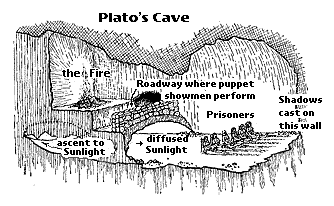
From Great Dialogues of Plato (Warmington and Rouse, eds.) New York, Signet Classics: 1999. p. 316.