

LCC Board of Education Testimony — September 3, 2025
Here are my remarks made before the Lane Community College Board of Education on September 3, 2025
Chair Folnagy, Members of the Board, President Bulger, Colleagues:
Good evening. My name is Jim Arnold. I’m a Lane County resident, a retired university and college administrator, and someone who sincerely cares about the future of Lane Community College.

First of all, congratulations to the re-elected and newly-elected Board members. I think it’s especially great to see Jesse seated to the Zone 7 position, for which I was an applicant last December.
Tonight I stand here as an ally of both the college’s faculty AND, well, the Board of Education too, because I am very concerned about the wide gap between the bargaining positions of the LCCEA and the administration. I worked in higher education for decades and I know how essential it is to have a stable, respected, and fairly-treated faculty if we want our students to succeed.
The proposals brought forward by the faculty union are thoughtful, forward-looking, and clearly rooted in student success. They’re calling for more support for students — including better access to advising, tutoring, and mental health services. They’re advocating for inclusive facilities, safe classrooms, and working conditions that allow faculty to focus on teaching and mentoring students.
On the other hand, the administration is proposing to reduce job security, eliminate long-standing agreements, and reserve the right to reopen pay discussions at almost any time, under vaguely defined conditions. That kind of unpredictability doesn’t just harm morale — it makes it harder to recruit and retain good faculty.
Now, I offer these comments in the context of a recent finding that the administration has engaged in unfair labor practices. Of course, at the same time, one of the continuing priorities of the president is to improve campus climate. Frankly, I’ve really been trying to wrap my head around all that.
In closing, I urge you all, as a Board, to strongly encourage your bargaining team to move toward a settlement that reflects Lane’s espoused values of integrity, relevance, learning, support and transformation. Wouldn’t it be wonderful if LCC’s espoused values were the ones we actually enact. So, even in these resource-challenged times, my advice to you is to choose to invest in students and in faculty.
Thank you for your time.
LCC Budget Committee Testimony — May 21, 2025
Here are my remarks made before the Lane Community College Budget Committee on May 21, 2025
Chair Patterson, Members of the Budget Committee, President Bulger, Colleagues, and Friends:
Hello again. My name is Jim Arnold. I’m a Lane County resident and a retired community college dean. In my last full-time position, I had responsibility for six academic departments plus athletics. I managed the personnel and budgets for everything from physics to football. I have a deep appreciation for the financial woes we face in higher education.
I’m here to follow up on my comments from last week, offer a few observations, and make another recommendation along the way.
At the last meeting, I asked why the projected 3.1 million dollar deficit had not been shared with us sooner — especially since the earlier proposal from the Budget Development Subcommittee didn’t reflect a shortfall. I also urged this Committee to request a revised budget — one that’s balanced and doesn’t rely on reserves.

I appreciated Mr. Isaacson’s candor in expressing confusion — which echoed my own — about what changed so suddenly to throw the budget out of balance. The administration cited a variety of factors, including shifting assumptions, the need for various refinements, and a lack of time for more thoughtful decision-making. I, for one, was not entirely persuaded by these arguments.
I also heard other Committee members express real discomfort with budgeting for a deficit while relying on administrative mid-year corrections. Mr. Mital observed that this could be interpreted as a “not to exceed” budget — but I contend that setting an artificially high ceiling doesn’t make an unbalanced plan a responsible one.
Now, it seems the administration is hoping for approval of their budget tonight. My recommendation is simple: take a step back. Hit the pause button, engage your most curious selves and inquire: “is that the right thing to do?” I ask you to give the process another week for serious, transparent deliberation.
Adrienne Mitchell’s latest analysis — which was made available to you yesterday via email — includes various scenarios that show a balanced budget is within reach. These alternatives deserve an honest review before any final decision is made. Perhaps you could consult administration and ask, “what’s wrong with these numbers?”
So, in conclusion, a gentle reminder: it’s the Board of Education — not just the administration — that is ultimately responsible for adopting the College’s budget and deciding on any reductions. This Committee and the Board play a vital role in public oversight. You are not here to rubber-stamp a proposal without knowing what’s at stake. I believe that you are here to ensure transparency, accountability, and stewardship of the college’s future.
Thanks so much.
LCC Budget Committee Testimony — May 14, 2025
Here are my remarks made before the Lane Community College Budget Committee on May 14, 2025
Chair Patterson, Members of the Budget Committee, President Bulger, Colleagues, and Friends:
Good evening. My name is Jim Arnold. Some of you know me, but for those who don’t, I’m a former university and community-college administrator. In retirement, I’ve remained involved in higher education, including part-time faculty and classified roles here at LCC. I also served on the Budget Development Subcommittee here during the 21–22 academic year.
I come before you tonight to share a few brief observations, pose some questions, and to make a recommendation.
From what I understand, this year’s Budget Development Subcommittee — made up of faculty, classified professionals, and administrators — engaged in what’s been described as an extremely collaborative shared-governance process. Their final product was a balanced budget, approved by the College Council last month, that included a surplus of around $600,000.

Then, last Wednesday, here in this room, the administration presented its version of a budget which, surprisingly, looked quite different. This proposal called for spending $3.1 million from the ending fund balance. If adopted, it would deplete the college’s reserves over the next few years and place the institution in a financially precarious position.
This shift is concerning. The BDS proposal assumed hiring 30 of 37 open positions — about 80% — leaving a reasonable number vacant. But the administration’s proposal shows significantly higher staffing levels.
According to the LCC HR office, current staffing is 189 faculty, 281 classified staff, and 70 managers. The administration now projects 207 faculty, 337 classified, and 80 managers (p. 43). That’s 84 more positions than we have now — and more than twice the number the BDS proposed to fill.
I’m left wondering: Where did these positions come from? Why are they now in the budget? And if the goal is to fill them this year, how does that make fiscal sense when it would lead to a multi-million-dollar deficit?
So, it seems, we have two competing proposed budgets, based largely on different assumptions about staffing. I am unsure about which one to trust — but drawing on my experience here, I’m inclined to support the thoughtful, deliberate work of the Budget Development Subcommittee.
I urge you to ask this: Why wasn’t a projected $3.1 million deficit shared with the Board, Budget Committee, or campus community before last week?
And finally, I strongly recommend that you request a revised proposal — one that’s balanced without relying on reserves, and that takes a more thoughtful (responsible?) approach to filling vacant positions.
Thanks so much for your time.
Time For a Change
This is the op-ed I published in the Eugene Weekly, April 17, 2025
I think it’s time we vote to reconstitute the Lane Community College Board of Education in May’s special election. The reason: this Board is completely dysfunctional with its current six-member configuration. The Eugene Weekly covered the painful machinations of this body in January, and what follow is my take…
When Lisa Fragala, a veteran LCC Board Member, was elected to the Legislative Assembly last November, she immediately resigned her position on the Board. Very soon thereafter a notice appeared on the LCC website announcing that there was an opening for the vacated position and that the College was seeking applicants from among Lane County voters. According to Board policy 2110 “When a vacancy is declared … the remaining board members shall meet and appoint a person to fill the vacancy from any of the electors of the district…”(emphasis mine).

I was one of four applicants for this slot. I am a retired, career higher-education administrator, having served, for example, with the Oregon University System for several years as the primary liaison to the state’s community colleges and the System’s policy expert on transfer-student activity. When that position ended, I spent a decade as a community college academic dean. In retirement, I have been a part-time LCC faculty member, during which time I was an officer in the faculty union and a member of the College’s Budget Development Subcommittee.
I thought I had a lot to offer to the Board and gave it my best shot during the interview process. However, I had read the application materials of my fellow candidates, watched their interviews, and would have been delighted to have had any of us appointed; we were a very strong pool from which to choose. As stated above, according to Board policy, members had the obligation to fill the position and make itself a whole, seven-member governing body.
During a Zoom meeting on December 16, 2024, the Board agreed to a process for making the selection that included a ranking system for candidates. Then, at the December 18 meeting, all four applicants were interviewed in person. In the first round of applicant ranking, three Board members voted for one candidate as their first choice (Jesse Maldonado), two voted for another (Bob Brew). Neither Dan Isaacson nor myself received any first-place votes. Even with this split, though, I imagined that reason would prevail and either Mr. Brew or Mr. Maldonado would be chosen. Four votes would be needed to appoint.
However, as the discussion proceeded, two Board members refused to rank the candidates, clinging to their one and only choice. In an even more egregious action, one member removed herself from participating entirely and even left the room during voting. The result was that, in spite of our qualifications, no candidate prevailed and the Board left the seat vacant in violation of their own policy and prior practice.
Then, subsequently , during the January 8, 2025, Board meeting, at the urging of Board Member Austin Folnagy, there was yet another (entirely painful and embarrassing) discussion of the selection process. A “motion to rescind” went nowhere and the position continued to remain vacant.

Finally, much to my surprise, at the April 2 meeting, this time at the urging of Board Chair Zach Mulholland, the matter was revisited yet again. Mr. Mulholland took the position that Jesse Maldonado should be now appointed to Position 7 since he is the only candidate from the original pool to throw his hat into the ring for election in May. This suggestion seemed like a no-brainer to me: yes, onboard Mr. Maldonado now so he wouldn’t have to wait until July 1. He is both a known quantity (having already interviewed) and is running unopposed.
Did this Board now do the logical thing? Nope, not a chance. With another three/three deadlock, the position continues to remain unfilled until after the election. The discussion preceding this vote was entirely cringe-worthy. Go find it on YouTube and then ask yourself if this is the group you want to represent the citizens of Lane County and making decisions (or not) about our College. I certainly have an answer for you. So here are my May-election recommendations, which will give us three new members.
Zone 1: Jerry Rust
Zone 3: Devon Lawson
Zone 4: Austin Folnagy (incumbent)
Zone 7: Jesse Maldonado
However, whatever you do, please vote. I know these are not the most high-profile races. Mail those ballots in! I think we all have an idea about what happens when citizens decline to participate in our beloved democratic process.
Kent State Plus 45
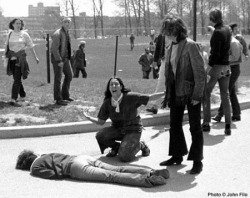
One of the Kent State casualties. Mary Ann Vecchio kneels by the body of Jeffrey Miller in this iconic, Pulitzer-Prize winning photograph by John Filo.
Tomorrow is Monday, May 4th, the 45th anniversary of the massacre at Kent State University. The tragedy was a seminal event in American history - a stunning blow to the American psyche as well as to the anti-war movement. Whatever side you were on regarding the question of the Vietnam War (and most people were aligned with one side or the other), if you were alive on Monday, May 4, 1970, you were aware of the events on the Kent State campus that day.
Here is my version of that time and why I write about it now.
On April 30, 1970, President Richard Nixon announced to a national television audience that he was ordering American troops into Cambodia. Although the stated purpose of this so-called “incursion” was to hasten an end to the ongoing slaughter in Vietnam, many Americans, myself included, were thoroughly appalled and believed the act to be an insane expansion of the war effort. Just ten days earlier, in another television address, Nixon had led us all to believe that our involvement in Southeast Asia was winding down in a meaningful way.
May 1970 was the last month of my final semester as an undergraduate student. I was a chemisty major, but I was socially-aware, politically-active and fervently anti-war. My college career had been interrupted when I received a draft notice on June 18,1969. I subsequently spent 22 days in the Air Force during late September and early October of that year – until a chronic knee condition quickly led to a medical discharge. Although by May of 1970 I was no longer at risk of losing my life in this war, I had spent four long years under the specter of the military draft – and the prospect of a gruesome, lonely death in a jungle a million miles away. For myself, and every American male my age, the war was personal. And, like many of my peers, I believed the U.S. intervention in Vietnam to be both illegal and immoral.
President “Tricky Dick” Nixon had been elected, at least in part, on the basis of his “secret plan” to endthe war. Yet, here he was, a little over a year into his presidency, ordering an escalation.

The original Kent State Memorial at UW-EC, dedicated on May 8, 1970. This plaque was removed from its original location in 2010 and presumably now resides in the campus archives. (Photo taken in July 2005. Click for enlarged version.)

From my personal file cabinet. Front page of UW-EC student newspaper “The Spectator” - published May 7, 1970. University President Leonard Haas addresses the Kent State demonstration in the middle of campus. The little red arrow on the left-hand side of the page points to me in the crowd. (Click for enlarged version.)
I was pissed. I remember spending the rest of the evening, after watching Nixon’s speech, composing a letter to the editor of my local newspaper. My misssive was not the most eloquent piece of prose ever written, but what I lacked in style, I hope I made up for in passion. This is the last straw. Nixon is wrong. He has to go. The war must end.
Many Americans agreed with me. Unrest on the nation’s campuses, especially, took a dramatic turn. On May 4, 1970, my letter was published in the Eau Claire (WI) Leader-Telegram, the same day that four full-time college students (Allison Krause, Jeffrey Miller, Sandra Scheuer and William Schroeder) at Kent State University were gunned down by Ohio National Guard troops. Another nine students (Joseph Lewis, John Cleary, Thomas Grace, Robbie Stamps, Donald Scott MacKenzie, Alan Canfora, Douglas Wrentmore, James Russell and Dean Kahler) were wounded; one was paralyzed for life, the others seriously maimed.
In the days immediately following Kent State, students at the normally-placid University of Wisconsin - Eau Claire (UW-EC) rallied. This was my campus. I, for one, picketed the Science building and boycotted classes where I had spent the majority of my time studying chemistry and math. On May 6th, a campus-wide demonstration was held, with a group of over 3,000 gathering on the lawn right outside the student union building. (See the accompanying photo, to the left, as published in the student newspaper the next day.) Two days later, four crab-apple trees were planted, along with a commemorative plaque (see photo above), in memory of the dead in Ohio. (See also accompanying photo, below, of article published in the May 14th edition of the student paper.)
In 2010, the Kent State Memorial was removed from the UW-EC campus as part of modernization efforts and the construction of a new student center building. Upon learning of the disappearance of this memorial, I was distressed. For four decades, I had rarely made a visit to the state of Wisconsin that didn’t include some time in meditation sitting among the trees and plaque belonging to the Kent State Four. The institution, without this particular artifact belonging to those turbulent times, somehow seemed incomplete.
TODAY, happily, after enduring five years of uncertainty about the status of the Kent State Memorial, I am here to report a significant new development. I recently received notice (see below) from UW-EC that on May 4th, tomorrow, a new memorial will be dedicated. The old memorial consisted of four crab-apple trees and a plaque. The word is that tomorrow’s event will unveil a memorial also consisting of four crab-apple trees and a plaque (though not the original one pictured above). I am sad that I cannot be there to participate in the event, but very pleased that there will be a new Kent State Memorial to get acquainted with during my next trip to campus.

From my personal file cabinet. UW-EC student newspaper “The Spectator” - published May 14, 1970. Continuing coverage of the Kent State demonstrations and the days that followed, including the dedication of a memorial: four crab-apple trees and a plaque planted in the ground by the student center building to forever remember the slain students. That’s me, at age 22, in the top left-center of the photo - taken during the May 6th demonstration. (Click for enlarged version.)
A few closing thoughts. The marches, demonstrations and class boycotts in the aftermath of Kent State added up to the most unrest the UW-EC campus had ever seen (or has seen since). And, in sum, when viewed in their historical context, the invasion of Cambodia, the ensuing protests, the massacre at Kent State, and the National Student Strike, were a turning point for the Nixon presidency. To recognize the significance of these events 45 years later, PBS recently (April 28, 2015) debuted a one-hour documentary entitled “The Day the ‘60s Died.” In this film about May 1970, the claim is made that the Kent State killings had a chilling effect on the nation’s anti-war activity. Indeed, it is diffcult to dispute the fact that The Movement was never quite the same. The National Guard was never held accountable. Demonstrations in support of the war became more frequent. The country was more polarized than ever, essentially divided into warring tribes. And it wasn’t until January 27, 1973, that the Paris Peace Accords ending the conflict were finally signed.
Soundtrack Suggestion
Tin soldiers and Nixon coming,
We’re finally on our own.
This summer I hear the drumming,
Four dead in Ohio.
(“Ohio” – Neil Young)
