Leadership, Organizations, Work TechnoMonk Leadership, Organizations, Work TechnoMonk

Analysis Paralysis

I have been thinking lately that I am suffering from an affliction I suspect many others at my workplace are also attempting to cope with: for want of a better term, “analysis paralysis.”

Ever since I began my present work assignment, I have been confronted with one ambitious “to-do list” after another. We have produced many, many lists and attempted to prioritize the items at many, many meetings I have attended. Among the giant list of tasks is the recently-revised and distributed, overwhelming, intimidating, multi-page strategic-plan document.

I have to admit: in the face of so much to do, and so little guidance about what the priorities are, I tend to remain somewhat frozen. Because, everything is a priority, I’m told. And, what I know is that when everything is a priority, nothing is. And that when everybody is responsible, nobody can be.

The organization is attempting to change several dimensions of its collective being all at the same time. Stress is high. Communication is low. Ad hoc decisions abound. Everyone is off balance; or, at least I know I am.

Come to think of it, all of this is sounding amazingly familiar. Because…

My 1995 dissertation about alcohol use and socialization in a college fraternity, used the “addictive organization” paradigm of Anne Wilson Schaef (1988) as the guiding theoretical framework. This way of looking at workgroups (and, in my study, a social group) came about as a rather logical extension of the “dysfunctional family” literature, which sees family groups behaving as addicts. Schaef proposed that it is possible to “recognize that organizations themselves are addicts, and that they function corporately the same way any individual addict functions” (p. 137).

Some of the elements of an addictive organization, according to Schaef (see chapter 4, pp. 137-176), include:

  • Communication that is indirect, vague, confused, and ineffective

  • Lots of gossip and many secrets

  • The expression of feelings is forbidden and outside of acceptable behavioral bounds

  • Loss of corporate memory; forgetfulness; inability to learn from mistakes

  • Dualistic thinking (limiting available options to yes/no, black/white, no room for gray area); setting up sides

  • Denial and dishonesty (problems “don’t exist” and lies protect the status quo)

  • Isolation (allows for one reality as the only reality) & self-centeredness (organization feels that it is the center of the universe)

  • Judgmentalism (adds the element of “bad” to people’s choices, especially when views are expressed that are counter-cultural)

  • Perfectionism (mistakes are not allowed)

  • Confusion and crisis orientation (everyone is always trying to figure out what is going on)

  • Manipulating consumers (covering up faulty products or faulty functioning)

  • Control (including personnel practices that are built on punishment not reward, as well as the belief that the organization can control how it is seen by others), and

  • Lots of time and attention working on structure (looking for cosmetic ways of addressing problems rather than attempting to discover root causes)

Whew! Now that’s a long list of symptoms! (Yet another list, sorry!) Yet, for the purposes of summarizing the model here, I’ve tried to be quite concise.

My question: I just wonder if there is anybody else who might be seeing and experiencing any of my current reality?

Read More

Freedom of Speech

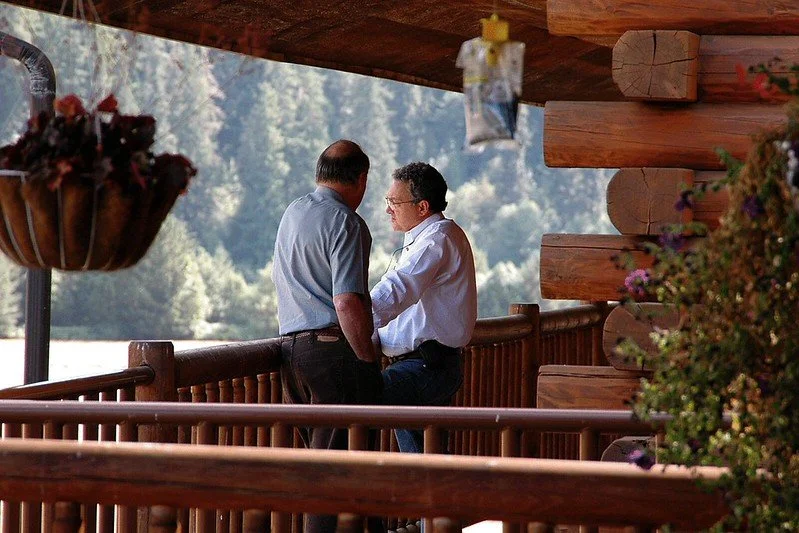
During Thursday and Friday this week, I attended a retreat of UCC faculty as part of our beginning-of-the-school-year inservice activities. The event was held at the Big K Guest Ranch in Elkton, Oregon (about 30 miles from here). The place is truly in the middle of nowhere. After driving about 18 miles north of (I-5 Exit 136) Sutherlin on Highway 138W, you take a right-hand turn onto a gravel road and proceed onward for another four miles…an experience bound to rattle your bones and car frame, even at 15 mph. However, the setting is quite idyllic, and a great spot for a group our size to get away and do some retreat-type work. The organizers constructed a very worthwhile agenda, and I was amazed at the effort and energy expended to make this a wonderfully-successful experience for everybody.

A lot of the time together was spent in small groups, examining topics relevant to both new and returning instructors. Even though I am not an instructor anymore [I was one of two administrators present (the other being the college president)], I found I was able to participate fully. And, the greatest benefit to me was getting to know faculty from my new, large division (as well as the entire campus).

On the final day, yesterday, we held discussions (during both the morning and afternoon sessions) on a variety of hypothetical ethical-dilemma situations. The final scenario involved a student who wore a t-shirt to class that had a (unidentified) racially-offensive message on it. The questions: what to do? How to handle this?

A variety of perspectives were offered. One person offered thoughts about a dress-code. Others provided suggestions aimed at trying to control student behavior and, hence, suppression of the t-shirt’s message.

I could not hold my tongue. At the end of the discussion (and our time together), I raised my hand. I offered the thought that a t-shirt was not offensive in and of itself, and that this was neither a dress code nor a student-conduct issue, but rather a free-speech one. Freedom of expression is one of our most cherished and important constitutional rights, I said, and that, especially in a college environment (where we are presumably devoted to a free exchange of ideas), we cannot stomp on such a fundamental American freedom. I observed that quite a number of campuses over the last couple of decades have attempted to restrict student behavior with speech codes, virtually all of which had been struck down by the courts on constitutional grounds. I tried to convey the message, and personal (legal?) opinion, that we cannot attempt to silence a student merely because his or her message might be offensive to some.

Of course, I likely sounded like an over-the-top civil libertarian. And, I know, I delivered this message with some degree of passion, but hopefully not so extreme as to offend my new colleagues. The ACLU has an excellent summary of this issue on their website, as well as descriptions of many specific cases involving freedom of expression (including t-shirts).

Read More

Listening & Leadership

Inspired by NPR’s This I Believe series...

I believe in listening. And in leadership. And that the two go hand-in-hand.

In the past two years, I have been in leadership positions that more directly affect the lives of people I work with than I ever have been before. While I’ve long seen myself as a student of leadership and organizational culture, and have led countless groups while working on specific tasks and projects, lately I’ve been called upon to provide direction, vision, and a voice for a large collection of other people on a day-to-day basis. It’s been a period to put my values regarding listening and leadership to a real test.

For I believe that effective leaders should listen to those they are charged to lead. All too often, I see leaders who seem to be “know-it-alls” or “fixers”: individuals who only listen to their constituents long enough to have a reply or “the solution” at the ready before the other is even finished talking. This kind of behavior is extremely off-putting. Who wants to be around somebody like that?

And I believe that listening demonstrates our respect, valuing and trust of others. For leaders to earn respect, they must show respect. So I believe that true, just shut-up-and-sit-there, good old non-judgmental listening is the primary way to do that. Trust and respect just naturally flow from good listening.

I have a dramatic personal experience illustrating when, as one being led, I was not listened to. A couple of years ago, with the most honorable of intentions, I was attempting to speak to the CEO of an organization on behalf of a group of employees; at one point in my report, I was rudely interrupted and informed the information I was sharing was not welcome or appropriate…that everything in the organization was, now, as “good as it gets.” It’s difficult to convey the intensity of that episode in this brief description but, I was, in essence, verbally and emotionally assassinated in public for attempting to express the “sense of the group.” For me, it was the single most appalling example of “leadership” that I had ever witnessed. I left the experience embarrassed, hurt and angry. And, forever, unable to respect the “leader” any more.

I run my show a lot differently. A LOT DIFFERENTLY. I believe in the power of stories, and love listening to them. I encourage my folks to come in, sit down, and tell me what’s going on in their lives. I listen. Because I care. And, I because I respect the variety of the human experience. That is, I respect them. I appreciate everything everyone does on behalf of the organization, and, after I have listened to them and their issues, I frequently advise them to pace themselves and to stay healthy. We’re all in this together, and we must take care of ourselves and trust each other along the way, or bad stuff will happen. Of course, bad stuff will happen anyway, but we’re much better equipped to handle those times if we tackle problems as part of a trusting team, rather than a stray collection of individuals who happen to share the same organizational space for a part of our lives.

Leaders. Followers. Everyone. Believe in this.

And listen…

The people who come to see us bring us their stories. They hope they tell them well enough so that we understand the truth of their lives. They hope we know how to interpret their stories correctly. We have to remember that what we hear is their story. (Robert Coles in The Call of Stories, p. 7).

Read More

Fitting In

I have no words for my reality. [ Max Frisch (1911–1991)]

Early on during my time as the science & technology dean (slightly less than two years ago), I called a gathering of the entire division to talk over some old and new business. Now, I guess my personal meeting-leading style is a bit different than other deans who have occupied this position: I remember mentioning things like “we all work too hard,” and that “we should take better care of ourselves,” and that “I’m not willing to die for this job”…that kind of stuff.

I think most would agree that I tend to be honest and direct.

Further, when I speak to things that I am passionate about, I typically have great energy. I’m expressive, I gesture, I emote. In sum, I likely exhibit a collection of personal characteristics and interpersonal communication styles that are different from your stereotypical, geeky, sometimes-reticent, always-in-his-head science guy.

Directly after one of these early meetings, I remember F coming up to me and exclaiming, “you don’t talk like any dean we’ve ever had here before!”

Now, at the time, I wasn’t exceptionally surprised by this remark. In addition to my science education (two degrees, a bachelor's and a master's), I also have a master’s in counseling. In case you didn’t know: this is quite an unusual background. While scientists tend to focus on theories, experiments, findings and ideas, counselors mostly attend to feelings, relationships, and personal growth. These are radically different approaches to knowing the world, and I admit that I probably am a pretty rare bird both in terms of my formal education and how I interact with the universe around me.

It seems, over time though, that the Division faculty here have rather gotten used to me and my non-traditional ways of talking and behaving. However, when it comes to job searching, I’m not so sure my, well, deviance is all that much appreciated. I’ve talked this over with M, and he agrees: when it comes to a job interview, a new group may not quite know what to make of me. “Could this be our new dean ?” [I can imagine some of them ( most of them) wondering...]

This topic has been more on my mind in the last few days due to another, more recent interaction: this time with T. As I was lamenting my lack of a job offer despite my ambitious interviewing schedule of late, I once again mentioned something like “I guess I just don’t talk like a science dean.”

Her comeback was a very quick, energetic, and expressive, “Jim, you don’t talk like anyone I’ve ever known !” She went on to say that, “in fact, I don’t think I’ve ever known anyone quite like you!”

Now, I’m positive that these statements were offered in only the most complimentary way. And, I certainly received them as such. Actually, such observations are (to me) pretty flattering. But, the more I’ve thought about the implications of these remarks, the more distraught I have become. In terms of locating a new workplace, how can I possibly find somewhere to “fit” if I am perceived to be so different? Who would want to hire me if I’m not “one of them?”

Well, it’s going to be hard, isn’t it? Actually, it HAS been difficult, and maybe this is one of the primary reasons I am facing unemployment: I am too different, and I really just don’t fit .

The question now is: where do I fit?

Read More

REALness, Authenticity & Leadership

I last wrote on the topic of becoming REAL (as defined in The Velveteen Rabbit). Actually, the more time I spend thinking about this topic, the more I’m coming to the place that that kind of REALness is more accurately aligned with age, maturity, wisdom, and being SIGNIFICANT to someone else. Yes, the Velveteen version of REALness appears to be a response to being loved for a long time.

Typically, though, I think of the term “being REAL” as being AUTHENTIC. I believe that being authentic is a critical factor to success in human relationships in general, and effective leadership in particular. Authenticity leads to trust which can lead to great things being accomplished.

You might ask: what exactly is authenticity?

Well, the phrase “bein’ who you are” comes to mind, first of all. Being real or authentic has a lot to do with displaying your true self to the world, without pretenses or “phoniness” (as Holden Caufield might say). Openness, honesty, and transparency are also other synonyms that seem to fit. At any rate, traits such as these in an individual are ones that I admire, am attracted to, and lead me to trust another. I will trust someone when I believe (when I feel) that the other person is allowing me in enough to see who they really are. They tell the truth. Their defenses are down; they allow themselves to be vulnerable. They are, simply, human, and comfortable with themselves. I love the connection that’s possible when individuals are truly authentic with each other.

I see authenticity as an important characteristic of great leaders, as well. Leaders by definition, after all, need followers. And, what inspires one to follow? Well, trust, of course. How could I possibly be expected to follow somebody I don’t trust?

So: Who do I trust: Who can I trust?

Answer: Someone I really know.

In my role as an academic dean at a college, my role is one of leadership. It is that by definition; anyone with the title of “dean” has some power by virtue of the position and can exert leadership (demand followership?) — if you think that that’s really possible. My style is not to rely on power, control, and role-definition, though, but rather to provide a kind of leadership based on trust: trust in me, trust in my decisions, trust that I’ll do the right thing, trust that I’m someone who has everyone’s best interest in my mind and in my heart.

When I came on board as the “interim dean” (and I'm still interim, eighteen months later), Katrina asked me what my priorities were going to be. I said, “relationships. This is probably not what you’d expect your Science & Technology Dean to say, but that’s me: not necessarily talking, thinking, or behaving like a science guy. I knew that to be successful (not ever having been a dean, department chair, or even a full-time faculty member anywhere, ever), I would have to build the trust of those around me as rapidly as I could. During the very first meeting of the entire Science & Technology Division, the first day of Fall term, I deliberately started to work on building that trust. At the beginning of that meeting, I took a healthy portion of time to “tell my story.” I outlined my biography, highlighting a few of the twists and turns that I’ve taken in my personal and professional life, and exposing, I guess, some of my “philosophy of life.” I believed then, and I still do, that this was a very important thing for me to do in terms of relationship- and trust-building.

I’m told that I’m an effective leader. If such is the case, then I think that’s happened because people trust me. And, I believe that they trust me because they know me. My goal is to be as honest and forthright as I possibly can, with no secrets and no secret agendas. I am who I say I am, do what I say I’m going to do when I say I’m going to do it — and do my job as competently and conscientiously as possible.

I don’t think that great leadership ever happens without trust. And, in my case, I know I could not ever see myself in a leadership role without letting those around me, know me.

Read More