The popular TV show Grey’s Anatomy is filmed in Seattle, and maybe its Pacific Northwest roots are part of the appeal for me. (This season the show made a move to 9:00 p.m. on Thursdays, so it is on ABC an hour before ER airs at 10:00 p.m. on NBC; I tape them both and watch them on the weekend). Aside from its obvious (and frequent) quirkiness, the show has real and touching moments that occasionally tend to unearth some truths about life and relationships.
Last Thursday’s Sometimes a Fantasy really caught my attention. Most episodes are filled with several different story lines, with some, not uncommonly, continuing from week-to-week. And the story of Izzie’s loss resumed this time. She had fallen in love with a heart-transplant patient who had asked her to marry him. However, shortly after he popped the question (and after Izzie had made an ethically-questionable call about his care), he died. Izzie’s story was juxtaposed with one about Megan, a young girl who came to the emergency room with multiple injuries. Although she was bruised, beaten, scarred and had stapled a wound on her arm with an office stapler, she claimed to feel no pain. The ultimate diagnosis for her was “chronic insensitivity to pain.” (Who knew there was such a thing!?)
So, he we had: Megan, dramatically physically damaged, who claimed to “feel no pain.” And Izzie, who stood immobilized outside the hospital, unable to motivate herself to return to work, when asked where it hurt, said “everywhere .”
The array of possible human experiences always tends to amaze me. In this dramatization, one person feels immense, debilitating, chronic, paralyzing pain, and the other, none at all.
During the operation on Megan, the surgeon observes that “everybody wants a life without pain. What does it get you? She needs to be on a poster somewhere to remind people that pain’s there for a reason.”
I know, I know. This is a TV show. But the writing this week seemed incredibly good…and provided a degree of wisdom than one typically does not encounter during prime time.
Of course, these observations extend my previous commentaries. You know that I think about pain a lot ; and an episode of a medical drama focusing on the topic is bound to attract my attention and dwell in my thoughts. Six days ago, in an attempt to address my chronic myofascial pain issues (including my long-standing chronic lower-back pain), I allowed a doctor to inject me 19 times with small amounts of Marcaine in my first major attempt at trigger-point injection therapy. Although I experienced some short-term relief that day, by the evening I was back to “normal.” And, as my back pain has been the predominant factor in my existence the last couple weeks, I drove to Eugene to see my chiropractor on Friday.
If “pain’s there for a reason,” I ask, “what is it ?”
A recent article in Timemagazine addresses The Mystery of Pain. (Of course, we’re talking physical pain here, although, I believe, emotional and psychic wounds can lead to just as much distress as physical ailments do.) This piece was of interest to me because physical pain has been an ongoing nemesis in my life…for almost all my life. For the timespan of most of my twenties (about seven and a half years), for example, I experienced daily, often-times debilitating, headaches. And, it was during these years that I began to cope with periodic lower-back pain as well. I ultimately interpreted both of these physical conditions as reactions to the overwhelming stress in my life at the time, namely finding myself in a marriage that was the completely wrong place for me to be. When I left that relationship at about age 30, I was able to turn around the crippling nature of these physical conditions, get myself off the medication (Valium) I was using to cope, and make some progress in the areas of physical health and emotional growth. (The obvious smack-in-the-face exception is the fact that I moved directly from being addicted to Valium to a lifestyle of alcohol use and abuse, and that subsequently took a few more years to overcome.)
There have been some small portions of my life where I have lived relatively head- and back-ache free, but those times seem rather a dim memory. I continue to cope, the best I can, with daily pains in these parts of my body, and succeed pretty well most of the time. They have become, simply, conditions I have learned to live with.
But, I have aged. And I’ve not acquired the ability to get rid of chronic conditions, but, rather, seem to be an unwilling “collector.” I am not one of the people identified in the Time article who has a deteriorating body and is asymptomatic. Nope. When something is “off” with my system, I feel it, often times, it seems, with a higher degree of intensity when compared to others. I have recently written, for example, about my diagnosis of Chronic Myofascial Pain. This is a condition that dominates my awareness in terms of the feelings (or lack thereof) in my lower extremities all-day, every-day. I’ve apparently not yet made significant-enough progress in my learning curve about this condition, given that my attempts at self-treatment have yielded virtually no change. The bottom line is: I live with these chronic pain conditions everyday AND try to be as functional a human being I possibly can at the same time. I find this pretty challenging.
The writer for Timeasks “why does the same problem hurt one person and not the next?” Good question! I often wonder this myself. He suggests that we consider three factors: the “pain-inflammation connection;” “neural blockades;” & “depression and hormones.” Although I’m sure that the inflammation connection is a large part of my physical stuff, the relationship of depression to pain, of course, intrigues me. That has to be part of my dynamic as well, given my propensity to perpetually struggle with my emotional health. I’m convinced, in fact, that if I could find the right something (drug? herb? sleep potion?) to help me with chronic depression, then these other ailments would not loom as large for me as they currently do.
The article concludes with the statement that “today pain remains a tantalizing mystery.” (Duh. You think?) For now, we are advised to “cheer up, pop an Advil, keep working, go to the gym, eat something and buy your spouse a present.”
Ohmygod. I certainly feel reassured about handling my pain now. Thanks, Time.
I have been posting entries here for nine months now. When I put together the first little note, last Thanksgiving Day, I wasn’t at all sure where I was going with this. I still don’t know that I’ve ever really defined a direction, but at this point, when I’m away for as much as five days now (the length of time since my last entry), I start getting a little antsy…thinking it’s about time to write something more. Besides: when that many days of living go by, a lot can happen. And, many things have happened in my life lately.
Some of the issues I talk about here come under the heading of random expressions of joy and angst. And, let’s be honest, in my writings I know I’ve focused more on angst than joy. But three days ago was my birthday, and though I was experiencing the usual self-reflection and anxiety about where I am at with my life (angst), there was some measure of joy as well. One of the best things to happen, mostly because it was so unexpected, was to receive a singing (“happy birthday to you”) phone call from friends in Portland. Although the day itself turned in to be one of my longest work days in a while, it was great to be remembered that morning.
I took the occasion of having a birthday, in tandem with working four-day weeks at the moment, to make an appointment with a doctor here for a check-up. I’ve written previously about the physical symptoms I’ve struggled with in recent months, speculating about such conditions as peripheral neuropathy and post-traumatic stress disorder. I know there’s a bunch of stuff going on with me physically that is not good. The stress I’ve endured the last two and a half years has taken a toll that I am aware of every single moment of every single day. And, the approaches I have used so far to address my symptoms have yielded only modest progress toward health. Through my chiropractor, I have used deep-tissue massage, ultra-sound, and chiropractic adjustment. I saw an acupuncturist for months, enduring the needles and moxibustion. I have continued on with the moxibustion approach myself, as well as frequent self-massaging of my legs. I take hot baths, and try to calm myself psychoacoustically. I read Pema Chödrön books and other spiritually-oriented tomes. And, I’ve just started reading Why Zebras Don’t Get Ulcers: The Acclaimed Guide to Stress, Stress-Related Diseases, and Coping. With this last book, I’m attempting to get a handle on all the psycho-neuro-biological dimensions of the human experience and how stress has led to the physical symptoms I’m experiencing. The physician I was seeing in Portland was of no help in addressing my condition, although he agreed with my personal assessment of how I got to this point and provided some medication to help with my anxiety.
The first week I was at work here, I asked around for suggestions for local doctors. The second week I decided to make some calls. The first doctor had not taken new patients in five years, I was told. However, the receptionist for the second doctor took down some basic information and consulted with him. Yes, I was told, the doctor would see me.
My appointment was two days ago, the day after my birthday, at the end of my third week of work. I was nervous about pursuing this, but, at the same time, very pleased with myself that I was following through on my commitment to focus on getting healthy. This physician seemed to be quite perceptive about my condition, had a name for it, and expressed some confidence that we could find an appropriate treatment. This was incredible news! It’s his view that I am suffering from Chronic Myofascial Pain, which explains the ongoing weirdness happening in my extremities, especially my left leg and foot. Although I’ve got blood work ordered to rule out other possible causes, what I’ve learned about this condition so far is indeed a fit with the symptoms I’ve been dealing with. I’ve already purchased a “survival manual” for suffers of this condition.
After all the hopelessness I’ve felt having endured this condition for over 15 months, I’m now hopeful that I can actually, eventually, heal myself. Hope, especially around the time of my birthday, is quite-unexpected. (But wonderful: don't get me wrong!)
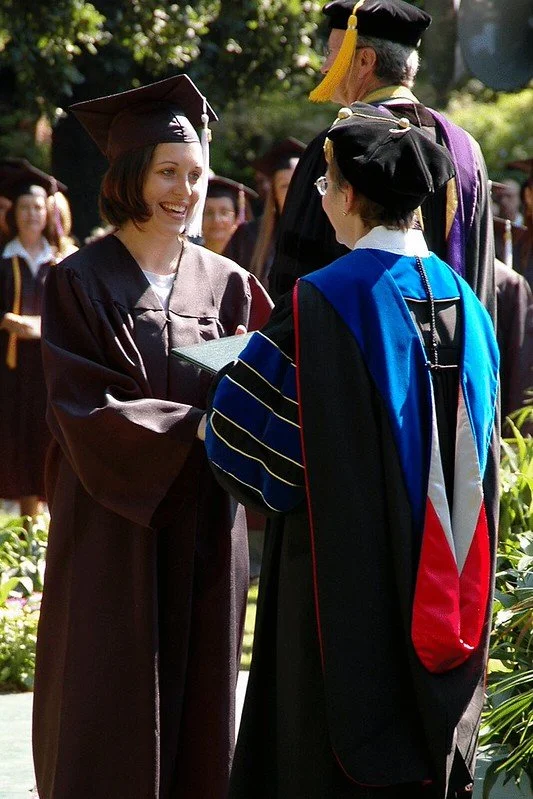
To round out this report of recent developments, I’ll mention that I attended the University of Oregonsummer commencement ceremony yesterday morning, as Beccalynn (Katrina’s daughter and Bryan and Tamson’s sister) is within a few credits of finishing her degree and decided to participate in graduation at this point. It was a beautiful day and I was delighted to be on hand for another rite-of-passage occasion. I’ve known Beccalynn since her late adolescence, and to see her now, married, the mother-of-two, and a college graduate, is another sign of hope for the future.
Last time, I talked a bit about cell-phone users and the annoying way their toys are used. I guess I’m still on the same rant today. The soundtrack of our lives in recent times, it seems, is no longer provided by the likes of Mozart or The Beatles or Death Cab for Cutie. Rather, the ambient, background sounds we all live with in the present day are dominated by the buzz of all-too-loud voices speaking gibberish into pocket-size electronic devices.
I honest-to-god believe this.
Then, combine all those cell-phone voices and ringtones with the noise pollution of cars, airplanes, jackhammers, blowers and mowers, and we’ve got ourselves a real problem.
Global-warming, terrorism, and wars in the Middle East aside, I conclude that we’re increasingly unhealthy and at-risk because of the noise pollution in our lives.
On the same day I wrote that last entry on “noise,” I rediscovered, in my music collection, a two-CD set by Dr. Andrew Weil called “sound body, sound mind: music for healing.” The message provided there coincides with my opinion on the effect of sound. Says Weil:
“Sound is an especially powerful influence on the human nervous system. It can harm and it can heal.”
I think that the noises we are subjected to in the course of a typical day heavily contribute to the amount of stress we experience. I know for certain that that’s true for me, anyway.
It has occurred to me recently that I may be afflicted with a condition called post-traumatic stress disorder (PTSD) as a result of the conditions of my life over the last two-plus years. If that’s true (I have no “diagnosis,” just suspicion), then perhaps I’m just flailing about and over-reacting here: I’m simply hypersensitive as a result of the state of my being right now.
But here’s the deal: I would hope that we humans could find a way to exist without being on sensory overload most of our waking hours.
I suspect that I’m not the only one who experiences their existence this way and wishes that things were different.
In the last couple days, I have started to use the psychoacoustic approach provided on the Weil CD set in an attempt to address my unacceptably high anxiety levels. I’m hoping that I can get some results with this method and that I can energize and heal my body and soul.
I believe there’s way too much noise in the world. I’m particularly annoyed with our use of cell phones, but, just generally, I think this society is way too noise-polluted. Tell me: just where does one go these days to get away from someone talking on their phone?
Now, don’t get me wrong. I’m not basically an anti-cell-phone person. My only phone is a cell phone. And, I own the latest technology; the phone does a lot of things a phone doesn’t really need to do: like take pictures (although I’ve never used this particular feature). I also own and use one of those Bluetooth devices that allow a wireless connection between an earpiece and the phone. (Which, to date, I’ve never used in public because I think they look so stupid on people. But that’s another issue…) However, I try mightily to NOT inflict my personal (and private!) conversations on the rest of the world. Why is it that so few people these days have any sensitivity to this issue? Why is it so generally acceptable to talk on the phone wherever you are?
For me: I’m tired of it. I’m tired of the “cell-phone voice” that I know immediately when I hear it. For example, I’m in a coffee shop reading a newspaper, with the normal background hum of voices and activity. Then, a person a table or two away takes or makes a call, and before I even look up to confirm, I know that voice . It’s somebody talking on their phone. Dang, is this annoying, or what!?
My new hair stylist here in Roseburg informed me that some salons are requiring clients to check their phones at the desk before services are begun. I haven’t heard of this practice anywhere myself, but, for one, I would support it. I’d simply leave my phone in the car. What? I can’t wait a half-hour to make a call? And, I support the movement of some places like movie theatres to install technology that block cell-phones from working. Now that would be a giant leap forward for mankind.