
Authenticity
Oftentimes, I truly struggle with the role in life that seems to be mine.
In relationship, I showed up: totally, passionately, and with great capacity for commitment. I lived, not merely played, the role of devoted partner, lover, friend, confidante, and care-giver. I loved deeply and had the expectation of being loved back proportionally.

Steadfast in my role, I kept hoping against hope that something would change. I anticipated that she would eventually discover, in this person, me, her mated soul.
Oh, I wanted: the joy of that discovery!
In this life, it seems I keep playing the role of the broken-hearted one. It was a constant theme that I was rejected, left to lick my emotional wounds, allow time for them to scar over, and then attempt the same uneven dynamic all over again.
How can two people be so close and yet so far apart? How can the universe be so cruel?
Today, everyday, I show up in an environment where I attempt to play a similar role. I find myself in another situation where there’s no commitment to me, yet I am expected to show up, perform, give my all, and care. I have been trying to play, at great personal cost, the role of a caring person in a dysfunctional, uncaring place.
Here’s the deal: I believe that I am an authentic individual. I am exhausted by the role of inauthenticity that this environment forces me to play.
I desire connectedness. Team play. Commitment. And, yes, love.
I continue to find myself in situations where those crucial, life-affirming forces are absent.
On and off stage, what I have to offer is my one-man act. Alone. I look around and the set is empty. Except for me.
All the world’s a stage,
And all the men and women merely players.
William Shakespeare
Psychic Prisons
I’m in no way a student of The Classics. I regret to report that my formal, “classical,” general education has been woefully inadequate. So, when I now (presume to) speak about Plato’s Republic, and “The Allegory of the Cave,” well, you’re going to need to take what I have to say with not only a grain of salt, but maybe an entire wheelbarrow full!
I was browsing Gareth Morgan’s Images of Organization (1986, my copy of the first edition) today, still (always!) trying to make some sense of my world. (You know me: I can’t seem to shut off my mind!) In the chapter that examines the metaphor of “organizations as psychic prisons,” the discussion begins with a description of Plato’s cave allegory.
The Wikipedia summary of the allegory (copied, pasted, edited) goes thusly:
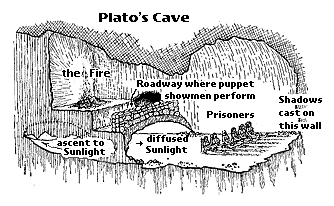
From Great Dialogues of Plato (Warmington and Rouse, eds.) New York, Signet Classics: 1999. p. 316.