

Freedom and Release
I’ve been lying around here like a lump on this incredibly grey and wet day here in Portland, feeling blue and lethargic. It’s one of those seasonal-affective-disorder days, to be sure. Amid all this darkness, I’m finding it difficult to find some semblance of light. (Literally or figuratively.) The Carly Simon lyrics go through my head:
Sufferin’ was the only thing made me feel I was alive
Thought that’s just how much it cost to survive in this world
(“Haven’t Got Time for the Pain” - 1974)
As I was sitting here at the computer earlier this morning, toying with ideas for what to write about today, an email came in from one of my new blog readers. It was a brief message, wishing me well. “My most heartfelt hope and prayer for you for 2006, besides transition to a wonderful job in a location that you love, is freedom and release,” she (“C”) says.
Freedom & release. I’m thinking that C just might understand a little bit of what I’ve talked about here in these pages: for example, that I’m in Zwischenraum, literally “the space between things.” In love and work, I’ve been let go and am stranded in a lifeboat between two islands: having left both, not knowing my destination in either. And, she apparently understands my discussion of psychic prisons: the sense that I am still the prisoner, even though I’ve left the cave. I have not yet thrown off the chains because I’m being blinded by the light outside, fearful of the unknown, and paralyzed by the number of choices I have. When C and I were together, I was quite attached to my interpretation of the shadows on the cave wall. My life, thought to be on course, was dramatically altered by rejection, both personally and professionally. Yes, I have been freed and released; now it’s up to me to find freedom and release.
So, I turn to Richard Bach and the Messiah’s Handbook. As you’ll recall from Illusions: The Adventures of a Reluctant Messiah, one merely needs to open this book up to a random (unnumbered) page, and the answer to your question is there. Today, as I’m ruminating over my life’s issues, I read:
“The only way to win, sometimes, is to surrender.”
Which, of course, is exactly right. As I was thinking about the Carly Simon lyrics and “sufferin’,” I was also pondering the first two of the Four Noble Truths of Buddhism.
1. Life means suffering. To live means to suffer, because the human nature is not perfect and neither is the world we live in. During our lifetime, we inevitably have to endure physical suffering such as pain, sickness, injury, tiredness, old age, and eventually death; and we have to endure psychological suffering like sadness, fear, frustration, disappointment, and depression. We are never able to keep permanently what we strive for, and just as happy moments pass by, we ourselves and our loved ones will pass away one day.
2. The origin of suffering is attachment. The origin of suffering is attachment to transient things and the ignorance thereof. The reasons for suffering are desire, passion, ardor, pursue of wealth and prestige, striving for fame and popularity, or in short: craving and clinging . Because the objects of our attachment are transient, their loss is inevitable, thus suffering will necessarily follow. Objects of attachment also include the idea of a “self” which is a delusion, because there is no abiding self. What we call “self” is just an imagined entity, and we are merely a part of the ceaseless becoming of the universe.
I admit attachment to certain models of the universe. I was attached to living in Eugene, doing a job that I knew and did well, and was comfortable in. And, I was very attached to a model of a relationship that existed, apparently only on the cave wall. What I “knew” was not “truth.” Attachment to both of those models of the world has caused, and still causes, me much suffering. The most healthy thing I could do is to surrender to the universe, define it as “all perfect” and make a new life for myself.
I am trying.
God grant me the serenity to accept the things I cannot change;
courage to change the things I can;
and wisdom to know the difference.
(“Serenity Prayer,” Reinhold Neibuhr — 1926)
First Do No Harm
I optimistically reported an energy “surge” yesterday. That has turned into an energy trough today. Sigh.
Ah, the ebb and flow of my life…the story continues.
A week ago, I reported on overwhelming feelings of sadness in the aftermath of some deep-tissue work on my legs. I’ve also discussed, within these entries, feelings of rejection, heartbreak and loss with respect to past relationships. Authenticity, trust and the meaning of the human experience are also topics I’ve taken on. I realize that the discussion of these, and similar, themes, are likely to continue. Examining my emotional state, awareness of my physical self, exploring spirituality and existential questions are part of the fabric of my life; I write what I know (or think I do) and ask questions as they occur to me.
But: what, exactly , am I doing this for? What is this blog about?
The simple answer, I guess: my own therapy. I write because writing is what I do. I write because it provides an outlet for thoughts and emotions I don’t have any other place for. And this particular venue gives me a place to share, should anyone self-select into my online world.
But, in writing about myself, I sometimes need to make reference to others. I said in a recent email to ya’ll that “…given that you’re in my life, it’s possible that you could end up being mentioned at some point. If that happens, I hope I respect your privacy and feelings appropriately.”
This means I’ve been doing some serious thinking about blogger ethics. Can I be true to myself, talk honestly about my experience, and still, at all times, treat others fairly and decently? I surely have no outright intention of embarrassing, attacking, angering or hurting you. So: I’ve been asking: what is the “right” way to go about this blogging business, anyway (at least in terms of a personal-experience blog like mine)?
Some thinking has gone into this subject already, of course. I’m not the first to be pondering the ethical treatment of fellow humans within this communication medium. A bloggers’ code of ethics has even been proposed.
I have explored this topic, albeit somewhat superficially, with a colleague I went to graduate school with. Although currently not a blogger himself, he is interested in my attempt here — and he’s an educational researcher with keen awareness of confidentiality issues and the possibility of “harm” to participants in research studies. In terms of the kind of human interplay that is blogging, he opines that:
…we have to remember that this ain’t research!!!! It’s public, democratic, open-sourced, put it out there and see who takes a whack at it discourse.
This goes to my own sense of a communitarian, dialogical reality (put that in your blog and float it). That is, we live in a world where very little is private, even though we value privacy above much else. Privacy is negotiated, just like everything else. And a writer (blogger) has to make his/her own decisions about what s/he can live with if somebody else gets a feeling hurt.
Well, that gives me something to think about.
Now, I don’t have any tremendous insights or answers that I can share with you here today. All I can say is that I continue to think about the potential impact my public words might have on my fellow human beings. And I absolutely intend to do everything in my power to respect others’ feelings and their right to privacy.
The Silly Putty Stalker
Do you remember that previous post of mine when I made a passing mention to Play-Doh? Well, I received an email at my work address this morning, saying:
I came across your email and post on the internet. I am looking for someone who can teach me to make Silly Putty. Have you or can you make Silly Putty? Or, do you have someone on your staff who would be interested? I live here in Portland. I am an independent inventor and … [a] device I am working on requires that I produce a viscoelastic polymer (silly putty) type compound.
What is with this guy?
I wrote back:
Are you by any chance referring to the post on my blog where I talked about Play-Doh?
Just so you know, that website is my private blog, and is in no way associated with this email address or my duties at the college. And, if this is really a serious inquiry (which I have a difficult time believing it is): no, I don' have any knowledge of, or interest in, making Silly Putty.
I am finding it curious that he apparently read some of this blog, and totally misconstrued the essence of the little essay I wrote. Either that, or today I have been the victim of a random Silly Putty spam message! But, why in the world would he track me down at work – and/or think that a Dean of Science & Technology would have any professional interest in Silly Putty? Very strange.
I’ll just call him The Silly Putty Stalker.
Now, here’s a report of one person’s response to my mass emailing last weekend regarding the existence of this blog. The message I received back was to comment neither on blog-entry content nor writing style, but rather to provide a very long (826 words) rambling reaction to the fact that I once mentioned the Evolutionblog (identified as “commentary on developments in the endless dispute between evolution and creationism”).
Now, why pick on me for that?
Of course, I’m sure I’m being challenged because that blog is pro-evolution, and basically critical of those concepts identified as “creationism” or “intelligent design.” So, there’s a little guilt by association going on here: which happens to be totally warranted in this case.
My position on these matters is quite simple. Believe what you want. Go ahead. It’s a free country (well, more or less). But, please, let’s keep science in the science classroom, and allow those other ideas (which are not scientific theories, but rather alternate belief systems of some kind) to be addressed elsewhere. I’d even allow discussion in other kinds of classrooms (philosophy? religion?), but…
Intelligent Design is: Absolutely. Not. Science.
Psychic Prisons
I’m in no way a student of The Classics. I regret to report that my formal, “classical,” general education has been woefully inadequate. So, when I now (presume to) speak about Plato’s Republic, and “The Allegory of the Cave,” well, you’re going to need to take what I have to say with not only a grain of salt, but maybe an entire wheelbarrow full!
I was browsing Gareth Morgan’s Images of Organization (1986, my copy of the first edition) today, still (always!) trying to make some sense of my world. (You know me: I can’t seem to shut off my mind!) In the chapter that examines the metaphor of “organizations as psychic prisons,” the discussion begins with a description of Plato’s cave allegory.
The Wikipedia summary of the allegory (copied, pasted, edited) goes thusly:
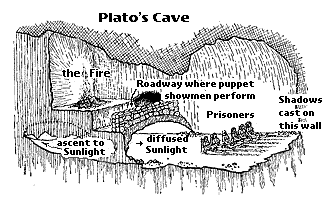
From Great Dialogues of Plato (Warmington and Rouse, eds.) New York, Signet Classics: 1999. p. 316.