
Generosity and Free Will
“I was trying to figure out what I should have already told you, but I never have. Something important, something every father should impart to his daughter. I finally got it: generosity. Be generous, with your time, with your love, with your life.” [From a terminally-ill, near death, Dr. Mark Greene, to daughter Rachel, during “On the Beach,” an episode of “ER,” May 9, 2002; emphasis mine.]

I wrote last time about my fall on the ice during the recent storm. As reported, I did not break any bones; however, the residual effects of the mishap continue to linger on. The trauma of the tumble seems to have taken up residence in my lower and upper back – as well as in my psyche. My spirits are quite low.
In the first two weeks after the storm, I had massage, physical-therapy, and Zero-balancing sessions – in addition to my regularly-scheduled therapy appointment. At this point, though, my recovery still has a way to go. I need significantly more time – andhelp- to facilitate my healing.
In questioning my life’s choices during this period of blueness, I reviewed an essay from February 2006 here on Musings entitled “Generosity.” I have had reason to reflect again on the meaning of this term and specifically its place in the context of friendship.
What am I talking about? Well, I now have reason to believe that what I had experienced as acts of generosity from a friend were, perhaps, deeds that had been misinterpreted by me. I now suspect that perhaps some kind of relational score-keeping had been in play. This has sent me even more into an emotional tailspin, leading me into a deeper examination of my own behavior; to wit: Who am I as a friend? Am I in search of some kind of reciprocity rather than act from a generous spirit? Am I generous enough with my love? My time? My energy? My life? Who am I, really? And, in this context, how am I perceived by others?

I have always believed that each of our lives are comprised of our own individual choices – a sum of the good and/or bad. This long-held belief has, recently, however, come to be challenged. During the last few weeks I have been trying to make my way through Determined by Robert Sapolsky, a dense academic treatise on the topic of free will. Sapolsky makes the compelling argument that, essentially, free will is a myth -- that our livesare really the sum of our biology, our environment, our experiences, of human evolution. The theory is that whatever we choose to do in any moment is dictated by the sum of our life up until the previous moment, that that moment is the result of the previous moment, on and on and on. From Sapolsky’s viewpoint “…all we are is the history of our biology, over which we have no control, and of its interaction with environments, over which we also have no control, creating who we are in the moment” (Sapolsky, 2023, p. 85).
So, in this particular paradigm of human existence, none of us can really be held accountable for our actions – they have all been pre-determined. In fact, every act of mine (ours), lets say in the matters of charity or generosity, are built into us and that we don’t really choose to behave in one way or the other.
I admit that I find myself being quite depressed at the concept that my (and your) existence has already been determined in advance, that my (our) choices are not really choices. Thinking about this interpretation of being human has not done anything positive for my spirits.
So, in sum, right now my body and my soul are in pain. I am seeking help from various sources to manage life right now. But I am in a state of confusion about the meaning of the human experience and what actions I (we) may (or may not) have control over. I am wondering what “choice” is --and whether or not I have the ability to actually choose the right way to work my way out of this painful period.
Reference
Sapolsky, R. (2023). Determined. New York: Penguin Press.
Books & Movies & The Meaning of Life

I was recently introduced to a children’s book I had not previously encountered: Shel Silverstein’s The Giving Tree. It is a short, moving, simply-illustrated story about the relationship, and various encounters, between a boy and a tree, over the boy’s lifetime (into old age). A friend shared with me that the book was deliciously, perhaps painfully, illustrative of the role of parenthood. (Indeed, with a little research, I found that numerous interpretations of the book abound, including those with religious, friendship, environmental, satirical, and parent-child themes.) The same book popped into my consciousness again this week in a list of “the best books to read at every age, from 1 to 100,” published by the Washington Post.
So, I already had Shel Silverstein and his work on my brain when I watched “The Upside” on the plane from MSP to SEA a few days ago. This movie, starring Bryan Cranston and Kevin Hart, is a story about a billionaire quadriplegic, Phillip (Cranston), and his ex-con caregiver, Dell (Hart). At one point, fairly late in the film, Phillip reluctantly agrees to a “date” with a woman, Lily (in a cameo role by Julianna Margulies), with whom he has been sharing an old-fashioned, snail-mail, love-letter relationship. Interestingly, Phillip and Lily had never met in person. This is where Shel Silverstein enters. Lily, during the course of this in-person lunch date with Phillip, describes the Silverstein book, The Missing Piece. In the story, a circle, with a pie-shaped piece missing, wanders (rolls) around looking for the perfectly-shaped piece which will complete it. When the circle finally finds the right object, it, at first, happily rolls along; ultimately, however, it discards the piece because it now moves too fast to be able to enjoy the companionship of others it had previously enjoyed, such as worms and butterflies. The storytelling leads Lily to reject Phillip, which devastates him.
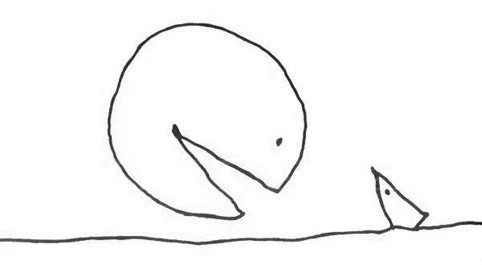
I was intrigued by the fact that this children’s book was used to move the plot forward. So, I found and read The Missing Piece, and have been meditating on it a lot. For me, the story brings up a number of fundamental philosophical questions: What am I doing here, wandering around, in this life? What am I looking for? What is the nature of wholeness? What does it mean to be complete? Do I have to give up self to be with another? Does that other have to give up self to be with me? Can I be with another and be myself? Are soul-mates a myth? Does a union, perfect or not, create less happiness, not more? How could that be? What is happiness? What is relationship? What is perfection? Why pursue it?
As usual, I am a little confused. Life is such a mystery. So many questions. So few answers. So many books. So little time.
[Additional resources: The Upside. The Missing Piece.]
Shards of Glass
Isn’t it interesting when even the tiniest of life events can lead to an examination of our mortality?
For example, the other night, I placed the very hot cover of a CorningWare baking dish in the sink and unconsciously ran cold water over it before it had a chance to cool. Of course, it disintegrated. The explosion was loud and dramatic; hundreds of large and small shards of glass were created instantaneously. One big triangular piece went down the garbage disposal.
I knew better than to have this happen. But it did. Luckily, I was able to avoid cutting myself while cleaning up the mess.

This piece of CorningWare and I go way back. I got married in 1968 and, as I recall, this was among our original collection of kitchenware. We were divorced in 1978 and this dish was included in my share of the division of goods. So, all told, I’ve been carting this thing around for nearly a half-century.
That’s a long relationship and it ended surprisingly abruptly. Boom.
Which got me thinking, again, about how rapidly things in life can change. The most mundane day can turn, in the blink of an eye, into one of disaster, injury, loss, diagnosis or death. Boom.
Let’s make the most of the time we have left. OK?
Elvis Has Left the Building
As I make an attempt to revive my activity here at Musings, after an extended hiatus, I reproduce below an edited version of a Facebook post I wrote in July of 2014.
------------------------------------------
I should officially announce to y’all that I have made a major transition in my life. After nineteen consecutive years as a higher education administrator (the last ten as a community college dean), I have moved on.
I am retired and have physically relocated from Larkspur, California, to Eugene, Oregon … the place on earth that feels most like “home.” I arrived back here on July 1 (2014).
In the spirit of full disclosure, this whole retirement gig was not exactly my idea. (What? Me retire?) It was the path I chose to pursue when my position (Dean of Math & Sciences) at the College of Marin was no longer available to me. The official act dealt with the “non-renewal of my annual contract” … an avenue the president went down with three senior administrators this year. So, I signed up for an early-retirement plan, packed up my shit, and blew that pop stand.
As some of you are aware, I found my role as a community college dean a challenging one. When I left the Oregon University System Chancellor’s Office in 2004 (after a totally politically-motivated reorganization that left many of us devastated), I was warned about the hazards of a dean’s job on a community-college campus. As it turns out, the information I had been provided was frighteningly accurate. At three different community colleges, in two states, over ten years, the storyline was a lot the same: petty campus politics; huge amounts of conflict; rampant dysfunction; and an above-average percentage of mean people. These environments had the effect of deflating my spirit and led me to question the decisions I had made along the way to remain an educator. It all seemed so totally contradictory to the life I thought I had signed up for and, over time, I became increastingly jaded.
However, I survived then, and I’m surviving now. The future is looking brighter and brighter every day, even though I’m still viewing the job-loss experience through the lenses of rejection and betrayal.

Have you watched, at all, the Netflix original series, “Orange is the New Black”? In the middle of the second season, one of the female correctional officers (Fisher) is fired. When she discloses this to one of the prisoners (Nichols), the response is, “You’re a decent human being. Getting canned from this soul-sucking pit is the best thing that ever happened to you. Go home, take a hot bath …”
OK. Right now, I’m officially in the “hot bath” stage.
Soundtrack Suggestion
Somewhere, somehow somebody
Must have kicked you around some
Tell me why you wanna lay there
And revel in your abandon
Listen it don’t make no difference to me baby
Everybody’s had to fight to be free
You see you don’t have to live like a refugee
Now baby you don’t have to live like a refugee
[“Refugee” – Tom Petty & the Heartbreakers]
Balance
I was in a meeting last week with a couple of folks who were aware of some of the challenges and stresses that have been coming my way recently. (And they didn’t even know about my surgery last December.) One of their questions was, “How do you do it, Jim?”
I said, “What? Stay sane you mean?”
Ah … such a good question. How does one take care of oneself when life seems pretty overwhelming?
For me, I mentioned just a few basic things …
