

Cutting the Cord
Wikipedia states that “cord-cutters” [are those people who] cancel their subscriptions to multichannel televisionservices available over cable or satellite, drop pay television channels, or reduce the number of hours of subscription TV viewed in response to competition from rival media….

Given this definition, I have become, in the last week, a bona-fide cord-cutter. It’s something I’ve been considering for a long time – perhaps years. My long-time provider for live TV has been Comcast (er, Xfinity) and I can’t remember a time in my life when I haven’t had a set-top box attached to coaxial cable coming out of the wall. Of course, don’t get me wrong, the picture quality, the ease of use, and the X1 voice remote are all extremely attractive features I’ve gotten used to. What I’ve not been able to accept are the ever-increasing monthly bills and the abysmal customer service.
However, I have always found excuses not to change. As you know, change is a bitch.
A couple of days ago, though, I walked into the local Comcast/Xfinity store armed with a file folder of research materials: copies of my bills from the last year-and-a-half; a tally of all the monthly/yearly costs for my streaming services; information about YouTube TV (where I’m signed up for a trial period); and an estimate of projected new costs compared to what I’m currently paying.

It didn’t take long for me to realize, hoever, that none of this stuff was going to be required. The service representative that I talked to didn’t really care; he seemed more than happy to just go ahead and cancel my cable and voice services, no questions asked. Poof! A few dozen key strokes later and he made it happen. All that was required was for me to choose which internet speed I wished to continue. I decided to move down from the Gigabit+ speed to the 800 Mbps option. Of course, this is likely still much more than I really need, but I’ve gotten used to what’s defined as “superfast.”
I also informed him that I was going to order a modem and stop renting that piece of equipment from them very soon. (After my initial investment, I will save an additional $15/month.) Additionally, my new “land-line” (actually VoIP) provider will be Ooma.
As it now stands, for live TV, I am now with YouTube TV. They happen to provide just about any option I think I need for live news and sports. Of course, I knew I could not live without HBO Max (now called simply Max), so I went to their website and signed up for a one-year package. And finally, I remain a customer of Netflix, Hulu, Apple TV+, Amazon Prime, and Paramount+. I am an absolute content junkie. Geesh!

So, in the end, according to contemporary terminology, I’m now a cord-cutter. My modem/router still remains connected via coaxial cable to the wall, of course. But I’m no longer using Xfinity as my cable TV provider and, for right now, YouTube TV seems to be working out just fine. Ask me in a few months for a progress report.
Books & Movies & The Meaning of Life

I was recently introduced to a children’s book I had not previously encountered: Shel Silverstein’s The Giving Tree. It is a short, moving, simply-illustrated story about the relationship, and various encounters, between a boy and a tree, over the boy’s lifetime (into old age). A friend shared with me that the book was deliciously, perhaps painfully, illustrative of the role of parenthood. (Indeed, with a little research, I found that numerous interpretations of the book abound, including those with religious, friendship, environmental, satirical, and parent-child themes.) The same book popped into my consciousness again this week in a list of “the best books to read at every age, from 1 to 100,” published by the Washington Post.
So, I already had Shel Silverstein and his work on my brain when I watched “The Upside” on the plane from MSP to SEA a few days ago. This movie, starring Bryan Cranston and Kevin Hart, is a story about a billionaire quadriplegic, Phillip (Cranston), and his ex-con caregiver, Dell (Hart). At one point, fairly late in the film, Phillip reluctantly agrees to a “date” with a woman, Lily (in a cameo role by Julianna Margulies), with whom he has been sharing an old-fashioned, snail-mail, love-letter relationship. Interestingly, Phillip and Lily had never met in person. This is where Shel Silverstein enters. Lily, during the course of this in-person lunch date with Phillip, describes the Silverstein book, The Missing Piece. In the story, a circle, with a pie-shaped piece missing, wanders (rolls) around looking for the perfectly-shaped piece which will complete it. When the circle finally finds the right object, it, at first, happily rolls along; ultimately, however, it discards the piece because it now moves too fast to be able to enjoy the companionship of others it had previously enjoyed, such as worms and butterflies. The storytelling leads Lily to reject Phillip, which devastates him.
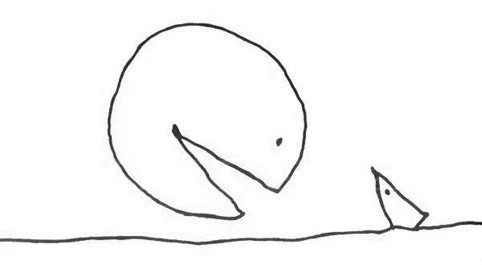
I was intrigued by the fact that this children’s book was used to move the plot forward. So, I found and read The Missing Piece, and have been meditating on it a lot. For me, the story brings up a number of fundamental philosophical questions: What am I doing here, wandering around, in this life? What am I looking for? What is the nature of wholeness? What does it mean to be complete? Do I have to give up self to be with another? Does that other have to give up self to be with me? Can I be with another and be myself? Are soul-mates a myth? Does a union, perfect or not, create less happiness, not more? How could that be? What is happiness? What is relationship? What is perfection? Why pursue it?
As usual, I am a little confused. Life is such a mystery. So many questions. So few answers. So many books. So little time.
[Additional resources: The Upside. The Missing Piece.]
Kent State Plus 45
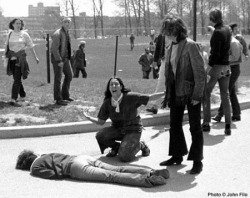
One of the Kent State casualties. Mary Ann Vecchio kneels by the body of Jeffrey Miller in this iconic, Pulitzer-Prize winning photograph by John Filo.
Tomorrow is Monday, May 4th, the 45th anniversary of the massacre at Kent State University. The tragedy was a seminal event in American history - a stunning blow to the American psyche as well as to the anti-war movement. Whatever side you were on regarding the question of the Vietnam War (and most people were aligned with one side or the other), if you were alive on Monday, May 4, 1970, you were aware of the events on the Kent State campus that day.
Here is my version of that time and why I write about it now.
On April 30, 1970, President Richard Nixon announced to a national television audience that he was ordering American troops into Cambodia. Although the stated purpose of this so-called “incursion” was to hasten an end to the ongoing slaughter in Vietnam, many Americans, myself included, were thoroughly appalled and believed the act to be an insane expansion of the war effort. Just ten days earlier, in another television address, Nixon had led us all to believe that our involvement in Southeast Asia was winding down in a meaningful way.
May 1970 was the last month of my final semester as an undergraduate student. I was a chemisty major, but I was socially-aware, politically-active and fervently anti-war. My college career had been interrupted when I received a draft notice on June 18,1969. I subsequently spent 22 days in the Air Force during late September and early October of that year – until a chronic knee condition quickly led to a medical discharge. Although by May of 1970 I was no longer at risk of losing my life in this war, I had spent four long years under the specter of the military draft – and the prospect of a gruesome, lonely death in a jungle a million miles away. For myself, and every American male my age, the war was personal. And, like many of my peers, I believed the U.S. intervention in Vietnam to be both illegal and immoral.
President “Tricky Dick” Nixon had been elected, at least in part, on the basis of his “secret plan” to endthe war. Yet, here he was, a little over a year into his presidency, ordering an escalation.

The original Kent State Memorial at UW-EC, dedicated on May 8, 1970. This plaque was removed from its original location in 2010 and presumably now resides in the campus archives. (Photo taken in July 2005. Click for enlarged version.)

From my personal file cabinet. Front page of UW-EC student newspaper “The Spectator” - published May 7, 1970. University President Leonard Haas addresses the Kent State demonstration in the middle of campus. The little red arrow on the left-hand side of the page points to me in the crowd. (Click for enlarged version.)
I was pissed. I remember spending the rest of the evening, after watching Nixon’s speech, composing a letter to the editor of my local newspaper. My misssive was not the most eloquent piece of prose ever written, but what I lacked in style, I hope I made up for in passion. This is the last straw. Nixon is wrong. He has to go. The war must end.
Many Americans agreed with me. Unrest on the nation’s campuses, especially, took a dramatic turn. On May 4, 1970, my letter was published in the Eau Claire (WI) Leader-Telegram, the same day that four full-time college students (Allison Krause, Jeffrey Miller, Sandra Scheuer and William Schroeder) at Kent State University were gunned down by Ohio National Guard troops. Another nine students (Joseph Lewis, John Cleary, Thomas Grace, Robbie Stamps, Donald Scott MacKenzie, Alan Canfora, Douglas Wrentmore, James Russell and Dean Kahler) were wounded; one was paralyzed for life, the others seriously maimed.
In the days immediately following Kent State, students at the normally-placid University of Wisconsin - Eau Claire (UW-EC) rallied. This was my campus. I, for one, picketed the Science building and boycotted classes where I had spent the majority of my time studying chemistry and math. On May 6th, a campus-wide demonstration was held, with a group of over 3,000 gathering on the lawn right outside the student union building. (See the accompanying photo, to the left, as published in the student newspaper the next day.) Two days later, four crab-apple trees were planted, along with a commemorative plaque (see photo above), in memory of the dead in Ohio. (See also accompanying photo, below, of article published in the May 14th edition of the student paper.)
In 2010, the Kent State Memorial was removed from the UW-EC campus as part of modernization efforts and the construction of a new student center building. Upon learning of the disappearance of this memorial, I was distressed. For four decades, I had rarely made a visit to the state of Wisconsin that didn’t include some time in meditation sitting among the trees and plaque belonging to the Kent State Four. The institution, without this particular artifact belonging to those turbulent times, somehow seemed incomplete.
TODAY, happily, after enduring five years of uncertainty about the status of the Kent State Memorial, I am here to report a significant new development. I recently received notice (see below) from UW-EC that on May 4th, tomorrow, a new memorial will be dedicated. The old memorial consisted of four crab-apple trees and a plaque. The word is that tomorrow’s event will unveil a memorial also consisting of four crab-apple trees and a plaque (though not the original one pictured above). I am sad that I cannot be there to participate in the event, but very pleased that there will be a new Kent State Memorial to get acquainted with during my next trip to campus.

From my personal file cabinet. UW-EC student newspaper “The Spectator” - published May 14, 1970. Continuing coverage of the Kent State demonstrations and the days that followed, including the dedication of a memorial: four crab-apple trees and a plaque planted in the ground by the student center building to forever remember the slain students. That’s me, at age 22, in the top left-center of the photo - taken during the May 6th demonstration. (Click for enlarged version.)
A few closing thoughts. The marches, demonstrations and class boycotts in the aftermath of Kent State added up to the most unrest the UW-EC campus had ever seen (or has seen since). And, in sum, when viewed in their historical context, the invasion of Cambodia, the ensuing protests, the massacre at Kent State, and the National Student Strike, were a turning point for the Nixon presidency. To recognize the significance of these events 45 years later, PBS recently (April 28, 2015) debuted a one-hour documentary entitled “The Day the ‘60s Died.” In this film about May 1970, the claim is made that the Kent State killings had a chilling effect on the nation’s anti-war activity. Indeed, it is diffcult to dispute the fact that The Movement was never quite the same. The National Guard was never held accountable. Demonstrations in support of the war became more frequent. The country was more polarized than ever, essentially divided into warring tribes. And it wasn’t until January 27, 1973, that the Paris Peace Accords ending the conflict were finally signed.
Soundtrack Suggestion
Tin soldiers and Nixon coming,
We’re finally on our own.
This summer I hear the drumming,
Four dead in Ohio.
(“Ohio” – Neil Young)

Henry, Mariette, and Me
I woke up yesterday, Saturday, in a state of utter exhaustion, feeling rejected and somewhat depressed. I emailed a friend who I had plans to see and said that I was on the brink of getting a migraine and was going to opt out of getting together.
Still, it turned out to be a very interesting day…which happens to be the reason I just love life: you get up in the morning and never have any idea, really, of what’s going to happen.
I had started the week out on Monday by interviewing for a job in Portland…a position that had great appeal for me. I was supposed to find out on Friday if I had made it to the finalist stage. I didn’t hear a thing, so I suspected I was due for a rejection letter or phone call sometime soon. Having lived in a state of limbo and sleeplessness for the week, as the weekend arrived, I was very tired. And, now, I was trying to cope with my rejection issues.
Somehow, I thought, I’ll be able to recover and move on…though it may take awhile.
But the day, yesterday, as I have suggested, was not all negative.
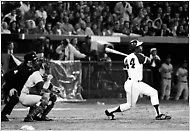
Henry Aaron hitting home run No. 715 on April 8, 1974.
When NPR Weekend Edition was on, I listened to Scott Simon interview Howard Bryant (of ESPN.com, and Weekend Edition sports commentator) about his latest book The Last Hero: A Life of Henry Aaron. Having grown up in Wisconsin in the 50s and 60s listening to, and a fan of, Milwaukee Braves baseball (and Hank Aaron in particular), I was excited to learn of this new book. I knew I had to have it, and have it now.
Therefore, I was moved to show up at the nearest Borders store in the afternoon at around 1:30. As I walked into the store, I noticed a couple of posters announcing that actress Mariette Hartley was scheduled to appear at 2:00 p.m. for a “conversation and signing” of her book Breaking the Silence. (The newly-self-published, recycled version of her 1990 best-seller.)
Hmmmmm, I thought. Mariette Hartley. I wonder what she looks like these days.
Well, moving on, I proceeded to find the Aaron biography, and carried it around while I browsed the fiction section; I also selected an Anita Shreve novel to take home, and then proceeded to navigate the long line at the checkout counter.
It was just turning 2:00 when I exited the store. As I was passing by the big front windows, I spied Mariette Hartley sitting at a table facing a part of the room where about 20 or so chairs were set up…and totally empty. No one wants to see Mariette Hartley?, I thought. Incredible.

I took my purchases to the car and then went back into the store. There were now two women sitting in the front row, chatting a bit with Hartley, but that was the sum total of the audience. Hesitantly, I approached and took a seat in the second row.
Hartley looked at me and smiled as I sat. It was a couple of minutes after 2:00, and she asked a store employee how to proceed, and was informed that “it’s your show.”
“Well, let me just start out by reading a little bit and then we can go from there,” she said to the three of us.
So, read she did: perhaps a couple of pages. She then talked a little bit more about her grandfather, her parents (her father’s suicide and her mother’s alcoholism), and her own mental illness (bipolar disorder). First one, then the other, of the two women in the front row asked some questions. She ultimately turned to me and asked, “what’s your name?”
“Jim,” I said. “And I do have a question. You mentioned a minute ago that your mother ‘swore you to secrecy.’ I guess you were talking about your father’s suicide? How long did you keep that information locked inside?”
With a deep intake of breath she hesitated, and then said, “oh, my..I think you’re going to make me cry.”
And, really, it didn’t seem like she was acting.
We continued talking a little bit longer, during which time more of her story emerged. I then said, “you know, I’m pretty amazed at how this day is turning out. I came into the store this afternoon because I was in search of the new Henry Aaron biography, which I heard about on NPR this morning, and I end up talking to Mariette Hartley about the intimate details of her life. How great is this? It looks like I’ll be taking home a biography and an autobiography this afternoon.”
She was very pleased that I was going to buy the book, and then signed it for me.
On the dedication page which says,
To my beloved family –
past present, and future
she wrote,
To dear Jim!
Bless you and your beloved family –
Lovingly
Mariette Hartley
Then she stood up and gave me a big (and genuine) hug…something, on this day, I really needed…and appreciated.
(Oh, by the way, at age 69, she still looks totally great.)
Today, again, I’m smiling.
Timing is Everything
I went to the movies a couple of days ago, and chose to see “The Curious Case of Benjamin Button.” This is a work adapted from a 1921 short story by F. Scott Fitzgerald, with the screenplay written by Eric Roth (who also wrote “Forrest Gump” - a fact that has prompted several comparisons between the two tales). The film stars Brad Pitt in the title role, with Cate Blanchett (“Daisy”) as the female lead and primary love interest of Benjamin. The film was directed by David Fincher (“Fight Club;” “The Game”).
Despite the comparisons with Forrest Gump, however, I suggest that “Benjamin” is really a meeting of “The Bridges of Madison County” and “The Time Traveler’s Wife.” As in these works, “Benjamin” is, first and foremost, a love story between two people who are doomed in their pursuit of being together long-term. The first comparison works for me because of the initial set-up: stories of relationships disclosed by a senior near death (“Benjamin”) or from beyond the grave (“Bridges”). “Bridges” is also a tale of two people who love each other deeply, yet only have four days really together. Additionally, a sense of fantasy and whimsy with regard to time are pervasive in both “Time Traveler” and “Benjamin.” And, it’s because of the twisted nature of time in both stories that the couples are not able to spend their lives with each other.
The essential premise of the film is that Benjamin is an old man when he is born (shriveled up, suffering from many of the infirmities of old age) and ages backwards until he dies as a dementia-ridden infant. It’s a cradle-to-grave story that stretches one’s imagination, I admit. But the story is told so lovingly, and with such imaginative special effects, that this suspension of reality, for me, for awhile, was entirely successful. Film critic Roger Ebert, interestingly, disagrees. He says:
[“Benjamin”] tells the story of a man who is old when he is born and an infant when he dies. All those around him, everyone he knows and loves, grow older in the usual way, and he passes them on the way down. As I watched the film, I became consumed by a conviction that this was simply wrong.
Well, Roger: I’m so sorry. You’re the one who is wrong. This entire film works, as it eloquently tells a (gut-wrenchingly moving) story of undying love between these two people.
As Benjamin lives his life, first as a young, old man, he meets the granddaughter of one of the residents of the “home” he lives in. He is immediately taken with her, but while Daisy looks her actual childhood age (of course), Benjamin appears to be in his 70s (or so). As the story unfolds, Daisy and Benjamin meet again and again, but never when it is really “age appropriate” or convenient...until, finally, in middle age, they are able to be together. And their love for each other can be mutually acknowledged and consummated.
