

Cutting the Cord
Wikipedia states that “cord-cutters” [are those people who] cancel their subscriptions to multichannel televisionservices available over cable or satellite, drop pay television channels, or reduce the number of hours of subscription TV viewed in response to competition from rival media….

Given this definition, I have become, in the last week, a bona-fide cord-cutter. It’s something I’ve been considering for a long time – perhaps years. My long-time provider for live TV has been Comcast (er, Xfinity) and I can’t remember a time in my life when I haven’t had a set-top box attached to coaxial cable coming out of the wall. Of course, don’t get me wrong, the picture quality, the ease of use, and the X1 voice remote are all extremely attractive features I’ve gotten used to. What I’ve not been able to accept are the ever-increasing monthly bills and the abysmal customer service.
However, I have always found excuses not to change. As you know, change is a bitch.
A couple of days ago, though, I walked into the local Comcast/Xfinity store armed with a file folder of research materials: copies of my bills from the last year-and-a-half; a tally of all the monthly/yearly costs for my streaming services; information about YouTube TV (where I’m signed up for a trial period); and an estimate of projected new costs compared to what I’m currently paying.

It didn’t take long for me to realize, hoever, that none of this stuff was going to be required. The service representative that I talked to didn’t really care; he seemed more than happy to just go ahead and cancel my cable and voice services, no questions asked. Poof! A few dozen key strokes later and he made it happen. All that was required was for me to choose which internet speed I wished to continue. I decided to move down from the Gigabit+ speed to the 800 Mbps option. Of course, this is likely still much more than I really need, but I’ve gotten used to what’s defined as “superfast.”
I also informed him that I was going to order a modem and stop renting that piece of equipment from them very soon. (After my initial investment, I will save an additional $15/month.) Additionally, my new “land-line” (actually VoIP) provider will be Ooma.
As it now stands, for live TV, I am now with YouTube TV. They happen to provide just about any option I think I need for live news and sports. Of course, I knew I could not live without HBO Max (now called simply Max), so I went to their website and signed up for a one-year package. And finally, I remain a customer of Netflix, Hulu, Apple TV+, Amazon Prime, and Paramount+. I am an absolute content junkie. Geesh!

So, in the end, according to contemporary terminology, I’m now a cord-cutter. My modem/router still remains connected via coaxial cable to the wall, of course. But I’m no longer using Xfinity as my cable TV provider and, for right now, YouTube TV seems to be working out just fine. Ask me in a few months for a progress report.
Books & Movies & The Meaning of Life

I was recently introduced to a children’s book I had not previously encountered: Shel Silverstein’s The Giving Tree. It is a short, moving, simply-illustrated story about the relationship, and various encounters, between a boy and a tree, over the boy’s lifetime (into old age). A friend shared with me that the book was deliciously, perhaps painfully, illustrative of the role of parenthood. (Indeed, with a little research, I found that numerous interpretations of the book abound, including those with religious, friendship, environmental, satirical, and parent-child themes.) The same book popped into my consciousness again this week in a list of “the best books to read at every age, from 1 to 100,” published by the Washington Post.
So, I already had Shel Silverstein and his work on my brain when I watched “The Upside” on the plane from MSP to SEA a few days ago. This movie, starring Bryan Cranston and Kevin Hart, is a story about a billionaire quadriplegic, Phillip (Cranston), and his ex-con caregiver, Dell (Hart). At one point, fairly late in the film, Phillip reluctantly agrees to a “date” with a woman, Lily (in a cameo role by Julianna Margulies), with whom he has been sharing an old-fashioned, snail-mail, love-letter relationship. Interestingly, Phillip and Lily had never met in person. This is where Shel Silverstein enters. Lily, during the course of this in-person lunch date with Phillip, describes the Silverstein book, The Missing Piece. In the story, a circle, with a pie-shaped piece missing, wanders (rolls) around looking for the perfectly-shaped piece which will complete it. When the circle finally finds the right object, it, at first, happily rolls along; ultimately, however, it discards the piece because it now moves too fast to be able to enjoy the companionship of others it had previously enjoyed, such as worms and butterflies. The storytelling leads Lily to reject Phillip, which devastates him.
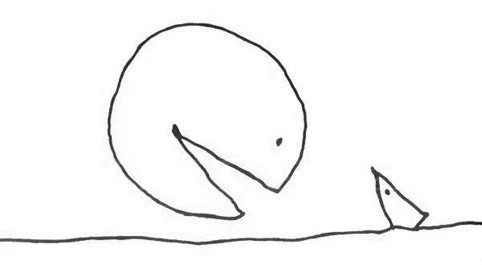
I was intrigued by the fact that this children’s book was used to move the plot forward. So, I found and read The Missing Piece, and have been meditating on it a lot. For me, the story brings up a number of fundamental philosophical questions: What am I doing here, wandering around, in this life? What am I looking for? What is the nature of wholeness? What does it mean to be complete? Do I have to give up self to be with another? Does that other have to give up self to be with me? Can I be with another and be myself? Are soul-mates a myth? Does a union, perfect or not, create less happiness, not more? How could that be? What is happiness? What is relationship? What is perfection? Why pursue it?
As usual, I am a little confused. Life is such a mystery. So many questions. So few answers. So many books. So little time.
[Additional resources: The Upside. The Missing Piece.]
One of These Days
The line, that pesky line, between “healthy” and “unhealthy” is amazingly thin. One minute, there you are...feeling fine and as if the world is mostly working. The next, a complete reversal of fortune strikes and you’re hanging on for dear life.
I was reminded of this again this week when, on Thursday night, in the middle of the night, about 2:00 a.m., I awoke with a blazing attack of sciatica. Of the constellation of body aches and pains I typically deal with, this is not one of them. So the whole episode was a very big surprise.
I eased out of bed in a pain-induced haze to try and figure what was going on, and practically fell flat on my face – as the left leg and hip would not tolerate any weight at all (without a pain level high enough to bring me close to unconsciousness). I may have screamed, I can’t actually remember. Surely inside my head I was screaming: what the fuck is going on here?!??
I had to go to the bathroom, so I gingerly, ever-so-slowly-and-agonizingly, made my way there to do my business. And, then back to bed. There wasn’t even a hint of this problem during the day or evening on Thursday. Yet, here I was...thinking about an emergency-room visit (not likely: I couldn’t possibly drive), or cortisone shots, or back surgery. Anything to rid me of this curse.
The next time I had to get up, I made my way to the computer and sent an email to my Feldenkrais practitioner to see if she had time to see me on Friday. I knew I wasn’t going to be making it into work in this kind of condition.
Before 7:00 a.m., she had replied, saying that I could come in at 4:00 p.m.. I took the day off, improving enough during the day so that I could actually make the drive to her office. And, as I sit here in Starbucks on Sunday afternoon writing this, I feel mostly “normal” again. Although during the night Friday night, and then again last night, the mere act of lying down in bed aggravated the condition. I’m fairly sleep-deprived at this point, but mostly pain-free.
But, I’m still thinking about that line and how quickly I’d slipped over it.
And, I’m pondering the chronic-pain-filled life of Amy Silverstein. I just this week finished reading her memoir entitled Sick Girl. In this excellent work of autobiography, Silverstein relates the story of her heart-disease diagnosis at age 24 that led, very swiftly, to a heart transplant. This is an eye-opening tale of what the life of a transplant patient is like after the operation. It’s truly not pretty, what with the twice-daily doses of obnoxious medicine that’s needed to fight organ rejection as well as the constant, unrelenting feeling of having something foreign in your body: and of never feeling good, right or normal again. Surprisingly, she’s survived this way for over twenty years now (despite being told that the heart would likely last ten).
At one point, Silverstein makes the observation that, sooner or later, we all face death and dying, and, for many, there’s the possibility of long-term illness along the way. She suggests that the longer we can live without having to face a life-threatening disease, the luckier we are.
And she’s probably right.
For my part, through all my issues with chronic pain, during the past few years especially, I have been pretty lucky. Nothing I’ve had has been essentially life threatening. And I’ve been incredibly successful in healing myself enough to function, these days, more-or-less, normally.
Nobody gets out alive, though. Nobody. And my anxiety level is raised lately with the prospect that I’ll be faced with a prostate biopsy in a couple of months. But, in the aftermath of a rather brief bout with sciatica, and knowing the first-hand experience of a heart-transplant patient, I feel fortunate. We’ll see how long my luck holds out, however. When is it going to be my time?
One of these days.
Soundtrack Suggestion
Well that’ll be the day when you say goodbye
Yeah, yes that’ll be the day when you make me cry
You say you’re gonna leave me, you know it’s a lie
’Cause that'll be the day when I die.
(“That’ll Be The Day” – Buddy Holly)
Timing is Everything
I went to the movies a couple of days ago, and chose to see “The Curious Case of Benjamin Button.” This is a work adapted from a 1921 short story by F. Scott Fitzgerald, with the screenplay written by Eric Roth (who also wrote “Forrest Gump” - a fact that has prompted several comparisons between the two tales). The film stars Brad Pitt in the title role, with Cate Blanchett (“Daisy”) as the female lead and primary love interest of Benjamin. The film was directed by David Fincher (“Fight Club;” “The Game”).
Despite the comparisons with Forrest Gump, however, I suggest that “Benjamin” is really a meeting of “The Bridges of Madison County” and “The Time Traveler’s Wife.” As in these works, “Benjamin” is, first and foremost, a love story between two people who are doomed in their pursuit of being together long-term. The first comparison works for me because of the initial set-up: stories of relationships disclosed by a senior near death (“Benjamin”) or from beyond the grave (“Bridges”). “Bridges” is also a tale of two people who love each other deeply, yet only have four days really together. Additionally, a sense of fantasy and whimsy with regard to time are pervasive in both “Time Traveler” and “Benjamin.” And, it’s because of the twisted nature of time in both stories that the couples are not able to spend their lives with each other.
The essential premise of the film is that Benjamin is an old man when he is born (shriveled up, suffering from many of the infirmities of old age) and ages backwards until he dies as a dementia-ridden infant. It’s a cradle-to-grave story that stretches one’s imagination, I admit. But the story is told so lovingly, and with such imaginative special effects, that this suspension of reality, for me, for awhile, was entirely successful. Film critic Roger Ebert, interestingly, disagrees. He says:
[“Benjamin”] tells the story of a man who is old when he is born and an infant when he dies. All those around him, everyone he knows and loves, grow older in the usual way, and he passes them on the way down. As I watched the film, I became consumed by a conviction that this was simply wrong.
Well, Roger: I’m so sorry. You’re the one who is wrong. This entire film works, as it eloquently tells a (gut-wrenchingly moving) story of undying love between these two people.
As Benjamin lives his life, first as a young, old man, he meets the granddaughter of one of the residents of the “home” he lives in. He is immediately taken with her, but while Daisy looks her actual childhood age (of course), Benjamin appears to be in his 70s (or so). As the story unfolds, Daisy and Benjamin meet again and again, but never when it is really “age appropriate” or convenient...until, finally, in middle age, they are able to be together. And their love for each other can be mutually acknowledged and consummated.
